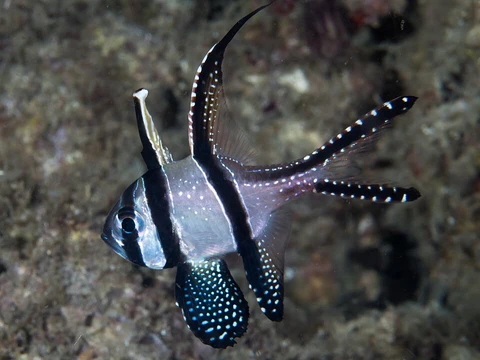
Nocturnal foraging
When the sun drops, the reef's busiest shift begins.

Nocturnal foraging is a well-documented behavioral strategy in which marine animals shift their primary feeding activity to the hours of darkness. Widely observed across coral reef ecosystems and open-ocean habitats, it involves a coordinated change in activity level, movement pattern, and often coloration as ambient light drops below a critical threshold. Rather than a single species' quirk, it is a recurring ecological solution: by feeding after sunset, animals reduce direct competition with diurnal predators and with same-day foragers of their own species.
- Behavior type
- Temporal niche partitioning / activity shifting
- Primary habitats
- Coral reefs, rocky substrates, open ocean
- Documented taxa
- Reef fishes (Labridae, Serranidae, Pomacentridae), crustaceans, cephalopods
- Ecological function
- Reduced intraspecific competition; predator avoidance
- Primary trigger
- Declining ambient light intensity (photoperiod)
- Associated sensory shift
- Enhanced low-light vision; increased reliance on lateral-line and olfactory cues
Lore & Background
In a typical coral reef, the daytime cast is territorial: damselfish guard their anemones, wrasses patrol their preferred micro-habitats, and snappers hold station above the rubble. As the last slant of sunlight fades, a visible transition ripples through the community. Fish that spent the day hovering in tight, color-saturated displays begin to drift outward, their bodies often shifting to paler, more cryptic patterns. The same individuals that refused to leave a two-meter radius at noon now cruise the reef slope, probing crevices, sifting sand, and snapping at small invertebrates that emerge only after the larger diurnal predators have retreated to their daytime shelters.
Reader's Guide
What you actually see when you watch a reef transition into its foraging shift is a slow, visible exhale. The tight, jittery hovering of a daytime damselfish over its anemone loosens. The fish drifts a meter, then two, its color draining from saturated orange to a flat, sandy beige. It stops, tilts one pectoral fin outward, and fans it in short, rhythmic pulses—each pulse stirring a thin ribbon of sand off the substrate. A tiny isopod scuttles out. The fish snaps, swallows, and is already moving to the next crevice.
A foraging wrasse on the reef slope looks almost lazy from a distance: a slow, undulating glide, head down, mouth opening and closing in small, exploratory gulps. It pauses over a patch of rubble, hovers, then drops a single jaw-snap at a small crab that was hiding under a broken coral fragment. The crab is gone. The wrasse resumes its glide.
The most striking detail for a first-time observer is the silence of competition. During the day, two conspecifics would flare, chase, and hold rigid territorial stances. At 22:00, they pass within a hand's width of each other, each absorbed in its own sand-sifting or crevice-probing, and neither registers the other. The reef has effectively doubled its foraging window, and the animals are using it without a single flare.
Did You Know?
- Many reef fish undergo a visible color shift at dusk, fading from bright territorial hues to pale, cryptic patterns that match the dim reef background.
- A single coral reef can support two distinct foraging 'shifts' of the same species—diurnal and nocturnal—effectively partitioning the same food resource across 24 hours.
- Nocturnal foragers in several reef fish families have retinas with a higher rod-to-cone ratio than their purely diurnal relatives, trading color vision for sensitivity in near-darkness.
- Small cephalopods such as certain octopuses and cuttlefish are almost exclusively nocturnal foragers, remaining hidden in dens by day and emerging to hunt only after the reef's light falls.
More in Biology
Elsewhere in Banggai cardinalfish
Spotted an error? Know more?
Reader corrections go straight into our review queue. Suggest an edit · How this site is sourced