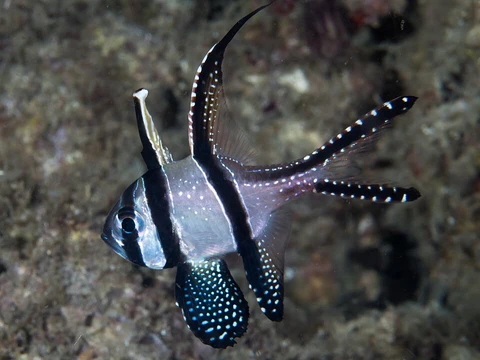
Dorsal fin
One low, spined sail over a tiny orange body — the cardinalfish's single dorsal fin is its quiet signature.

Buiobuione · CC BY-SA 4.0
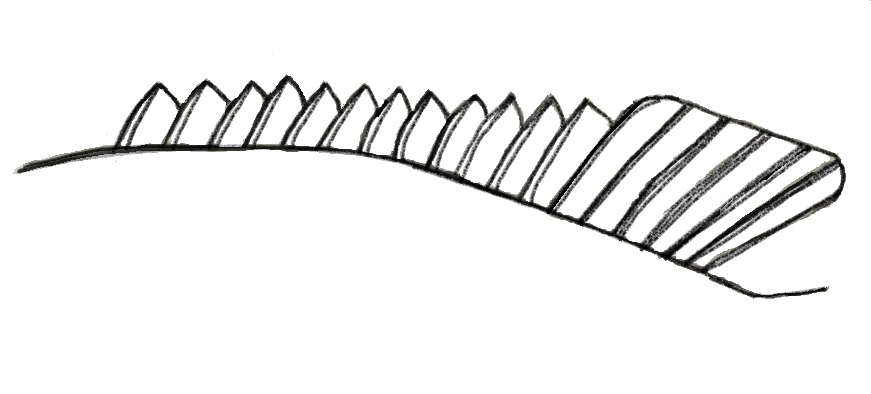
The dorsal fin of *Pterapogon kauderni* (the Banggai cardinalfish) is a single, continuous fin running along the midline of the back, combining a short spiny anterior section with a longer soft-rayed posterior section. As a member of the family Apogonidae, this fish possesses one dorsal fin rather than the two separate fins seen in many other marine teleosts, making its single-fin architecture a defining apogonid trait.
Functionally, the dorsal fin serves as a stabilising surface during the slow, deliberate cruising that characterises this species in the open water column above reef rubble and seagrass beds. It also acts as a defensive structure: the stiff anterior spines can be erected to deter small predators, while the posterior soft rays provide the fine motor control needed for the quick, darting escape responses typical of cardinalfishes.
- Species
- Pterapogon kauderni (Banggai cardinalfish)
- Family
- Apogonidae (cardinalfishes)
- Fin type
- Single dorsal fin (spiny + soft-rayed)
- Dorsal fin formula (approx.)
- XI spines, 10–12 soft rays
- Native range
- Banggai Islands, Sulawesi region, Indonesia
- Sexual dimorphism
- Males larger and more vividly orange-red; females smaller with duller coloration
Lore & Background
In the shallow, sun-dappled lagoons of the Banggai archipelago, *Pterapogon kauderni* hovers just above scattered coral rubble and seagrass patches, its large eyes scanning for both prey and threat. The dorsal fin, low-set and slightly fanned, is the first structural detail a diver notices: a narrow band of stiff spines giving way to a translucent, gently rippling membrane of soft rays. Unlike the tall, sail-like dorsal fins of angelfishes or the deeply forked profiles of many reef damselfishes, the cardinalfish's dorsal fin is modest in height, keeping the fish's silhouette streamlined for its preference of open-water hovering rather than tight crevice dwelling.
Males display a deeper orange-to-red wash across the posterior soft rays, a coloration that intensifies during courtship when the fin is held in a broad, slightly arched display. Females, smaller and paler, show a more muted, greyish-orange tint in the same region. This sexual dimorphism in fin coloration is one of the most reliable visual cues for sexing the species in the field.
The spiny anterior portion of the dorsal fin, while short, is functionally significant. When threatened, the fish can erect these spines, presenting a small but effective barrier to the jaws of larger reef predators. The soft-rayed posterior section, by contrast, is highly articulated, allowing the fish to modulate thrust and stability with remarkable precision during the slow, undulating swimming that defines its foraging behaviour in the water column.
Reader's Guide
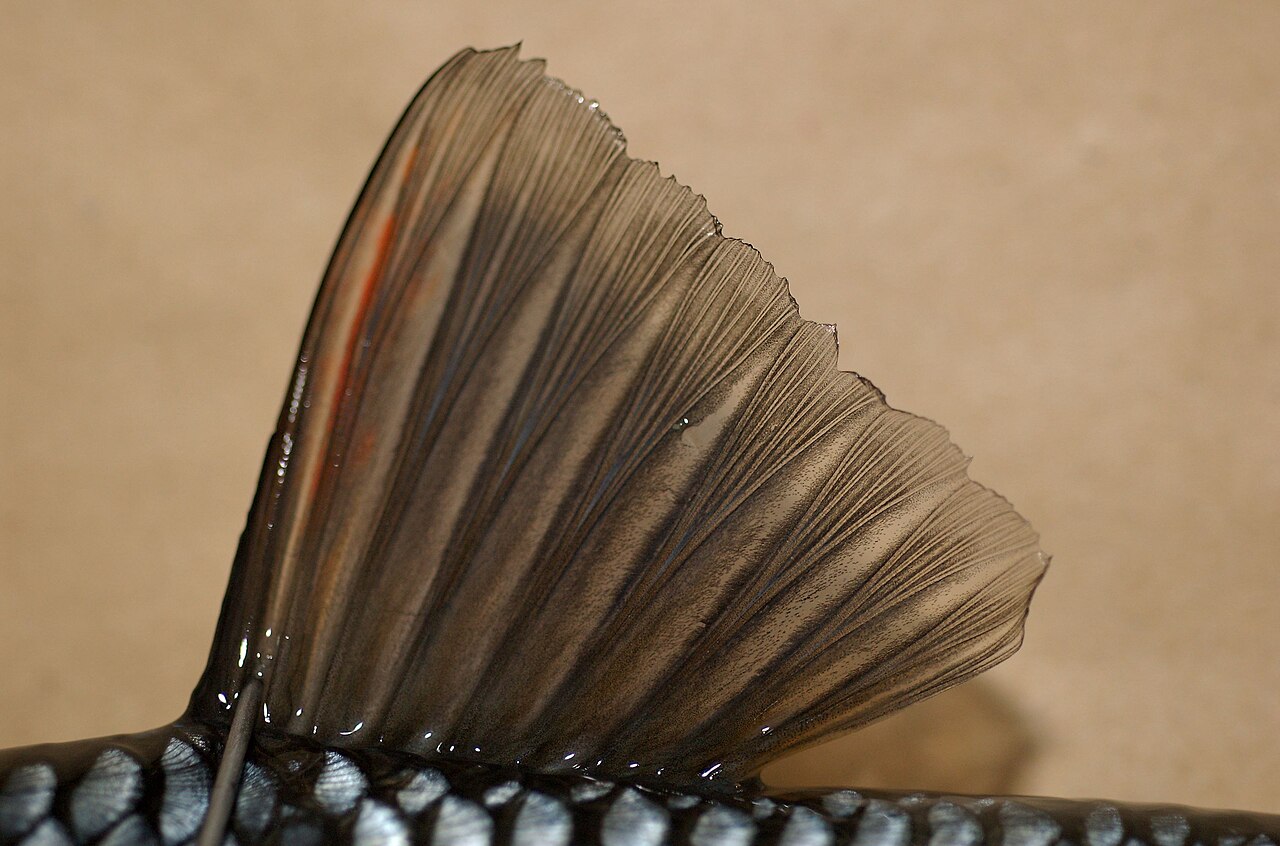
The eye catches the dorsal fin first as a low, continuous arc along the fish's back — a single fin, not the two-part arrangement seen in many reef teleosts. The anterior third is a tight row of short, stout spines, pale and slightly translucent, giving the fin a bristly, almost urchin-like texture at its leading edge. Unlike the tall, sail-shaped dorsal of a flame angelfish, this spiny section is modest in height, roughly one-fifth of the fish's total body length.
Behind the spines, the soft-rayed posterior section extends in a gentle, slightly concave curve. The membrane between the rays is thin and nearly transparent in females, but in males it carries a warm orange-to-red wash that deepens toward the trailing edge. The rays themselves are fine and closely spaced, giving the fin a smooth, almost fabric-like appearance when relaxed.
Scale texture along the nape, just below the fin's origin, is small and cycloid, creating a subtle sheen that contrasts with the larger, more reflective scales on the flank. The overall effect is of a quiet, low-profile fin — functional and understated, yet unmistakably apogonid in its single-arch architecture.
Did You Know?
- Pterapogon kauderni is endemic to the Banggai Islands off Sulawesi, Indonesia, making it one of the most geographically restricted cardinalfishes in the Indo-Pacific.
- Males of this species are significantly larger and more vividly colored than females, a sexual dimorphism visible even in the dorsal fin's coloration.
- Like all members of the family Apogonidae, the Banggai cardinalfish possesses a single dorsal fin rather than the two separate dorsal fins common in many other reef fish families.
- The species' large eyes, a hallmark of the genus Pterapogon, are proportionally among the largest in the family, an adaptation to the dim, mid-water column habitat it favours.
Taxonomy & Physical Distinction
The Banggai cardinalfish occupies a unique taxonomic position as the sole representative of its genus, having been split from the broader Pterapogon group into its own distinct lineage within the cardinalfish family Apogonidae. Standing at a maximum of eight centimeters in total length, this small tropical marine species is instantly recognizable among its relatives. Its first dorsal fin bears a distinctive tassel-like appearance, while the rays of both the anal fin and the second dorsal fin are notably elongated. The tail is deeply forked, and the body displays three bold black bars running across the head and trunk. The front edges of the anal and second dorsal fins carry prominent black markings that further set it apart. In terms of sexual dimorphism, the species is largely monomorphic, meaning males and females look nearly identical under normal conditions. The one exception appears during brooding, when the male develops a conspicuously enlarged oral cavity to house developing young. These combined traits make the Banggai cardinalfish unmistakable in any collection of cardinalfishes.
Distribution & Conservation Status
The Banggai cardinalfish is confined to an extraordinarily narrow geographic footprint, with its entire natural range spanning roughly 5,500 square kilometers around the Banggai Archipelago in Indonesia. Its populations are scattered across the shallow waters surrounding seventeen large islands and ten smaller ones, with a total estimated population of approximately 2.4 million individuals. A minor population also persists in Luwuk harbor off Central Sulawesi. Beyond its native waters, the species has appeared in two non-native locations: the Lembeh Strait in North Sulawesi, where aquarium traders introduced it around 2000 some 400 kilometers north of its natural range, and Secret Bay on the northwest coast of Bali, where small numbers were observed as recently as 2014. Despite its popularity in the aquarium trade and its status as one of the few marine species regularly bred in captivity, the Banggai cardinalfish is now classified as endangered. Human-driven environmental degradation and iridovirus infections represent the principal threats to its survival, while continued wild harvesting for the pet trade compounds the pressure on already isolated, sedentary populations.
Ecology & Symbiotic Relationships
As the only diurnal species within the cardinalfish family, the Banggai cardinalfish operates in a distinct ecological niche. It is a demersal fish that typically gathers in stable groups of around nine individuals, though lagoon aggregations can reach as many as 500. These groups favor calm, sheltered shallows at depths of 1.5 to 2.5 meters, occupying coral reefs, seagrass meadows, and open sandy or rubble bottoms on the leeward sides of larger islands. The fish exhibits strong homing behavior, returning to its original group location after disturbance. Its most remarkable ecological relationship is with the long-spined sea urchin Diadema setosum, among whose spines the cardinalfish can shelter from predators without sustaining a sting. Young fish prefer anemones, while older individuals gravitate toward urchins and branching corals. The species also coexists with anemonefish, anemone shrimp, and other cardinalfish genera in shared microhabitats. Critically, these associations are not one-sided: research shows that when collectors remove the cardinalfish, the abundance of their associated invertebrate partners declines, underscoring the fish's role as a keystone presence in these shallow communities.
Reproduction & Life Cycle
Reproduction in the Banggai cardinalfish follows a paternal mouthbrooding strategy that distinguishes it from most marine fish, as the species entirely lacks a free-swimming planktonic larval stage. Courtship is initiated by the female, who selects a mate and isolates him from the colony by establishing a roughly 50-to-60-centimeter spherical spawning site. Her signature display, described as 'side-by-side trembling,' involves approaching the motionless male from behind with vigorous shaking before positioning herself alongside him. Pairs form anywhere from a few hours to two weeks before spawning and vigorously defend their territory, which is established several meters from the main group. The female's body size governs egg size and fecundity, while the male's size determines the total number of eggs the pair can produce, favoring pairings between similarly sized individuals. Eggs measure about 2.5 millimeters in diameter, and hatchlings remain in the father's mouth for an undetermined period. The species has a brief lifespan, reaching roughly four years under optimal captive conditions but likely only one to two years in the wild.
Gallery

Frequently Asked Questions
What does the dorsal fin of a Banggai cardinalfish look like?
It is one unbroken fin running along the top of the back, beginning with a short spiny front section and flowing into a longer soft-rayed rear section. Rather than two separate fins, you see a single low, continuous sail over the tiny orange body.
Why does the Banggai cardinalfish have only one dorsal fin instead of two?
That single-fin layout is a defining trait of the cardinalfish family (Apogonidae), setting these fish apart from many other marine bony fishes that carry two separate dorsal fins. It is a built-in family characteristic, not a quirk unique to Pterapogon kauderni.
What is the approximate dorsal fin formula?
The fin carries roughly eleven spines followed by ten to twelve soft rays. The spiny anterior portion provides rigidity, while the soft-rayed posterior section allows smooth, flexible movement during cruising.
What does the dorsal fin actually do for the fish in the wild?
It functions as a stabilising surface that helps the fish hold a steady position while it drifts slowly through open water above reef rubble. Without that low, spined sail, the small body would have far less control over its slow, deliberate swimming.
Is the dorsal fin different between males and females?
The fin structure itself is the same in both sexes, but because males are noticeably larger and more vividly orange-red, their dorsal fin reads as more prominent and saturated. Females, being smaller with duller overall coloration, display a less striking version of the identical fin.
More in Description
Elsewhere in Banggai cardinalfish
Spotted an error? Know more?
Reader corrections go straight into our review queue. Suggest an edit · How this site is sourced