Biology and life history
Where they live, how deep they go, and the habitats that define them—straight from the FishBase database.

Drawn from the meticulous data vault of FishBase, here are the verified biological and life-history statistics for *Pterapogon kauderni*—the Banggai cardinalfish. Only fields FishBase actually tracks for this species are included, giving you the raw, unfiltered numbers behind one of the aquarium trade's most beloved fish.
- Depth range
- 0–16 m
- Habitat zone
- demersal
- Body shape
- short and / or deep
- Vulnerability index
- 19.08 of 100
- Fishery importance
- of no interest
- Aquarium trade
- commercial
Lore & Background
Depth range: 0–16 m Habitat zone: demersal Body shape: short and / or deep Vulnerability index: 19.08 of 100 — low risk Fishery importance: of no interest Aquarium trade: commercial
You’ll find them clustered around jetties, hovering over silty sand bottoms where seagrass (*Enhalus acoroides*) grows. Their world revolves around the long-spined sea urchin (*Diadema setosum*). Groups of 2 to 60 fish drift directly above these prickly fortresses—the youngest, just 2–3 cm long, stick closest to the spines. When danger looms, they vanish into the urchin's needle-thicket like ghosts. By night, they likely hunt small benthic and planktonic crustaceans. The male takes on an extraordinary duty: he incubates the eggs in his mouth until they hatch. Each egg is a whopping 2.5 mm across, and the young linger in the safety of his oral cavity for an undetermined time after hatching (Ref. 9936, 48635). Remarkably, newly hatched larvae skip a planktonic phase entirely (Ref. 35886). Juveniles also seek refuge among anemones (Ref. 45560, 48635). This species has been successfully reared in captivity (Ref. 35417).
Reader's Guide
These are database values, not aquarium guidance. FishBase does not publish captive-care parameters, and none are inferred here.
Sources FishBase species summary (SpecCode 15426) — https://www.fishbase.se/summary/Pterapogon-kauderni.html — Froese, R. and D. Pauly, eds. FishBase, v25.04. FishBase.
Island Endemism and the Path to Endangerment
The Banggai cardinalfish occupies one of the most restricted ranges of any marine fish, confined entirely to the waters surrounding the Banggai Archipelago in Indonesia. Its entire natural distribution spans roughly 5,500 square kilometers, with an estimated total population of 2.4 million individuals spread across the shallows of seventeen large and ten small islands. A modest additional population persists in Luwuk harbor off Central Sulawesi, while a translocated group was established in the Lembeh Strait of North Sulawesi after aquarium traders introduced the species there in 2000. Small sightings have also been recorded as far away as Secret Bay in northwest Bali. Despite its popularity in the global aquarium market and its status as one of the relatively few marine species regularly bred in captivity, wild harvesting continues at significant scale. Compounding this pressure, human degradation of coastal habitats and outbreaks of iridovirus disease have driven the species to endangered status, making its tiny geographic footprint a critical vulnerability.
A Distinctive Silhouette Among Cardinalfishes
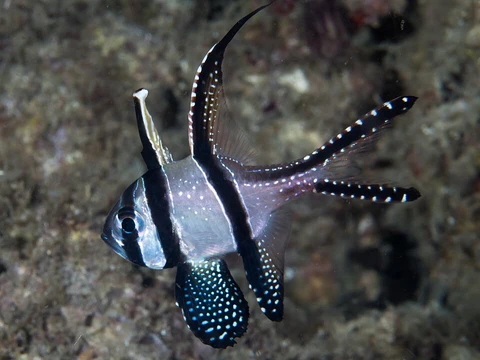
At a maximum of eight centimeters in total length, the Banggai cardinalfish is a compact yet unmistakably striking member of the Apogonidae family. Its most immediately recognizable feature is the tasseled first dorsal fin, accompanied by elongated rays on both the anal fin and the second dorsal fin, and a deeply forked tail. Three bold black bars run across the head and body, while the front edges of the anal and second dorsal fins carry prominent black markings. These traits set it apart from every other cardinalfish. Sexually, the two forms are monomorphic in appearance, but males reveal their identity during brooding through a conspicibly enlarged oral cavity. Taxonomically, the species stands alone: it was once grouped within the genus Pterapogon, but the sailfin cardinalfish has since been recognized as a distinct genus of its own. Its visual appeal has made it a staple of the ornamental aquarium trade worldwide, and it ranks among the small number of marine fish that hobbyists can reliably reproduce in home tanks.
Shallow-Water Social Life and Symbiotic Shelters
Unlike its relatives, the Banggai cardinalfish is the sole diurnal species in its family, active during daylight hours in shallow water typically between 1.5 and 2.5 meters deep. It favors calm, sheltered habitats on the leeward sides of larger islands, ranging from coral reefs and seagrass meadows to open sandy and rubble substrates. The fish live in sedentary groups—usually around nine individuals, though lagoon aggregations can reach several hundred—and exhibit strong homing behavior, returning to their original spot after disturbance. Their relationship with long-spined sea urchins is particularly notable: young fish shelter among anemones, while juveniles and adults retreat into urchin spines, branching corals, sea stars, and mangrove prop roots when threatened, seemingly immune to the urchins' stings. They coexist peacefully with anemonefish, anemone shrimp, and other cardinalfish genera. Research has shown that when collectors remove these fish, the abundance of their associated invertebrate partners declines, underscoring the ecological web they anchor.
Paternal Brooding and a Compressed Life Cycle
Reproduction in the Banggai cardinalfish follows a paternal mouthbrooding strategy that distinguishes it from most marine fish. Courtship is initiated by the female, who isolates a chosen male by creating a roughly 50-to-60-centimeter spherical spawning site and performing a vigorous trembling display while the male remains still. Pairs establish and defend spawning territories a few meters from the main colony, sometimes up to two weeks before the actual spawn. Eggs, about 2.5 millimeters across, are carried in the male's mouth after hatching, and the species entirely lacks a free-swimming planktonic larval stage. Female size governs egg number and size, while male size sets the total reproductive output, so pairing tends to occur between similarly sized individuals. The species has a brief lifespan—roughly four years under optimal captive conditions and perhaps only one to two years in the wild—coupled with low fecundity, factors that limit its capacity to recover from population declines.
Gallery






More in Biology
Elsewhere in Banggai cardinalfish
Spotted an error? Know more?
Reader corrections go straight into our review queue. Suggest an edit · How this site is sourced