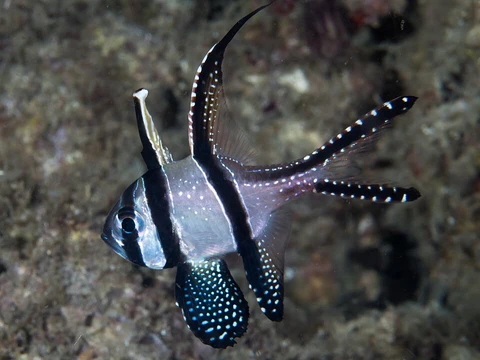
Pectoral fin
The fish's hands: a paired fin that steers, brakes, and in some species, walks.

The pectoral fin is a paired appendage situated on the lateral surface of a fish's body, typically just posterior to the operculum (gill cover). In bony fishes (Osteichthyes) it is a fan of lepidotrichial fin rays radiating from a bony pectoral girdle (scapula and coracoid); in cartilaginous fishes (Chondrichthyes) the equivalent structure is supported by cartilaginous radials. It is the direct evolutionary homologue of the tetrapod forelimb, and its morphology varies enormously across species—from the broad, rounded paddles of a damselfish to the needle-like extensions of a butterflyfish or the rapid, fluttering fans of a seahorse.
Functionally, the pectoral fin serves as the primary organ of fine steering, braking, and maneuvering in most teleosts, while in a few lineages (seahorses, some toadfish, certain catfish) it is repurposed as a principal propulsive surface or even a weight-bearing 'leg.' Its musculature, innervation, and vascular supply make it one of the most metabolically active regions of the fish body.
- Type
- Paired appendage (left and right)
- Typical position
- Lateral, posterior to the operculum
- Skeletal support (osteichthyes)
- Bony girdle (scapula, coracoid) + lepidotrichial rays
- Skeletal support (chondrichthyes)
- Cartilaginous girdle + cartilaginous radials
- Primary roles
- Steering, braking, maneuvering; propulsion in some taxa
- Tetrapod homologue
- Forelimb (arm/foreleg)
- Musculature
- Multiple named muscle groups (e.g., coraco- and omobranchialis)
Lore & Background
In comparative vertebrate anatomy the pectoral fin is one of the most instructive structures for tracing evolutionary change. The same basic blueprint—a girdle of two or three elements bearing a series of radiating supports—appears in the earliest jawed fishes (Placodermi, ~420 Ma) and is recognisably the ancestor of the tetrapod forelimb. Fossil records from the Devonian (e.g., Eusthenopteron, Panderichthys) show the gradual reorganisation of fin rays into digits, confirming the long-held hypothesis that walking on land evolved from the manipulation of a pectoral-fin skeleton.
In living fishes the pectoral fin's role is context-dependent. In fast, open-water swimmers such as tuna and mackerel the fins are reduced and used mainly for fine course corrections and braking. In reef dwellers—damselfishes, wrasses, butterflyfishes—the fins are larger, more flexible, and often asymmetrical in shape, enabling the tight, multi-directional manoeuvres needed among branching corals. In seahorses and pipefishes the dorsal fin is the main propulsor while the pectoral fins beat at high frequency for thrust, a reversal of the typical teleost arrangement. In a few bottom-dwelling lineages (certain toadfishes, some air-breathing catfishes) the pectoral girdle is reinforced and the fins are propped beneath the body, effectively converting the appendage into a weight-bearing limb.
Neurologically, the pectoral fin is supplied by the first and second spinal nerves and is innervated by a dedicated pectoral nerve plexus. Electromyographic studies on live teleosts show that the fin's muscle groups activate in precise, overlapping sequences during turning, hovering, and backward swimming, confirming that the pectoral fin is not a passive 'rudder' but an actively controlled, multi-degree-of-freedom manipulator.
Reader's Guide
The eye catches the pectoral fin first as a translucent, fan-shaped membrane hugging the flank just behind the gill cover—often the most colour-saturated or patterned region of a small reef fish. In a clown damsel (Pterapogon kauderni), for instance, the pectoral fin is a clean, pale fan edged with a thin dark margin, contrasting sharply with the white-and-black body bands, and unlike the broad, rounded pectorals of a damselfish it is slightly more elongated, giving it a subtly pointed trailing edge.
Drill closer and the lepidotrichial rays become visible: typically eight to ten primary rays in a small teleost, each branching once or twice toward the membrane margin. The rays are stiffer at the base (anchored in the scapulo-coracoid girdle) and progressively more flexible distally, which is what allows the fin to flex into a tight 'claw' shape during braking or to spread wide for lift. The inter-ray membrane is thin, almost gelatinous, and in living fish shows a fine network of capillaries that flush pink or red when the fish is stressed or actively swimming.
Compared with the dorsal or anal fins, the pectoral fin is the only paired fin that routinely moves in three-dimensional arcs—dorsally, ventrally, and laterally—because its girdle articulates with the skull through a mobile joint. This is why, in a live specimen, the pectoral fin is almost never fully retracted; it is in a state of constant micro-adjustment, beating at 2–6 Hz in a hovering damselfish or sweeping in slow, deliberate arcs in a butterflyfish navigating a tight crevice. The scale texture immediately surrounding the fin base is often smoother and more heavily pigmented than the body scales, forming a subtle 'shoulder' that marks the fin's attachment point.
More in Description
Elsewhere in Banggai cardinalfish
Spotted an error? Know more?
Reader corrections go straight into our review queue. Suggest an edit · How this site is sourced