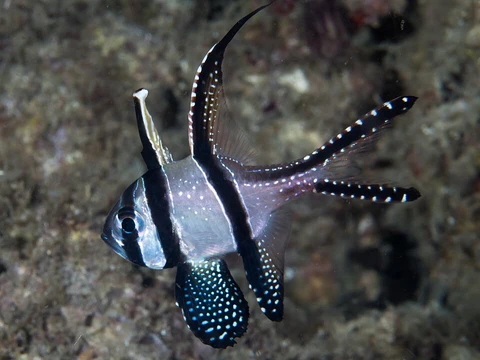
Chaetodon lunula
A pale moon on the reef: a small butterflyfish that eats sponges and wears its name in black ink.

Chaetodon lunula, commonly known as the Crescent Moon Butterflyfish, is a small reef-dwelling fish in the family Chaetodontidae. Its most striking feature is a bold black crescent-shaped mark set against a pale, silvery-white body, giving the species its name (lunula, Latin for 'little moon'). It inhabits coral reefs across the western Pacific, where it plays a specialised ecological role as a sponge grazer, helping to control sponge populations on the reef surface.
Unlike many of its larger, more colourful butterflyfish relatives, Chaetodon lunula is relatively understated in coloration but unmistakable in pattern. It is a solitary or pair-forming species typically found in shallow lagoon and outer-reef environments, where its sponge-based diet distinguishes it from the more generalist feeding butterflyfishes that surround it.
- Scientific name
- Chaetodon lunula
- Common name
- Crescent Moon Butterflyfish
- Family
- Chaetodontidae
- Distribution
- Western Pacific (Philippines, Indonesia, and surrounding reef systems)
- Diet
- Spongivorous (sponges)
- Habitat
- Shallow coral reefs, lagoons, and outer reef slopes
- Iucn status
- Least Concern
Lore & Background
Chaetodon lunula is a specialist in a sea of generalists. While many butterflyfishes pick at coral polyps, small invertebrates, or algae, this species has evolved a narrow dependence on sponges. Its mouth is adapted for rasping sponge tissue, and it will often be seen head-down on a reef face, methodically grazing the surface of a sponge colony. This dietary specialisation means it occupies a niche that few other reef fishes fill, making its presence a useful indicator of sponge-community health on a given reef.
The crescent marking is not merely decorative; it is a key species-recognition signal. In the visual chaos of a coral reef, the high-contrast black arc on a pale body allows individuals to identify mates and conspecifics quickly. Pairs are often observed moving in loose coordination over the same patch of sponge-rich substrate, suggesting a degree of site fidelity that is common among smaller chaetodontids.
Reproductively, like most butterflyfishes, C. lunula is a simultaneous hermaphrodite, capable of switching sex. Males may guard a small territory and court multiple females in sequence. Spawning, as is typical for the family, occurs in the water column, often near the surface at dawn or dusk, with the pair releasing clouds of buoyant eggs and milt that are immediately subject to predation by the vast open-water planktivore community.
Reader's Guide
Chaetodon lunula is currently listed as Least Concern on the IUCN Red List. This reflects a relatively broad distribution across western Pacific reef systems and the absence of a single dominant threat driving population collapse.
That said, 'Least Concern' does not mean 'unaffected.' The species is collected for the ornamental aquarium trade, where its unusual pale-and-black pattern appeals to hobbyists seeking something less saturated than the typical butterflyfish. Because it is a small, relatively unobtrusive species, it is often overlooked in trade surveys, meaning export volumes are likely underreported.
Its spongivorous diet adds a layer of vulnerability: if sponge communities on a reef degrade through disease, bleaching-driven algal overgrowth, or sedimentation, the fish loses its primary food source locally. This does not necessarily trigger a range-wide decline, but it can create isolated population dips that are easy to miss in broad assessments.
The species' preference for shallow lagoon and outer-reef habitats also places it in the zone most directly exposed to coastal development, anchoring damage, and recreational pressure. Conservation attention is therefore best directed at maintaining the structural integrity of the sponge-rich reef habitats it depends on, rather than at species-specific interventions, at least for now.
Did You Know?
- The species name 'lunula' is Latin for 'little moon,' referring to the crescent-shaped black mark on its otherwise pale body.
- Unlike most butterflyfishes that eat coral polyps or general reef invertebrates, C. lunula is a sponge specialist, rasping sponge tissue with its adapted mouthparts.
- Like most chaetodontids, it is a simultaneous hermaphrodite, meaning individuals can change sex over their lifetime.
- Its pale coloration is unusual among butterflyfishes, most of which are vividly yellow, blue, or patterned in multiple hues.
Frequently Asked Questions
What is Chaetodon lunula?
Chaetodon lunula is a small reef fish in the butterflyfish family, instantly recognizable by the bold black crescent marking on its pale silvery body. The species epithet 'lunula' is Latin for 'little moon,' a nod to that distinctive crescent pattern.
Where can I find Chaetodon lunula in the wild?
This species ranges across western Pacific coral-reef systems, particularly around the Philippines and Indonesia. It favors shallow lagoons, reef flats, and outer reef slopes where sponge growth is plentiful.
What does Chaetodon lunula eat?
Rather than grazing on coral polyps or tiny invertebrates like many of its relatives, this fish is a dedicated sponge consumer. It scrapes sponges directly off the reef surface, making sponges its sole dietary focus.
Why is Chaetodon lunula ecologically important?
By specializing in sponge consumption, it keeps sponge populations from overgrowing and smothering the surrounding coral habitat. This niche role makes it a small but functionally critical member of reef communities.
How does Chaetodon lunula differ from other butterflyfish?
Compared to the larger, vividly patterned butterflyfish it is related to, this species is noticeably smaller and far more subdued in color. Its pale body paired with a single black crescent gives it a minimalist look that stands apart from the flashier members of Chaetodontidae.
More in Conservation
Elsewhere in Banggai cardinalfish
Spotted an error? Know more?
Reader corrections go straight into our review queue. Suggest an edit · How this site is sourced