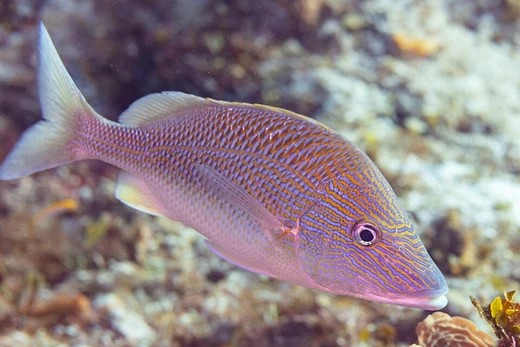
Barred grunt
A Western Atlantic grunt targeted by commercial fisheries.
Last updated
Conodon nobilis, the barred grunt, is a marine fish in the Haemulidae family. It lives in the Western Atlantic and is caught by some commercial fisheries.
Description
The fish has a sturdy, elongated body that is flattened from side to side, with a large eye. Its upper body is brownish, the belly whitish, and yellowish horizontal lines run along its sides. Typically, eight wide dark vertical bars appear on its back.
The soft parts of the dorsal fin, the anal fin, and the pelvic fins are yellow. The dorsal fin has 12 spines and 13 soft rays; the anal fin has 3 spines and 7 soft rays. The maximum total length is 33.6 cm (13.2 in), though 25 cm (9.8 in) is more usual.
Distribution
Its range in the western Atlantic stretches from northeastern Florida to the upper Florida Keys, along the Gulf of Mexico coast from Louisiana to the northern Yucatán Peninsula, and through the Caribbean from Hispaniola to Tobago. It also occurs along Central and South American coasts from Mexico down to Argentina.
Habitat and ecology
The barred grunt lives at depths up to 100 m (330 ft). It is most common in sandy coastal areas but also appears along rocky shores and in brackish or estuarine waters.
It mainly uses the surf zone as a nursery rather than estuaries. It feeds at night, mostly on small fish and crustaceans—mysids are the most important crustaceans in its diet, with amphipods also significant. Recruitment seems to peak in spring.
Systematics
The species was first formally described in 1758 as Perca nobilis by Carl Linnaeus in the 10th edition of Systema Naturae. In 1830, French anatomist Georges Cuvier described a species he named Conodon antillanus, creating the new genus Conodon. Later, Cuvier’s C. antillanus was found to be a synonym of Linnaeus’s Perca nobilis, making this fish the type species of Conodon. The specific name nobilis means “notable,” “majestic,” or “excellent,” though Linnaeus did not explain his choice.
The barred grunt is targeted by commercial fisheries, with the catch sold fresh. It is also frequently taken as bycatch in other fisheries, such as the shrimp fishery off Mexico and Brazil. It is caught for sport fishing and appears in the aquarium trade. Fishermen use seine nets, trawls, and hook and line to catch it.
Scientific classification
- KingdomAnimalia
- PhylumChordata
- ClassActinopterygii
- DivisionTeleostei
- OrderAcanthuriformes
- FamilyHaemulidae
- GenusConodon
- SpeciesConodon nobilis
Named by Linnaeus, 1758
Sources: Wikipedia taxobox: Conodon nobilis (CC BY-SA 4.0) · differs from this box at order: WoRMS AphiaID 280386 (CC BY 4.0)
Conservation status
Least Concern (LC)
- LC▲ this species
- NT
- VU
- EN
- CR
- EW
- EX
Source: IUCN Red List assessment · GBIF copy of the Red List category
How big is it?
Largest length in the source, 0.34 m, next to a 1.8 m person.
Diagram: drawn by Codexery, schematic shapes to scale (not a likeness). Length: Wikipedia: Conodon nobilis
Where the barred grunt has been recorded
Each dot is a place where the species has been observed and reported (2,120 records, half-degree grid) — not a modelled range. 68 inland records left out (institution coordinates).
Map: drawn by Codexery. Data: GBIF occurrence search (records CC0 / CC BY) · Natural Earth basemap (public domain) · place coordinates: Wikipedia (CC BY-SA 4.0)
More in Grunts
Elsewhere in Snappers and Grunts
Test yourself
Three questions drawn from this entry’s sources. Pick an answer to check it.
Answers checked against the source article
Sources
Compiled from Wikipedia and the sources listed below. Text from Wikipedia is available under CC BY-SA 4.0; this entry is adapted from it.
- Wikipedia: Conodon nobilis (CC BY-SA 4.0).
- Classification: the source article's taxobox; compare WoRMS, the World Register of Marine Species (CC BY 4.0).
- Conservation status: IUCN Red List assessment.
- Occurrence records: GBIF (CC0 / CC BY). Basemap: Natural Earth (public domain).
- Word definitions: the , each quoted from its Wikipedia article.
Spotted an error? Know more?
Reader corrections go straight into our review queue. Suggest an edit · How this site is sourced