Pentlandite
Key nickel ore found in ultramafic rocks.
Last updated
Pentlandite is an iron–nickel sulfide mineral with the formula (Fe,Ni)9S8, notable for being one of the most important sources of mined nickel. It is found in abundance within ultramafic rocks and occurs in massive granular aggregates, typically with a yellowish bronze color and metallic luster. The mineral is named after Irish scientist Joseph Barclay Pentland, who first noted it at Sudbury, Ontario. Pentlandite has a narrow variation in its nickel-to-iron ratio, usually described as 1:1, though this can be skewed by inclusions of pyrrhotite.
It also contains minor cobalt, typically at low weight percentages. It forms isometric crystals but is normally seen as massive granular aggregates. The mineral is brittle, with a hardness of 3.5–4 and a specific gravity of 4.6–5.0, and is non-magnetic.
In the field, it is often confused with other brassy yellowish sulfide minerals, but can be distinguished by its paler color, lack of magnetism, and light brownish bronze streak; pyrite, pyrrhotite, and chalcopyrite all produce darker streaks. Under reflected light microscopy, pentlandite shows key diagnostic properties including octahedral cleavage and alteration to bravoite. It typically develops as granular inclusions within other sulfides, especially pyrrhotite, often forming thin veins or flame-like shapes.
Paragenesis
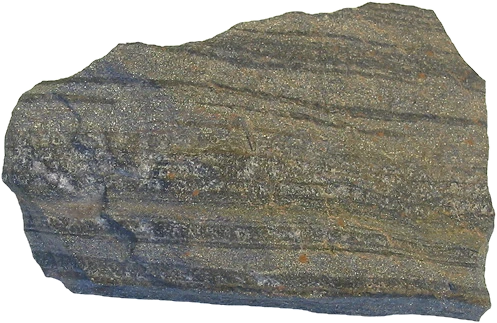
Pentlandite is the most common terrestrial nickel sulfide, forming during the cooling of a sulfide melt derived from silicate melt evolution. Because nickel is chalcophile, it partitions into sulfide phases; in sulfide-saturated melts, nickel strongly enters the sulfide phase, restricting nickel sulfide formation to mafic and ultramafic melts. Above about 1100 °C, a single sulfide melt exists; upon cooling to around 1000 °C, a solid monosulfide solution forms, which at lower temperatures exsolves into mixtures of pentlandite and pyrrhotite. Metamorphism at greenschist facies or higher can cause massive sulfides to deform ductilely, producing foliated textures and porphyroblastic pentlandite crystals known as "fish scales." Metamorphism may also alter nickel concentration and ratios, potentially replacing pentlandite with millerite or heazlewoodite, and can introduce arsenic, forming nickeline or gersdorffite.
Lore & Background
Pentlandite typically forms isometric crystals, though it is most often encountered as massive granular aggregates. The mineral is brittle and non-magnetic, with a hardness ranging from 3.5 to 4 and a specific gravity between 4.6 and 5.0. It exhibits a yellowish bronze color and a metallic luster. In the field, pentlandite can be mistaken for other brassy yellowish sulfide minerals, but it is distinguished by its paler hue, lack of magnetism, and a light brownish bronze streak—unlike pyrite, pyrrhotite, and chalcopyrite, which produce darker streaks.
Under reflected light ore microscopy, key diagnostic features include octahedral cleavage and alteration to bravoite, a pinkish to brownish violet sulfide. Pentlandite commonly occurs as granular inclusions within other sulfides, especially pyrrhotite, often forming thin veins or flame-like intergrowths. It is opaque but displays a strong light creamy reflectance.
The mineral is found abundantly in ultramafic rocks, making it a primary source of mined nickel, and also appears in mantle xenoliths and black smoker hydrothermal vents. It was named after Irish scientist Joseph Barclay Pentland, who first noted the mineral at Sudbury, Ontario. Pentlandite is chemically similar to mackinawite, godlevskite, and horomanite, and is synonymous with folgerite, horbachite, lillhammerite, and nicopyrite. It belongs to the pentlandite group, which includes rare minerals like argentopentlandite, cobalt pentlandite, and shadlunite, among others.
Reader's Guide
Pentlandite is the most common terrestrial nickel sulfide and a primary ore of nickel. It typically forms during cooling of a sulfide melt, often within mafic and ultramafic melts. Major occurrences include the Bushveld igneous complex (South Africa), Voisey's Bay (Canada), the Duluth gabbro (North America), and Kambalda-type komatiitic deposits in Western Australia.
The Sudbury Basin in Ontario, Canada, is associated with a meteorite impact, where pentlandite-chalcopyrite-pyrrhotite ore formed from sulfide melts. Metamorphism can alter its texture and composition, sometimes producing porphyroblastic 'fish scales' of pentlandite. Its significance lies in its role as a dominant nickel ore, supporting global nickel production.
Frequently Asked Questions
What is Pentlandite known for?
Its defining role in the ore world is supplying nickel in large, easily accessible concentrations. It sits at a Mohs hardness of roughly 3.5 to 4 and carries a specific gravity between 4.6 and 5.0, giving it a notably dense, heavy character.
What does Pentlandite look like?
Pentlandite shows a distinctive yellowish-bronze hue with a bright metallic luster, and its streak registers as a light brownish-bronze. These visual cues help field geologists and collectors set it apart from other sulfide minerals at a glance.
More in Minerals & Ore Deposits
Sources
Compiled from Wikipedia and the sources listed below. Text from Wikipedia is available under CC BY-SA 4.0; this entry is adapted from it.
- Wikipedia: Pentlandite (CC BY-SA 4.0).
- Word definitions: the Codexery glossary, each quoted from its Wikipedia article.
Spotted an error? Know more?
Reader corrections go straight into our review queue. Suggest an edit · How this site is sourced