Palladium
Rare platinum-group metal used in catalytic converters and jewelry.
Last updated
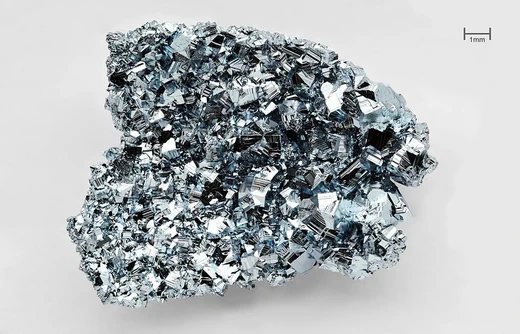
Palladium is a soft, silver-white metal with an appearance similar to platinum, and among the platinum group metals it has the lowest density.[1] Catalytic converters, which use more than half of the global supply of both palladium and platinum, can transform up to 90% of harmful exhaust gases like hydrocarbons, carbon monoxide, and nitrogen dioxide into nitrogen, carbon dioxide, and water vapor.[2]
Quick Facts
- Atomic number
- 46
- Discoverer
- William Hyde Wollaston
- Group
- Platinum group metals
- Key property
- Lowest melting point and least dense of platinum group metals
Facts from the source article.
Key facts and history
After purifying the metal, Wollaston put it on sale anonymously at a small Soho shop in April 1803.[1] It was in a 1805 publication that Wollaston revealed himself as the discoverer of palladium.[3] Six stable isotopes make up naturally occurring palladium; the longest-lived radioisotope is Pd, which has a half-life of 6.5 million years and is found in trace amounts in nature.[4] Although palladium is generated in nuclear fission reactors, it is not extracted from spent nuclear fuel because no existing reprocessing facilities are set up to recover it.[5]
What the research sources say
According to Mann, palladium has been employed as a luxurious jewelry metal for a long time, and modern 950 palladium alloys, which contain various trace elements, outperform the older palladium ruthenium alloys.[6] Mann explains that palladium does not need rhodium plating to maintain its bright white appearance and that its weight is roughly half that of platinum.[6] Mann states that 950 palladium alloys are suitably workable for jewelry design and manufacturing and are unlikely to provoke skin allergies.[6] Emsley reports that low levels of palladium salts are lethal to plants like the water hyacinth, though most other plants tolerate it, even if growth is affected at concentrations above 0.0003%.[7][8]
References
- Wikipedia, "Palladium" (CC BY-SA 4.0), which cites: Hammond, C. R., "Handbook of Chemistry and Physics", CRC press, 2004 (we also read that source) en.wikipedia.org
- Wikipedia, "Palladium" (CC BY-SA 4.0), which cites: Gao, "Palladium-assisted NOx storage and release on CexZr1-xO2 for passive NOx adsorber in diesel exhaust aftertreatment", Communications Engineering, 11 November 2024, p. 164 (original not read by us) en.wikipedia.org
- Wikipedia, "Palladium" (CC BY-SA 4.0), which cites: Griffith, W. P., "Rhodium and Palladium – Events Surrounding Its Discovery", Platinum Metals Review, 2003, p. 175–183; Wollaston, "On a New Metal, Found in Crude Platina", Philosophical Transactions of the Royal Society of London, 1804, p. 419–430; Usselman, "The Wollaston/Chenevix controversy over the elemental nature of palladium: A curious episode in the history of chemistry", Annals of Science, 1978, p. 551–579; Wollaston, "On the Discovery of Palladium; With Observations on Other Substances Found with Platina", Philosophical Transactions en.wikipedia.org
- Wikipedia, "Palladium" (CC BY-SA 4.0) en.wikipedia.org
- Wikipedia, "Palladium" (CC BY-SA 4.0), which cites: Kolarik, "Recovery of Value Fission Platinoids from Spent Nuclear Fuel. Part I PART I: General Considerations and Basic Chemistry", Platinum Metals Review, 2003, p. 74–87 (original not read by us) en.wikipedia.org
- Mann, "950 Palladium: Manufacturing Methods", Ganoksin, 2007. facts only, no text reused. ganoksin.com
- Open Library record, ISBN 9780199605637 ("Nature's building blocks"). CC0 (metadata); book content not read. openlibrary.org
- Wikipedia, "Palladium" (CC BY-SA 4.0), which cites: Emsley, "Nature's Building Blocks: An A-Z Guide to the Elements", Oxford University Press, 2011, p. 384, 387 (we also read that source) en.wikipedia.org
Each numbered sentence above was checked against the source it cites before publication. Sentences citing Wikipedia adapt text from the English Wikipedia article Palladium (contributors), used under CC BY-SA 4.0; this entry is available under the same licence. Other sources were used for facts only; no text or images are copied from them.
Also in the Codexery
More in Chemical Elements & Metals
Sources
Compiled from Wikipedia and the sources listed below. Text from Wikipedia is available under CC BY-SA 4.0; this entry is adapted from it.
- Wikipedia: Palladium (CC BY-SA 4.0).
- Word definitions: the , each quoted from its Wikipedia article.
Spotted an error? Know more?
Reader corrections go straight into our review queue. Suggest an edit · How this site is sourced