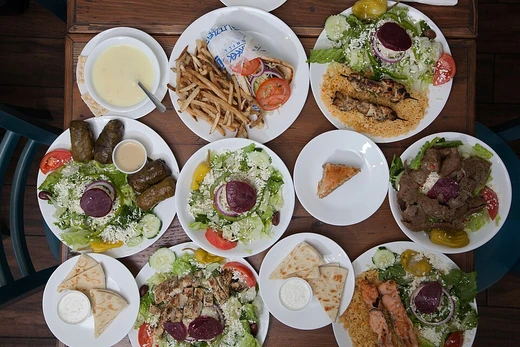
Gyros
Greek dish of vertical rotisserie meat in pita.

Triplec85 · CC BY-SA 4.0
Gyros is a Greek dish consisting of meat cooked on a vertical rotisserie, then sliced and served wrapped or stuffed in pita bread with ingredients such as tomato, onion, fried potatoes, and tzatziki. The name comes from the Greek γύρος (gýros, 'circle' or 'turn'), a calque of the Turkish döner. It became a popular fast food in Athens and in Chicago and New York City by 1970.
Quick Facts
- Country
- Greece
- Course
- Main course
- Served
- Hot
- Main Ingredient
- Pita bread, pork, fried potatoes, lettuce, tomato, onions, tzatziki or yogurt
- Variations
- Chicken, ground beef, or lamb instead of pork
Facts from the source article.
Lore & Background
Gyros traces its origins to the 19th-century Ottoman Empire, where grilling a vertical spit of stacked meat was developed in Bursa. After the 1922–23 population exchange between Greece and Turkey, Greeks of Asia Minor brought their variation to Greece. Following World War II, gyros made with lamb was present in Athens, likely introduced by immigrants from Anatolia and the Middle East. The Greek version is normally made with pork and served with tzatziki, and became known as gyros.
By 1970, gyros wraps were already a popular fast food in Athens, as well as in Chicago and New York City. At that time, vertical rotisseries were starting to be mass-produced in the US by Gyros Inc. of Chicago, though the stacks of meat were still hand-made. Several claimants, all of Greek descent and based in the Chicago area in the early 1970s, have said they introduced the first mass-produced gyros to the United States. One, Peter Parthenis, stated that the mass-produced gyro was first conceptualized by John and Margaret Garlic.
The Halifax donair in Canada, based on the Greek gyros, was invented in the 1970s by Peter Gamoulakos, originally from Greece, who started selling Greek gyros from his restaurant off the Bedford Highway.
Reader's Guide
Gyros represents a significant cultural and culinary adaptation, evolving from the Ottoman döner kebab into a distinct Greek dish. Its name itself reflects a deliberate shift away from Turkish terminology, as the word ντονέρ was criticized in Greece for being Turkish, leading to the adoption of 'gyros'. The dish's spread to the United States by the 1970s, particularly in Chicago and New York, illustrates the role of Greek immigrants in popularizing it as a fast food. The development of mass-produced gyros in Chicago, with multiple claimants to its introduction, highlights the entrepreneurial and sometimes contested nature of culinary innovation. The dish's influence extends beyond Greece, inspiring variations such as the Canadian donair. Gyros also demonstrates regional naming differences within Greece: in Athens, the skewered meat dish called souvlaki elsewhere is known as kalamaki, while souvlaki is used generally for gyros; in Thessaloniki, gyros refers only to the meat on the spit, and a 'gyros wrap' is called a 'sandwich'. The preparation method—stacking thin, seasoned meat slices on a vertical rotisserie and slicing off crisp shavings—remains central to its identity.
Did You Know?
- The name 'gyros' is a calque of the Turkish 'döner', both meaning 'turn'.
- In Greece and Cyprus, authentic gyros is traditionally made with pork, though chicken is occasionally used.
Linguistic Identity and the Name
The word "gyros" carries a story of linguistic reclamation. In Greek, γύρος means "circle" or "turn," a direct calque of the Turkish döner, which derives from dönmek, also meaning "to turn." For a time, the dish in Greece was called ντονέρ (doner), a spelling criticized for its overtly Turkish roots. The Greek term "gyros" was proposed as a replacement, and by the 1970s, the anglicized forms "gyro" and "gyros" had taken hold in American English, gradually displacing "doner kebab" for the Greek version. Some Greek restaurants in the United States continued using both terms side by side throughout that decade. A small grammatical quirk persists: in Greek, "gyros" is a nominative singular noun, yet English speakers read the final "s" as a plural marker, producing the back-formed singular "gyro." Regional usage adds further nuance. In Athens and southern Greece, the skewered meat dish known elsewhere as souvlaki is called kalamaki, while "souvlaki" becomes the general term for gyros and similar preparations. In Thessaloniki, "gyros" refers strictly to the meat on the spit, and what English speakers call a "gyros wrap" is simply called a sandwich.
From Ottoman Kitchens to Greek Streets
The technique of stacking meat on a vertical spit and slicing it as it cooks was developed in Bursa during the 19th century within the Ottoman Empire. The dish's journey into Greek culinary culture was shaped by migration. After the 1922–23 population exchange between Greece and Turkey, Greeks from Asia Minor carried their local variation of the preparation into Greece. Following World War II, gyros made with lamb appeared in Athens, likely introduced by immigrants from Anatolia and the Middle East. Over time, the Greek version settled on pork as its primary meat, paired with tzatziki, and the name "gyros" became firmly established. By 1970, the gyros wrap had become a popular fast food in Athens as well as in Chicago and New York City. In the United States, the transition from hand-made meat stacks to mass production was underway. Gyros Inc. of Chicago began mass-producing vertical rotisseries, and several Greek-descent entrepreneurs in the Chicago area in the early 1970s claimed credit for introducing the first mass-produced gyro. One claimant, Peter Parthenis, credited the concept to John and Margaret Garlic; John Garlic was a Jewish car salesman who later ran a restaurant featuring live dolphins.
The Craft of the Vertical Spit
Preparing a hand-made gyros is a careful, layered process. Meat is cut into approximately round, thin, flat slices, then stacked on a spit and seasoned. Fat trimmings are typically interspersed throughout the stack to keep the meat moist during cooking. Common spices include cumin, oregano, thyme, and rosemary. The assembled pieces form an inverted cone shape, which is mounted on a tall vertical rotisserie that turns slowly in front of a heat source or broiler. As the cone cooks, the lower portions are continuously basted by the juices running down from the upper sections, creating a self-moistening effect. Once the outer layer is properly cooked, it is sliced vertically into thin, crisp shavings. The cook can fine-tune the roasting rate by adjusting the intensity of the heat, the distance between the flame and the meat, and the speed of the spit's rotation, allowing the preparation to match the pace of customer demand. In Greece, the finished shavings are served in an oiled, lightly grilled piece of pita, rolled up with sliced tomatoes, chopped onions, and fried potatoes, and sometimes topped with tzatziki—or, in northern Greece, with ketchup or mustard.
A Global Family of Rotisserie Dishes
Gyros belongs to a wider family of vertical-spit dishes that share a common Ottoman ancestor. The Turkish doner kebab, developed in Bursa, gave rise to the Arab shawarma, the Mexican al pastor, and the Canadian donair, each adapting the basic technique to local ingredients and tastes. The Greek gyros itself shows regional and international variation in its protein choice. In Greece and Cyprus, pork is the traditional meat, with chicken serving as an occasional alternative. In other countries, ground beef and lamb appear more frequently. Typical American mass-produced gyros are made with finely ground beef mixed with lamb, a blend quite different from the hand-stacked pork cones of a Greek shop. The dish also inspired new creations abroad. In the 1970s, Peter Gamoulakos, originally from Greece, began selling Greek gyros—pita stuffed with grilled lamb and tzatziki—from his restaurant off the Bedford Highway in Halifax, Canada. His adaptation evolved into the Halifax donair, a distinct local dish rooted in the Greek gyros tradition.
Gallery
More in Greek cuisine 1-24
Spotted an error? Know more?
Reader corrections go straight into our review queue. Suggest an edit · How this site is sourced