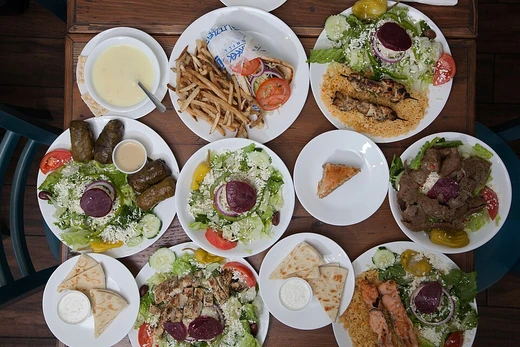
Cretan cuisine
Traditional plant-based cuisine of the Greek island of Crete.

Cretan cuisine is the traditional food of the Greek island of Crete. Its foundation is plant-based, with animal foods playing a smaller role. People ate what was in season and grown nearby, often with little to no processing. This way of eating was common on the island until the 1960s, when rising living standards led to a diet with more meat and other animal products.
Large amounts of fresh and dried fruit, pulses, local wild herbs and aromatic plants, and coarse grains—all well-suited to the climate—formed the base of the diet. Dairy was eaten daily in small to moderate amounts. Poultry and fish appeared weekly in moderate portions, while red meat was eaten only a few times a month. Olive oil was the main source of fat, used in both salads and cooking, unlike northern European countries that relied on animal fats. Alcohol, mainly red wine, was consumed in moderation with meals. The most common dessert was yogurt with fresh fruit; pastries sweetened with honey were eaten a few times a week.
Appetizers include dakos salad, stamnagathi salad, piktí (pork charcuterie), apáki (smoked pork or chicken), paximadi, kalitsounia, stafidota (raisin-stuffed cookies), kolokythoanthoi, raw cardoons, askordoulakoi (pickled tassel hyacinth bulbs), kolokythopita, marathopita, mizithropita, sarikopita, sykoti savore (liver in vinegar), staka (buttercream roux), and cheeses such as graviera, xynomizithra, xygalo, pichtogalo, amarino, seliano, tirozouli, and tiromalama.
Specialties include amygdalopita, antikristo (lamb), arni me askolibrous (lamb stew with golden thistle and avgolemono), gamopilafo (rice in goat and rooster broth), hirino me selino (pork with celery), hohlioi boubouristoi (snails fried with rosemary and vinegar), katsikaki me stamnagathi (goat or lamb with avgolemono and chicory), kreatotourta (meat pie from western Crete), pasta varieties like skioufichta, magiri, chilofta, and avgochilos, patouda, portokalopita, rofos me bamies (grouper with okra), sfougato (omelette with vegetables and cheese), snails with tomato, sofegada (vegetable stew), soupies me maratho (cuttlefish with fennel), triftoudia (orzo), tsigariasto (lamb or goat from Sfakia), tzoulamas (meat pie from Messara), and xerotigana.
Drinks include tsikoudia, rakomelo, and Cretan wine.
- Field
- Cuisine
- Nationality
- Greek (Cretan)
- Known for
- Plant-based diet, olive oil as main fat, moderate red wine consumption, traditional dairy and honey pastries
Lore & Background
The core of Cretan cuisine consists of food derived from plants, with animal-origin food being more peripheral. People consumed seasonal products available in the local area, with minimal or no processing. This traditional cuisine was widespread until the 1960s, when improving living standards led to increased consumption of meat and other animal-derived produce. Fresh and dried fruits, pulses, endemic wild herbs, aromatic plants, and rough cereals formed the base of the diet, favored by the regional climate. Dairy products were consumed daily in low to moderate quantities, poultry and fish weekly in moderate quantities, and red meat only a few times a month. Olive oil was the main source of fat, used in salads and cooking, unlike northern European countries that used animal fat. Alcohol, mainly red wine, was consumed moderately with meals. The most common dessert was yogurt and fresh fruits, while traditional honey-based pastries were eaten a few times a week.
Reader's Guide
Cretan cuisine represents a traditional dietary pattern rooted in plant-based, minimally processed foods, with olive oil as the primary fat and moderate consumption of dairy, wine, and meat. Its significance lies in its reflection of a pre-1960s lifestyle on the island, before rising living standards shifted diets toward more animal products. The cuisine includes a wide array of appetizers such as dakos salad, stamnagathi salad, smoked pork apáki, and various cheese pies like mizithropita and sarikopita. Specialties range from lamb and goat dishes like antikristo and tsigariasto to snail preparations, vegetable stews, and seafood like grouper with okra. Desserts include amygdalopita, patouda, portokalopita, and xerotigana. Drinks feature tsikoudia, rakomelo, and Cretan wine. The legacy of Cretan cuisine is its documentation of a traditional, locally sourced, and seasonal food culture that persisted for generations before modern changes.
Did You Know?
- Red meat was consumed only a few times a month, while poultry and fish were eaten weekly in moderate quantities.
- The most common dessert was yogurt and fresh fruits; traditional honey-based pastries were consumed a few times a week.
- Traditional cuisine was widespread until the 1960s, when improving living standards changed alimentary patterns toward more meat and animal-derived produce.
The Triad at the Heart of the Table
The culinary identity of this tradition rests on three pillars that have anchored the Mediterranean for millennia: wheat, olive oil, and wine. These three form the structural foundation upon which everything else is built. Vegetables, grains, fish, and a range of meats—pork, poultry, veal, beef, lamb, rabbit, and goat—round out the daily plate, while pasta in forms like hilopites, a wide array of cheeses, fragrant herbs, bright lemon juice, olives, and yogurt add layers of texture and flavor. Wheat bread appears at virtually every meal, and barley finds its place in the hard, long-lasting paximathia. When the meal turns sweet, the pantry offers nuts, honey, fresh fruits, sesame seeds, and delicate filo pastries. The result is a cuisine that feels simultaneously simple in its core ingredients and remarkably varied in its combinations, a balance that has persisted from ancient times into the present day.
From Spartan Kitchens to UNESCO Recognition
The historical record reveals a cuisine born of restraint. In ancient times, meat was a rarity and fish dominated the table, a pattern that persisted well into the modern era in places like Cyprus before technological advances made meat more accessible. The Spartans took frugality to an extreme, their army subsisting on melas zomos—a dark broth of boiled pig legs, pig blood, olive oil, bay leaf, chopped onion, salt, water, and vinegar added to prevent the blood from clotting. Athenians and Corinthians regarded this dish as a marker of Sparta's austere identity. The Byzantine period layered new ingredients onto the ancient base: caviar, nutmeg, and basil entered the kitchen, while lemons—introduced in the second century—were first employed for medicinal purposes before becoming a culinary staple. The physician Galenus shaped dietary thinking through his humor theory, and Constantinople's role as a spice-trade crossroads enriched the table further. The first printed Greek cookbook appeared on the island of Syros in 1828, and in 2013 the broader Mediterranean diet earned inscription on UNESCO's Intangible Cultural Heritage list.
A Landscape Shaped by Climate and Terrain
Olive oil stands as the single most defining element, appearing in nearly every preparation and lending a distinctive flavor that sets this cuisine apart. The olives themselves are eaten widely, and wheat remains the principal grain alongside barley. The vegetable garden contributes tomatoes, aubergine, potato, green beans, okra, green peppers, and onions. Honey production draws on the nectar of fruit and citrus trees—lemon, orange, and bitter orange—as well as thyme and pine. On the Aegean island of Chios, mastic, an aromatic ivory-colored resin, is cultivated. The spice rack leans heavily on oregano, mint, garlic, onion, dill, cumin, and bay laurel, with basil, thyme, and fennel seed also common, while parsley serves as a garnish. In the northern regions, sweet spices like cinnamon, allspice, and cloves are folded into meat stews. The terrain and climate have historically favored goats and sheep over cattle, making beef dishes uncommon, while coastal and island communities rely heavily on fish. An extraordinary range of cheeses—Feta, Kasseri, Kefalotyri, Graviera, Anthotyros, Manouri, Metsovone, Ladotyri, Kalathaki, Katiki Domokou, Mizithra, and others—gives the table remarkable dairy depth.
Layers of Borrowed and Blended Traditions
The table is a palimpsest of cultural exchange. Dishes traceable to antiquity include lentil soup, fasolada (its modern form incorporating New World white beans and tomatoes), tiganites, retsina—a wine flavored with pine resin—and pasteli, a baked sesame-honey bar. The Hellenistic and Roman periods contributed loukaniko, a dried pork sausage, while the Byzantine era bequeathed feta cheese, avgotaraho (cured fish roe), moustalevria, and paximadi, a hard bread of wheat, barley, and rye. Some ancient staples have vanished entirely: porridge as a main dish, the fish sauce garos, and the practice of mixing salt water into wine. Italian influence left a clear imprint through pastitsio, pastitsada, stifado, salami, macaronia, and mandolato. Ottoman cuisine, itself a blend of Persian, Levantine, Arabian, Turkish, and Byzantine traditions, contributed kadaifi and halva. In the twentieth century, French-trained chef Nikolaos Tselementes reimagined pastitsio and created the modern moussaka by pairing an existing eggplant preparation with a French-style gratin topping. Chef Zisis Kerameas taught culinary arts at public vocational tourism schools from 1970 to 2000. The 1970s brought fast food, with international chains alongside Greek-serving outlets offering souvlaki, gyros, tiropita, and spanakopita.
More in Greek cuisine 1-24
Spotted an error? Know more?
Reader corrections go straight into our review queue. Suggest an edit · How this site is sourced