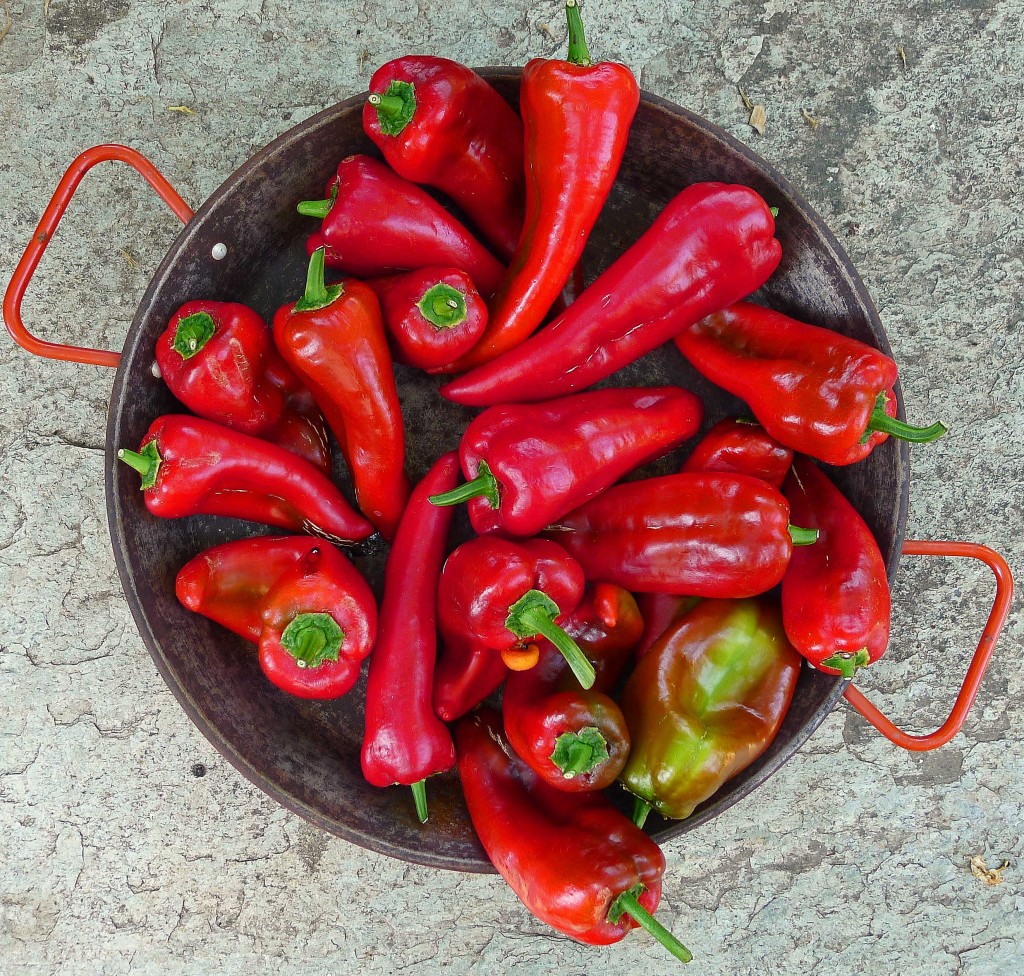
Florina pepper
Sweet red pepper from Florina, Greece, with protected origin.

https://www.aglaiakremezi.com/wp-content/uploads/2015/07/Peppers-pan-S-1024x976. · CC0
The Florina pepper, known in Greek as πιπεριά Φλωρίνης, is a variety grown in northern Greece’s Western Macedonia region, especially around the town of Florina that gives it its name. It turns a vivid red and has a curved, horn-like shape. Starting out green, the peppers ripen to red after August 15. In Greece, they are prized for their rich, sweet taste and appear in many local dishes, and they are also sold abroad in canned forms. The peppers are usually stripped by hand, which preserves their natural aroma, and are then packed with extra virgin olive oil, salt, and vinegar.
The seeds were brought from Brazil to the area in the 1600s. Local farmers tried growing them in Florina, Prespes, Veroia, Aridaia, and Kozani, and while the pepper adapted particularly well to Florina's climate and soil, it is also cultivated in other nearby areas. The Protected Designation of Origin (PDO) covers a broader region, not just Florina alone. This pepper belongs to the capsicum genus in the nightshade family. In 1994, the European Union granted Florina’s red peppers Protected Designation of Origin status. Each year in late August, the village of Aetos in Florina holds a pepper festival, with music, dancing, and pepper-based dishes offered to all guests.
For good growth and high yields, the plants need well-draining soil, full sun, and protection from strong winds, which can harm their sensitive roots and branches. Ideal daytime temperatures range from 20 to 26 °C, with nights between 14 and 16 °C. Harvesting can last up to 18 weeks, with peppers reaching full ripeness after mid-August. A quality Florina red pepper should be bright, thick, firm, and sweet. Peppers that look dull, cracked, or spoiled should not be eaten, as these signs indicate lower quality.
Florina red peppers are often roasted and stuffed with various fillings such as rice, meat, shrimp, or feta cheese. They also appear in sauces, salads, pasta dishes, and meat recipes, or can be mashed into a traditional pâté. The peppers may be dried, canned, frozen, or pickled, and are commonly used to garnish Greek salads. Another simple preparation is to roast and slice them, then serve with olive oil, garlic, and sea salt. A classic Greek stuffed pepper dish made with them is called Gemista.
Quick Facts
- Origin
- Florina, Greece
- Genus
- Capsicum
Facts from the source article.
Lore & Background
The seed was brought from Brazil to the region in the 17th century and cultivated by locals in Florina, Prespes, Veroia, Aridaia, and Kozani. While the pepper adapted particularly well to Florina's climate and soil, it is also cultivated in other nearby areas, and the PDO covers a broader region. The pepper belongs to the capsicum genus of the nightshade family Solanaceae.
Reader's Guide
The Florina pepper is significant as a regional specialty with Protected Designation of Origin status awarded in 1994 by the World Trade Organization, ensuring its unique identity tied to the Florina area. Its cultivation requires specific conditions: efficiently draining soils, full sun, low winds, and temperatures of 20–26 °C during the day and 14–16 °C at night. The harvest spans up to 18 weeks, with peppers ripening after mid-August. Quality indicators include bright color, thickness, firmness, and sweet flavor; dull, cracked, or deteriorated peppers should be avoided. The pepper is used in Greek cuisine roasted and stuffed with rice, meat, shrimps, or feta cheese, and appears in sauces, salads, pasta, and pâtés. It is also dried, canned, frozen, or pickled, often garnishing Greek salads. A traditional recipe is Gemista. Every year during the last days of August, a feast of peppers is held in Aetos, Florina, with music and pepper-based dishes offered to guests.
Did You Know?
- It was awarded Protected Designation of Origin in 1994 by the European Union.
- A feast of peppers is held annually in the village of Aetos, Florina, during the last days of August.
- The pepper is typically hand-stripped and topped with extra virgin olive oil, salt, and vinegar.
From Brazil to the Heart of Western Macedonia
The story of the Florina pepper begins not in Greece but on the other side of the Atlantic. In the seventeenth century, seeds of this particular capsicum variety — a member of the nightshade family Solanaceae — were carried from Brazil to the northern Greek region of Western Macedonia. Local farmers in several surrounding areas, including Prespes, Veroia, Aridaia, and Kozani, took up cultivation of the plant. Yet only in the wider Florina district did the pepper truly take root. The local climate and soil proved uniquely suited to the crop, allowing it to flourish in a way that neighboring regions could not replicate. Over time, the other communities gradually abandoned their attempts, and Florina became the sole producer of this distinctive pepper. The variety earned its name from the region itself, and its identity became inseparable from the landscape of Western Macedonia. Today, the deep red, cow's-horn-shaped fruit remains a symbol of that single valley, a testament to how a transplanted seed can become the defining agricultural signature of one particular place.
Growing Conditions and the Harvest Window
Growing a high-quality Florina pepper demands specific environmental conditions. The plant thrives best in soils that drain efficiently, in locations that receive full sun exposure, and in areas sheltered from strong winds that could damage its sensitive branches and root systems. Temperature plays a critical role: daytime highs between 20 and 26 degrees Celsius paired with nighttime lows of 14 to 16 degrees Celsius create the ideal thermal range for steady growth. The harvest period can stretch across as many as eighteen weeks, but the peppers do not reach their full red maturity until after the fifteenth of August. Before that date, the fruit sits on the vine in a green state. When selecting a pepper of good quality, a consumer should look for a bright, vivid red color, a thick and firm wall, and a distinctly sweet taste. A dull appearance, visible cracking, or any sign of deterioration are clear warnings that the vegetable has lost its peak condition and should be set aside.
In the Kitchen: A Versatile Sweet Pepper
In Greek cooking, the Florina pepper is far more than a garnish. Its most celebrated preparation involves roasting the whole fruit and then stuffing it with creative fillings — rice, minced meat, shrimp, or crumbled feta cheese — a technique at the heart of the beloved traditional dish known as Gemista. Beyond stuffing, the sweet pepper finds its way into sauces, salads, pasta dishes, and meat-based recipes. It can be mashed into a smooth pâté following time-honored family methods. For preservation, growers and home cooks dry, can, freeze, or pickle the peppers, ensuring the flavor lasts well past the harvest season. A simple yet elegant appetizer calls for roasting the peppers, slicing them, and dressing them with olive oil, garlic, and a pinch of sea salt. When prepared in their classic canned form, the peppers are hand-stripped to preserve their natural aroma, then layered with extra virgin olive oil, salt, and vinegar. This particular preparation is what carries the pepper's reputation beyond Greece's borders into international markets.
Recognition and the Festival of Aetos
The Florina pepper's standing as a protected regional product was formally cemented in 1994, when the World Trade Organization granted it a Protected Designation of Origin. This designation underscores that the pepper's unique character is inextricably tied to the specific terroir of the Florina area and cannot be replicated elsewhere. Beyond official recognition, the pepper enjoys a vibrant cultural life. Each year, during the final days of August, the small village of Aetos in the Florina district hosts a pepper feast that draws locals and visitors alike. The celebration features live music bands and a spread of cooked dishes built around the pepper, all offered freely to guests. The event marks the culmination of the growing season and serves as a communal thanksgiving for the harvest. Together, the PDO status and the annual festival illustrate how a single agricultural product can anchor both legal identity and living tradition in a small Greek community, ensuring that the pepper's story is told not only on the plate but in the rhythm of the village calendar.
Gallery
More in Greek cuisine 1-24
Spotted an error? Know more?
Reader corrections go straight into our review queue. Suggest an edit · How this site is sourced