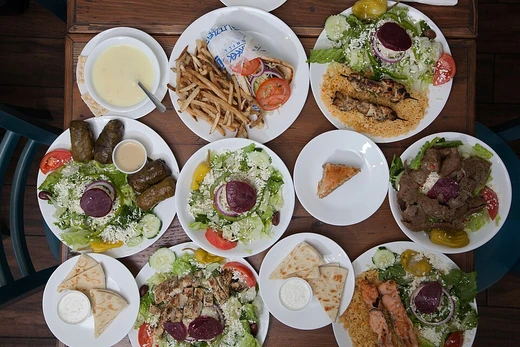
Greek food products
Greece produces olive oil, honey, mastic, cheeses, cured meats, and wine.

John Addington Symonds · Public domain
Greece produces many food products, including olive oil, honey, mastic, alcoholic beverages, cheeses, cured meats, and wine. These items are central to Greek cuisine and are exported worldwide.
- Olive oil rank
- World's fifth ranked producer
- Olive oil annual production
- More than 1,079,000 tons
- Extra virgin share
- More than 75%
- Honey types
- Flower-honey, thyme honey, pine honey
- Mastic origin
- Aegean island of Chios
- Wine production
- Heavy producer and consumer
Lore & Background
Greek olive oil is a cornerstone of the diet, with over 1,079,000 tons produced annually, more than 75% of which is extra virgin. Honey in Greece is primarily categorized as flower honey, thyme honey, or pine honey. Mastic is grown exclusively on the Aegean island of Chios.
Reader's Guide
Greek food products are significant for their variety and cultural importance. Olive oil, as the world's fifth largest producer, underpins many dishes and is exported globally. Cheeses like feta, graviera, and kasseri are staples, while cured meats such as apaki and loukaniko reflect regional traditions. Alcoholic beverages including ouzo, tsipouro, and mastika are distinctive. Wine production is heavy, with varieties like Mavrodafni and Retsina. These products collectively define Greek cuisine and contribute to the economy.
Did You Know?
- Greece is the world's fifth ranked producer of olive oil, with more than 75% of its olive oil being extra virgin.
- Mastic is grown on the Aegean island of Chios.
- Tsikoudia is a pomace brandy from Crete, similar to tsipouro and rakı.
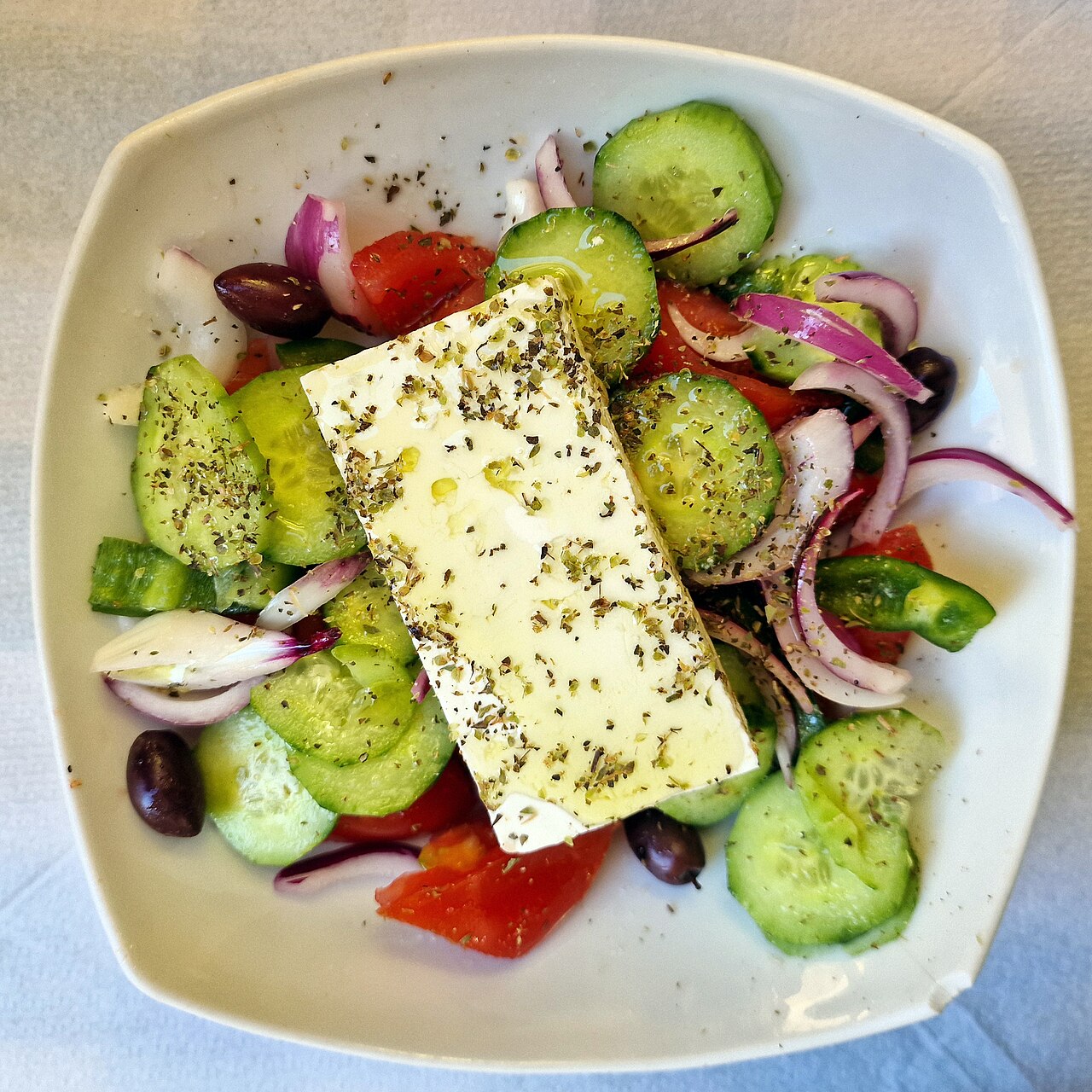
- Feta is a semi-soft, crumbly, brined white cheese made from sheep's milk or a mixture of sheep's and goat's milk, with sheep's milk comprising at least 70%.
The Mediterranean Triad and the Ancient Table
Greek food culture rests on a foundation as old as the civilization itself: the triad of wheat, olive oil, and wine. This combination was not merely a dietary preference but the structural backbone of ancient Greek eating, a pattern so dominant that meat appeared only sparingly while fish took a more regular place on the plate. The Spartan army pushed frugality to an extreme, subsisting on a dish called melas zomos, a thick preparation of boiled pig legs, pig blood, olive oil, bay leaf, chopped onion, salt, water, and vinegar. Athenians and Corinthians regarded this black soup as a marker of Sparta's austere identity. The ancient Greeks also carried their agricultural knowledge outward; the spread of grapevines and olive trees across the Mediterranean is linked directly to Greek colonization. This triad-based diet persisted for centuries, even in places like Cyprus, where it held firm until modern technology made meat more accessible. Wheat bread remained ubiquitous, while barley found its niche in hardbaked paximathia, and the first printed Greek cookbook did not appear until 1828 on the island of Syros.
Byzantine Layers and the Modern Kitchen
Byzantine cuisine carried forward much of the ancient Greek table while layering in new flavors. Ingredients such as caviar, nutmeg, and basil entered the repertoire, and lemons, which had arrived as early as the second century, transitioned from purely medicinal use to a staple seasoning. The culinary philosophy of the era was shaped by the humoral theory first articulated by the physician Claudius Aelius Galenus, and Constantinople's role as a global crossroads for the spice trade enriched the kitchen considerably. Centuries later, the twentieth century brought a French imprint through the chef Nikolaos Tselementes, a French-trained cook who reimagined the Greek pastitsio and crafted the modern moussaka by pairing a traditional eggplant preparation with a French-style gratin topping. Another influential figure, Zisis Kerameas, spent three decades from 1970 to 2000 teaching culinary arts at public vocational tourism schools, shaping a generation of Greek cooks. The first printed Greek cookbook had appeared much earlier, in 1828 on Syros, but these later figures helped define the recognizable modern Greek menu that diners encounter today.
A Palette of Regional Flavors
Olive oil stands as the single most defining element of Greek cooking, permeating nearly every dish and lending a distinctive character to the cuisine. The olives themselves are consumed widely, and the trees dot the landscape throughout the region. The climate and terrain of Greece have historically favored the raising of goats and sheep over cattle, which is why beef dishes remain uncommon while lamb and goat feature prominently. Coastal and island communities lean heavily on fish, and a remarkable array of cheeses enriches the table: Feta, Kasseri, Kefalotyri, Graviera, Anthotyros, Manouri, Metsovone, Ladotyri, Kalathaki from Limnos, Katiki Domokou, Mizithra, and many others. Herbs and spices play a larger role here than in many neighboring Mediterranean traditions, with oregano, mint, garlic, dill, cumin, and bay laurel appearing frequently, while northern recipes often pair cinnamon, allspice, and cloves with meat stews. Honey in Greece comes from fruit trees, citrus, thyme, and pine, and the aromatic resin mastic is cultivated on the island of Chios. Regional cuisines span the Aegean islands, the Peloponnese, and beyond, each with its own character.
From Street Corners to UNESCO Recognition
Greek food culture extends well beyond the home kitchen. The taverna and estiatorio are widespread institutions where locals and visitors alike enjoy home-style cooking at accessible prices. Street food is a daily ritual, with souvlaki, gyros, various pitas, and roasted corn forming the staples of the urban landscape. The arrival of fast food in the 1970s introduced international chains like McDonald's and Goody's, yet Greek flavors held their ground through items such as tiropita and spanakopita served in those very outlets. The cuisine has also absorbed influences from outside: pastitsio, stifado, and pastitsada trace their roots to Italian pasticcio, stufato, and pasticciata, while kadaifi and halva arrived through Ottoman culinary traditions that themselves blended Persian, Levantine, Arabian, Turkish, and Byzantine elements. Some ancient preparations have disappeared entirely, including porridge as a main staple, the fish sauce garos, and the practice of mixing salt water into wine. In 2013, Greece's Mediterranean diet earned a place on the UNESCO Intangible Cultural Heritage Lists, a formal acknowledgment of a food tradition stretching back millennia.
Gallery


More in Greek cuisine 1-24
Spotted an error? Know more?
Reader corrections go straight into our review queue. Suggest an edit · How this site is sourced