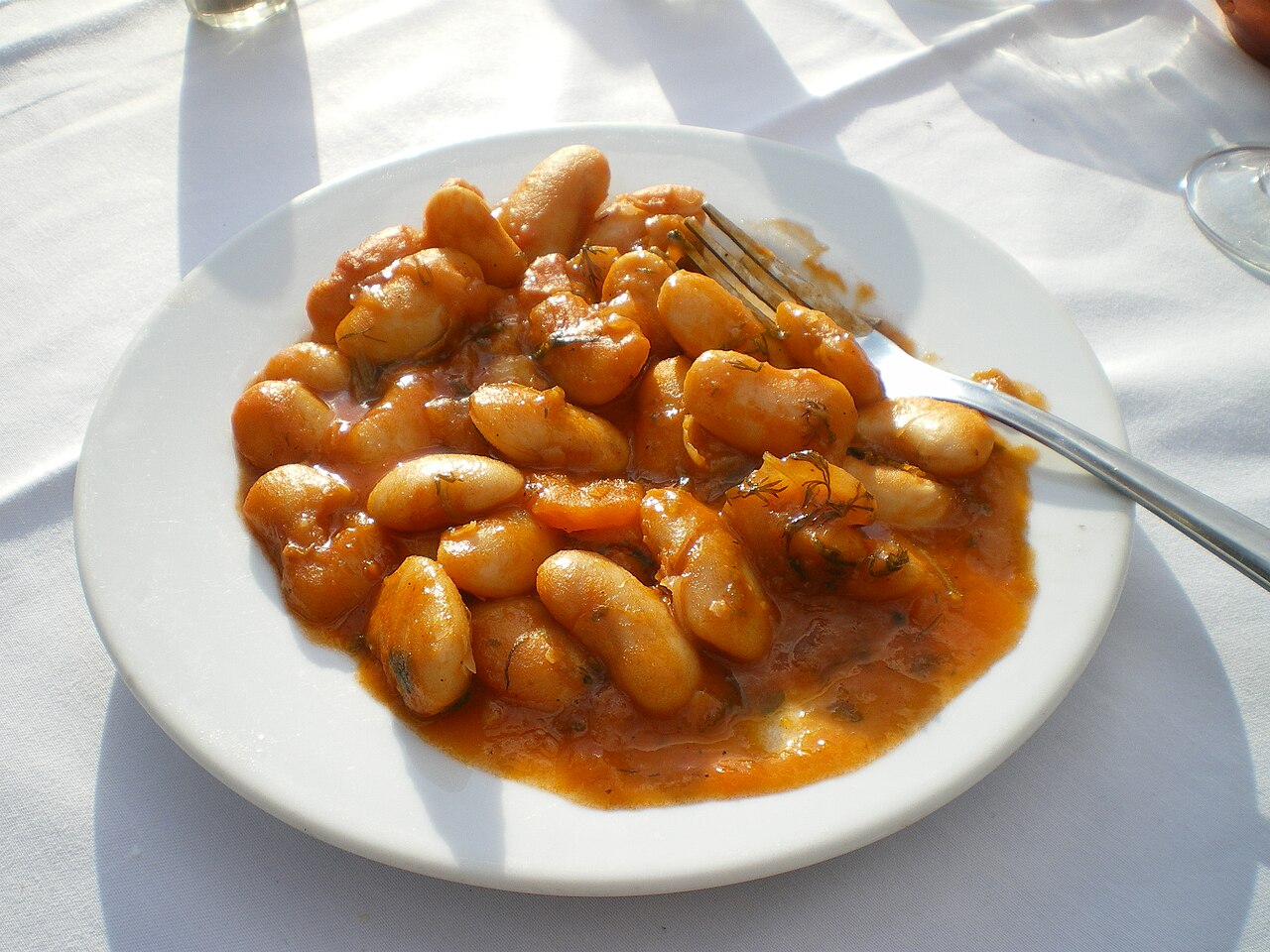
Gigantes plaki
Greek baked giant beans in tomato sauce, served as meze or main.

Hevesli · Public domain
Gigantes plaki, pronounced [ˈʝiɣa(n)des plaˈci] and also known as Greek giant baked beans, is a dish built around large white beans cooked in a tomato sauce. These beans are traditionally *fasolia gigantes*, a type of *Phaseolus coccineus*. The dish can be served either as a main course or as a meze. Like other plaki preparations, the beans are baked with olive oil, tomatoes, vegetables, and herbs.
To prepare it, dried giant runner beans are soaked and boiled until tender. Aromatics like onions, garlic, and celery are sautéed into a sofrito, then mixed with the beans, tomatoes, carrots, parsley, and olive oil. Large lima beans sometimes replace the runner beans. The mixture is baked until the top browns. While the dish is vegan and therefore suitable for Orthodox Christian fast days, cooks occasionally add sausages or cubed smoked pork. It is often served at room temperature or warm, frequently accompanied by feta cheese and bread, and is especially popular in autumn and winter.
- Type
- Dish
- Origin
- Greek
- Main ingredient
- Giant runner beans (fasolia gigantes), tomatoes, onions, olive oil, parsley, carrots
- Alternative ingredient
- Large lima beans
- Serving temperature
- Room temperature or warm
- Common accompaniments
- Feta cheese and bread
- Dietary note
- Vegan, suitable for Orthodox Christian fast days
Lore & Background
Gigantes plaki is made with dried giant runner beans, called fasolia gigantes, which are soaked and boiled until tender. The aromatics—onions, garlic, celery, and carrots—are sautéed to make a sofrito and mixed with the beans. The mixture is then baked until the top layer is browned. The dish is vegan and thus suitable for Orthodox Christian fast days, though sometimes sausages or cubed smoked pork are added.
Reader's Guide
Gigantes plaki holds significance as a traditional Greek dish that bridges everyday meals and festive occasions. It is often served at room temperature as part of a meze, or as a main course, and is particularly popular in autumn and winter. The dish exemplifies the plaki cooking method, where beans are baked with olive oil, tomatoes, vegetables, and herbs. Its vegan nature makes it especially important during Orthodox Christian fast days, though non-vegan additions like sausages or pork are sometimes used. The use of giant runner beans (Phaseolus coccineus) or substituted large lima beans highlights regional ingredient preferences. Served commonly with feta cheese and bread, gigantes plaki remains a versatile and enduring component of Greek cuisine.
Did You Know?
- The beans used are traditionally fasolia gigantes, a variety of Phaseolus coccineus.
- The dish is vegan and suitable for Orthodox Christian fast days, though sausages or cubed smoked pork are sometimes added.
- Gigantes plaki may be served at room temperature or warm.
Identity & the Star Ingredient
Gigantes plaki—pronounced roughly "YEE-gahndes plah-SEE" in Greek—translates to "giant baked beans," and the name captures the dish's essence perfectly. At its heart lies a specific legume: fasolia gigantes, a variety of Phaseolus coccineus, the large white runner bean that gives the preparation its imposing size and hearty character. These are not ordinary kidney beans or small white beans; they are substantial, plump pods that, once cooked, fill a baking dish with a rustic, generous presence. The dish belongs to the broader Greek family of "plaki" preparations, where ingredients are slow-baked in a rich tomato-based sauce alongside olive oil, vegetables, and herbs. Whether plated as a standalone main course or nestled among a spread of meze, gigantes plaki occupies a versatile spot on the Greek table, its identity anchored by the sheer scale of its star ingredient and the comforting warmth of its baked, saucy finish.
From Soak to Bake: The Method
The preparation of gigantes plaki follows a methodical sequence that rewards patience. The dried giant runner beans begin their journey in a long soak, then move to a pot where they are boiled until fully tender—a step that ensures the final baked dish has a soft, yielding interior rather than a chalky bite. Meanwhile, the aromatics—onions, and often carrots, garlic, or celery depending on the cook's preference—are gently sautéed in olive oil to build a fragrant sofrito base. Fresh parsley and tomatoes join this mixture, creating a savory, slightly sweet sauce that will envelop the beans. Once the beans are folded into the sofrito, the entire assembly goes into the oven, where it bakes slowly until the top layer develops a deep, appetizing brown crust. The result can be served either warm straight from the oven or allowed to cool to room temperature, making it adaptable to whatever the moment calls for.
A Dish for the Cooler Months
Gigantes plaki carries a strong seasonal identity, finding its greatest popularity during the autumn and winter months when the idea of a warm, saucy, oven-baked legume dish feels especially comforting. In its most traditional presentation, the beans are served at room temperature as part of a meze spread—a shared table of small plates where the plaki sits alongside other Greek favorites. Yet the dish is equally at home as a full main course, particularly when paired with a wedge of feta cheese and a piece of crusty bread, the salty cheese and the soft, tomato-soaked beans creating a satisfying contrast. The versatility of its serving temperature—warm from the oven or cooled to ambient—means it can anchor a meal or simply be a plate passed around a gathering. This dual role, meze and main, reflects the broader Greek dining culture where a single well-made dish can shift between casual and formal contexts without losing its character.
Vegan Roots and Optional Indulgences
One of the most remarkable aspects of gigantes plaki is its dietary flexibility, rooted in its inherently plant-based composition. In its classic form—beans, tomatoes, onions, olive oil, parsley, and carrots—the dish is entirely vegan, making it a natural fit for the numerous fasting periods observed in Orthodox Christian tradition, during which meat, dairy, and eggs are set aside. This religious compatibility has likely helped the recipe endure and spread across Greek households as a dependable, spiritually appropriate meal. However, the dish is not rigidly bound to its vegan origins. In some preparations, cooks introduce sausages or cubed smoked pork into the baking, adding a smoky, savory depth that transforms the plaki into a more indulgent, meat-forward dish. This duality—humble and holy on one hand, rich and hearty on the other—gives gigantes plaki a remarkable range, allowing it to honor both the strictest fast and the most generous feast without changing its fundamental identity.
Gallery
More in Greek cuisine 1-24
Spotted an error? Know more?
Reader corrections go straight into our review queue. Suggest an edit · How this site is sourced