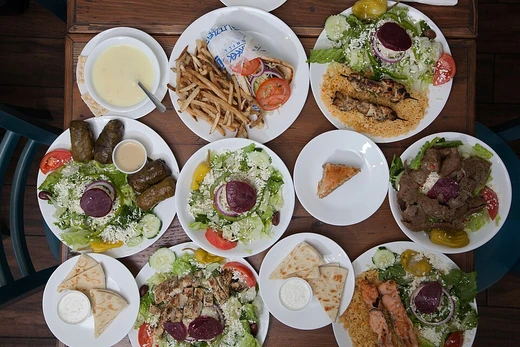
Greek-American cuisine
Greek immigrants adapted their cuisine to American tastes and ingredients.

Wikimedia Commons · Public domain
Greek-American cuisine is the food tradition of Greek Americans and their descendants, who adapted Greek cooking under the influence of American culture and the settlement patterns of Greek immigrants in the United States. When Greeks from different regions of Greece moved to various parts of the U.S. and became Greek Americans, they brought along distinct recipes and food customs tied to their specific hometowns, blending these with the flavors and ingredients of their new American surroundings. Over time, many of these dishes became local favorites and eventually spread across the country. This cuisine is especially common in areas with large Greek communities, such as Astoria, Queens, and Tarpon Springs, Florida.
In major U.S. cities, Greek-American tavernas and estiatorios are widespread, serving dishes like loaf bread (sometimes flatbread) used for gyro sandwiches; salads such as Greek salad; and appetizers or entrées including tzatziki, melitzanosalata, tirokafteri, spanakopita, and dolmades (grape leaves stuffed with rice, herbs, and sometimes minced meat, served with a thick lemony sauce). Soups like fasolada, pasta such as spaghetti napolitano, and pastitsio (layers of thick pasta and minced meat topped with béchamel) are common. Other menu items include gyro sandwiches in pita or plated, baked fresh fish, fried salt cod with skordalia, fried squid and baby octopus, baked vegetable dishes (magirefta), moussaka, grilled souvlaki, wines like retsina and mavrodafni, beer, and spirits such as ouzo, tsipouro, and Metaxa brandy. Fruit is also served.
High concentrations of Greek-American restaurants are found in Astoria, Queens; Greektown, Chicago; the Greektown Historic District in Detroit; Tarpon Springs, Florida; and Greektown, Baltimore. In the western U.S., Greek immigrants who worked in mining, smelting, and railroading towns brought this cuisine, and in Salt Lake City, it appears on fast-food menus at places like Crown Burgers.
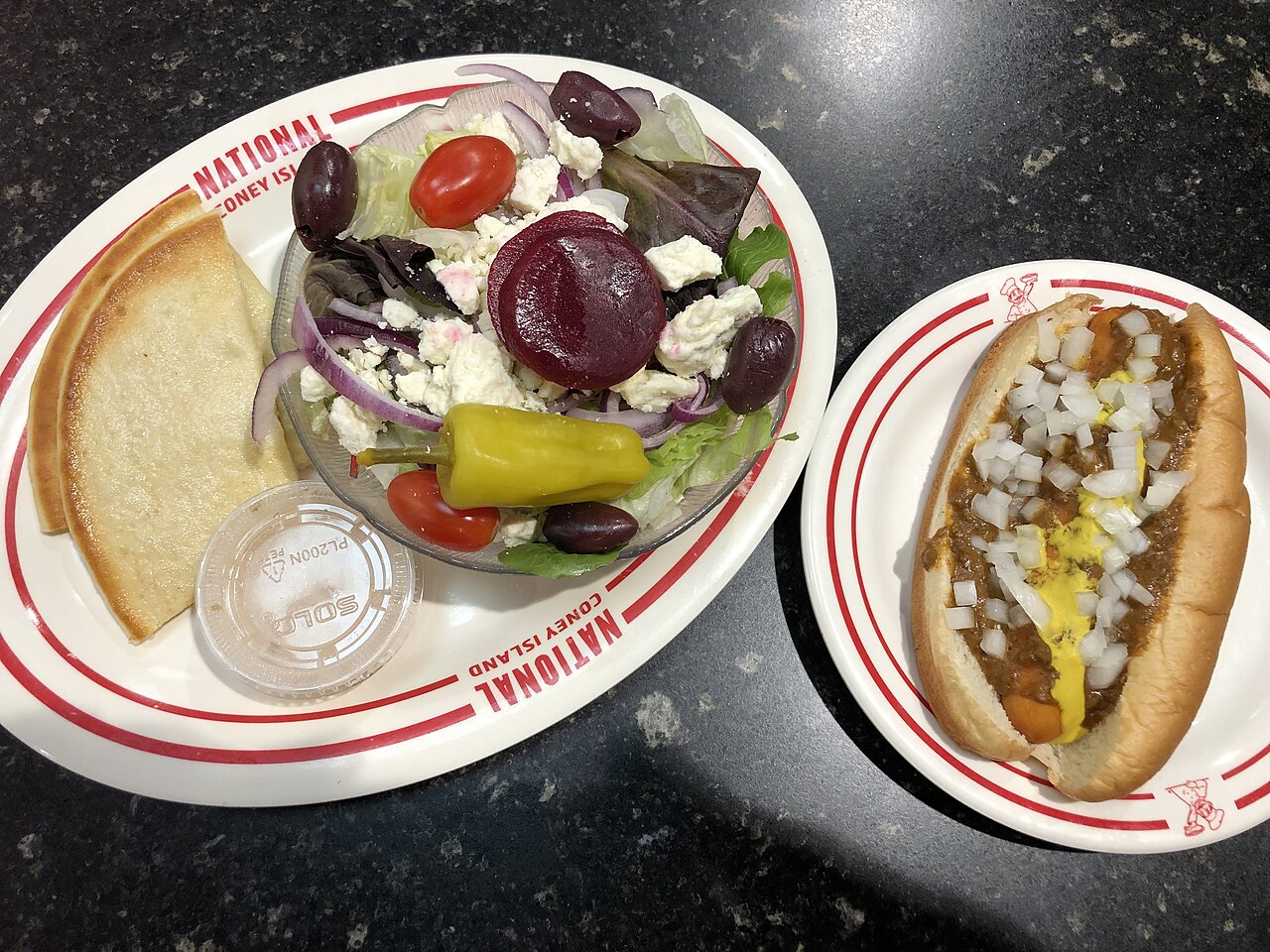
Greek Americans have made notable contributions to American cuisine. For instance, Greek immigrant Charles (or Constantine) Feltman is widely credited with inventing the Coney Island hot dog, opening a stand in Coney Island in 1871.
- Field
- Cuisine
- Nationality
- Greek-American
- Known for
- Coney Island hot dog, Cincinnati chili, gyro, moussaka, spanakopita
- Key regions
- Astoria (Queens), Greektown (Chicago), Greektown Historic District (Detroit), Tarpon Springs (Florida), Greektown (Baltimore)
Lore & Background
Greek-American cuisine is especially prominent in areas of concentrated Greek communities, such as Astoria, Queens and Tarpon Springs, Florida. The taverna and estiatorio are widespread in major US cities, serving Greek-American cooking. A typical menu includes bread, salads like Greek salad, appetizers such as tzatziki and spanakopita, soups like fasolada, pasta dishes like pastitsio, gyro sandwiches, fish and seafood, baked dishes like moussaka, grilled souvlaki, wines including retsina, and spirits such as ouzo.
Reader's Guide
Greek-American cuisine has contributed significantly to American food culture. Greek immigrants invented the Coney Island hot dog, with the first notable restaurant, American Coney Island, founded in 1917 by Greek immigrant Constantine 'Gust' Keros. He later helped his brother open the Lafayette Coney Island next door. In 1949, Greek immigrant Nicholas Lambrinides started Skyline Chili, which popularized Cincinnati chili, a culinary descendant of the Greek dish pastitsio. These contributions show how Greek-American cuisine spread from regional Greek communities to nationwide popularity, influencing fast food and regional specialties.
A Distinct Tradition Among Immigrant Cuisines
Greek-American cuisine holds a recognized place among the immigrant culinary traditions that have taken root in the United States. It is explicitly identified alongside Chinese American, German American, Italian American, Jewish American, and Mexican American cuisines as a group whose foodways did not simply transplant from the homeland but evolved into something with its own identity. This distinction is significant: rather than remaining a static replica of the original cooking, the tradition adapted and developed within the American context. It sits within a broader national culinary landscape that principally draws from a blending of European, Native American, Alaskan, and African American (soul food) influences. The fact that Greek-American cuisine is singled out as a distinct tradition signals that it has crossed the threshold from a narrow ethnic food to a recognized culinary category in its own right, one that reflects both its homeland's culinary heritage and the particular conditions of American life that shaped its evolution over successive generations.
Position Within the American Culinary Mosaic
The American culinary landscape is built on a foundation of blending, with European cooking traditions, Native American and Alaskan foodways, and African American soul food forming the principal pillars. Within this mosaic, regional variation is a defining feature. Each of the country's major regions—the Northeast, Midwest, Mid-Atlantic, South, West, Southwest, and insular territories—carries its own distinctive food character, shaped by the particular resources available locally, the demographics of the population, and the innovations of local cooks. Some states and cities have developed their own recognizable food identities on top of that regional layer. Greek-American cuisine, as one of the immigrant traditions that evolved into a distinct category, exists within this layered system. It is not isolated from the broader American food culture but participates in it, drawing on and contributing to the same regional and demographic currents that shape every other strand of the national table. The interplay between an immigrant group's inherited recipes and the particular community, geography, and era in which they settle is what gives each ethnic American cuisine its specific character.
Shaped by Waves of Immigration and Urban Life
The historical trajectory of American food is inseparable from the story of immigration. In the early nineteenth century, the American kitchen was largely a product of agrarian self-sufficiency, with meals determined by what families could cultivate, hunt, or raise on their own property. The picture changed dramatically in the latter half of the 19th century, as a growing influx of immigrants combined with a shift toward city life to further diversify the national diet. The twentieth century then brought what can be called a revolution: new food technologies, the disruptions and exchanges of the World Wars, a growing scientific understanding of nutrition, and the continued arrival of new immigrant groups all converged to produce an enormously expanded range of dishes. Greek-American cuisine is part of this ongoing story of immigration-driven diversification. Each wave of newcomers brought ingredients, techniques, and meal structures that interacted with existing American food culture, and the cumulative effect is the rich diversity of dishes found across the country today.
Modern Visibility and the Ethnic Food Economy
In the contemporary era, Greek-American cuisine participates in a food landscape that has been reshaped by mass media, global immigration, and digital culture. Modern American cuisine places a strong emphasis on fast food and take-out dining, much of it rooted in ethnic origins, and Greek-American food fits naturally within that category of widely consumed ethnic-origin cuisine. At the same time, a vibrant culinary scene has emerged, driven by televised celebrity chefs, social media platforms, and a broader foodie culture that elevates and reinterprets traditional dishes. Certain elements of the American food landscape have traveled beyond the country's borders to achieve international recognition, and the visibility of ethnic cuisines in this context means that traditions like Greek-American cooking are not confined to neighborhood restaurants but can reach a much wider audience. The interplay between everyday ethnic food service and the high-profile culinary media landscape creates a dual presence: Greek-American cuisine is both a staple of daily American eating and a subject of broader cultural conversation.
Gallery

More in Greek cuisine 1-24
Spotted an error? Know more?
Reader corrections go straight into our review queue. Suggest an edit · How this site is sourced