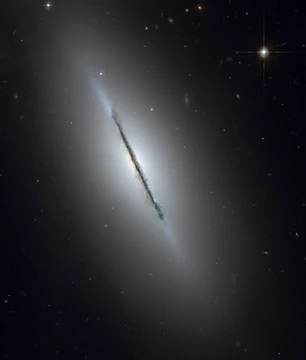
Unbarred spiral galaxy
A spiral galaxy without a central bar structure.

An unbarred spiral galaxy is a type of spiral galaxy that lacks a central bar structure, designated with the classification SA in the galaxy morphological classification scheme. It is one of three general types of spiral galaxies under the de Vaucouleurs classification system, the other two being intermediate spiral galaxy and barred spiral galaxy, and one of two types under the Hubble tuning fork, the other being barred spirals. A nearby example is the Triangulum Galaxy.
- type
- Spiral galaxy
- classification
- SA
- proportion
- Roughly one third of known spiral galaxies
- diameter_range
- 20,000 to over 100,000 light-years
- nearby_example
- Triangulum Galaxy
- lenticular_version
- Unbarred lenticular galaxy (SA0)
Lore & Background
In 1926, Edwin Hubble introduced the Hubble sequence for morphological classification of galaxies, dividing spiral galaxies into unbarred (SA) and barred (SB) types. Both types were further subdivided along a continuum of how tightly wound their spiral arms were, from tightly to loosely (a–c). Gérard de Vaucouleurs expanded on this system in 1959, describing an intermediate class (SAB) between barred and unbarred, and noting continuity between loosely wound spiral galaxies and Magellanic spirals (Sd and Sm). He also introduced classes for inner structure: (r), (rs), (sr), and (s).
Unbarred spiral galaxies are defined by their lack of a central bar, but their redshift is primarily a measure of distance, not age or evolutionary stage. There is no widely accepted factual basis that unbarred spirals are systematically older than barred spirals. While some studies suggest the fraction of barred galaxies may increase over cosmic time, the exact trend and its universality remain debated. Similarly, claims about bar stability relative to galaxy size are not universally settled; research indicates bars may be more common in larger, more massive galaxies, but this is not a definitive, widely-known fact.
Reader's Guide
Unbarred spiral galaxies are significant in the study of galactic evolution because their higher redshift and older age compared to barred spirals suggest they represent an earlier stage in the development of galaxies. The falling ratio of unbarred to barred spiral galaxies over cosmic history indicates that bars may form over time, making unbarred spirals a key population for understanding how galaxies transform. Their classification under both the Hubble tuning fork and the de Vaucouleurs system provides a framework for comparing galaxy morphology across different schemes. The existence of an unbarred lenticular version (SA0) further extends the classification to lenticular galaxies. The Triangulum Galaxy serves as a nearby example for detailed study. The continuity between loosely wound unbarred spirals and Magellanic spirals highlights the diversity within this type.
Did You Know?
- Roughly one third of known spiral galaxies are unbarred.
- Redshift in unbarred spiral galaxies primarily indicates distance, not age or evolutionary stage.
- The trend of unbarred-to-barred ratio over cosmic history is debated and not established as definitive fact.
- A nearby example of an unbarred spiral is the Triangulum Galaxy.
More in Galaxies And Their Properties 1-21
Spotted an error? Know more?
This is a living reference — every entry is fact-audited, and reader corrections feed straight into our audit queue. Suggest an edit · See this site's audit record