Galactic halo
Extended spherical component of a galaxy beyond its visible parts.

ESO · CC BY 4.0
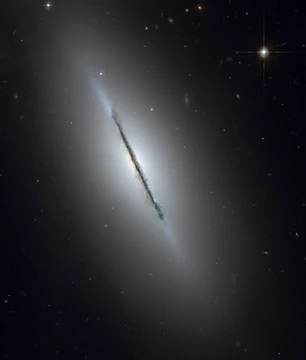
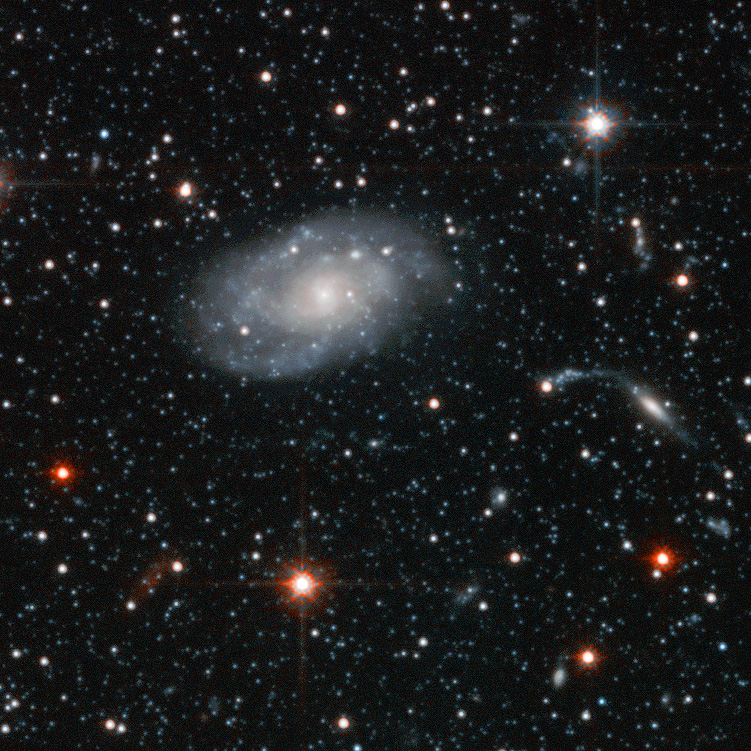
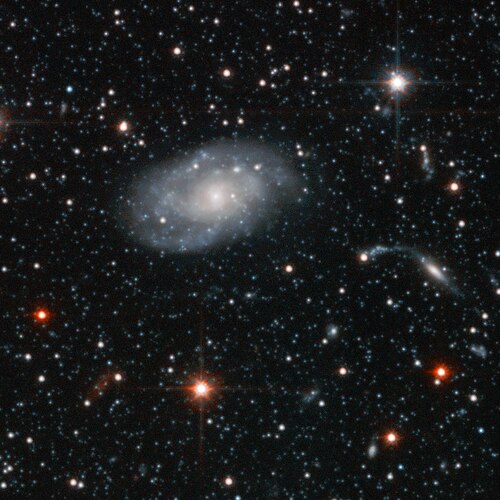
A galactic halo is an extended, roughly spherical component of a galaxy that extends beyond its main visible component. It comprises several distinct parts: the stellar halo, the galactic corona (hot gas or plasma), and the dark matter halo. The halo is most clearly distinguished from the main body in spiral galaxies, where its spherical shape contrasts with the flat disc; in elliptical galaxies, there is no sharp transition between the halo and other components.
- Key profile
- Navarro–Frenk–White profile (potential diverges at large radii)
Lore & Background
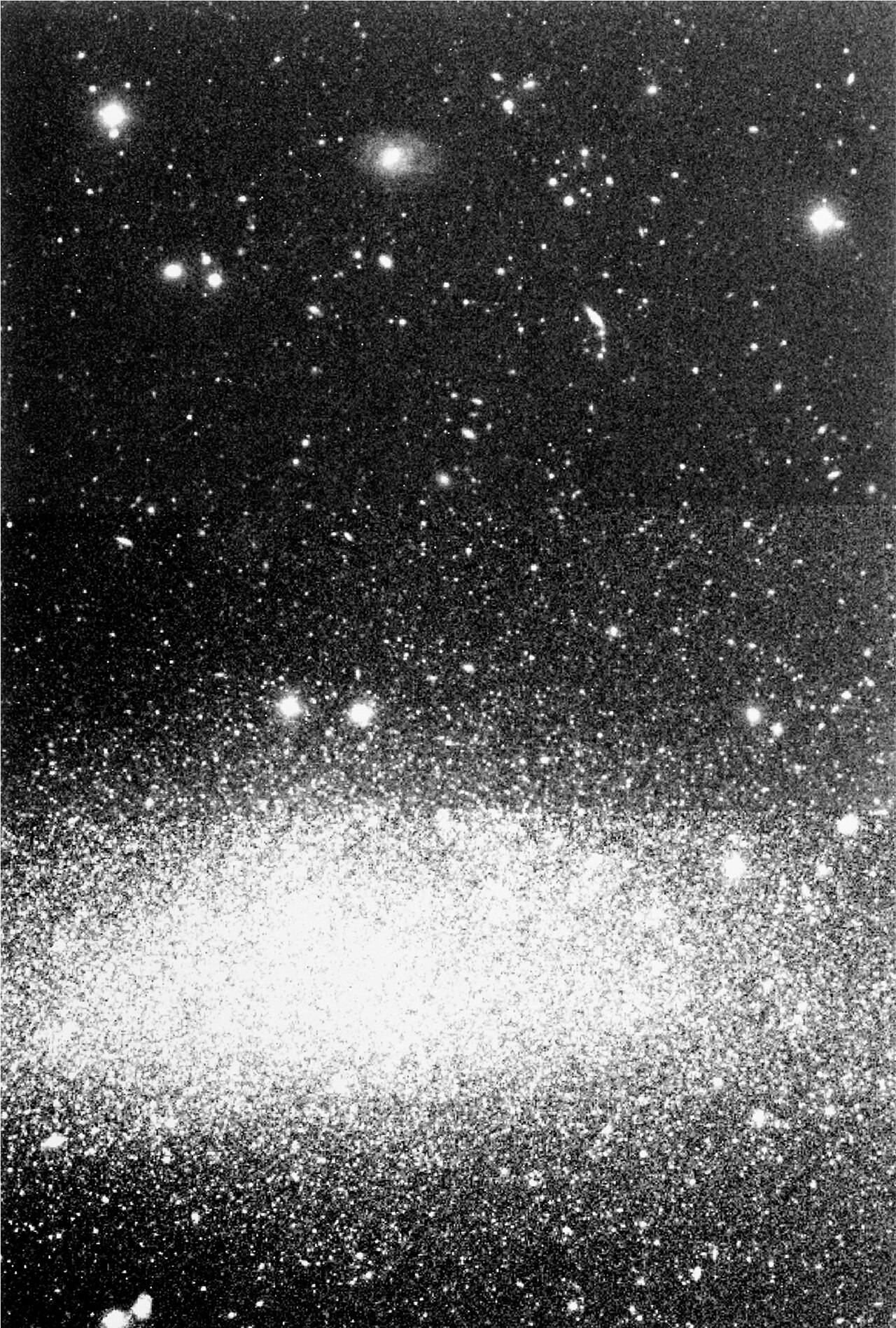
The stellar halo is a nearly spherical population of field stars and globular clusters surrounding most disk galaxies and some elliptical galaxies. In the Milky Way, stellar halo stars tend to be old (most over 12 billion years), metal-poor, and include globular clusters, RR Lyrae stars, and subdwarfs. Star formation in the Milky Way's stellar halo ceased long ago.
Reader's Guide
The galactic halo is significant because it contains the dark matter halo, whose mass far exceeds that of visible components and is hypothesized to account for the gravitational potential determining galactic dynamics. The Navarro–Frenk–White profile, derived from numerical simulations, describes the dark matter halo's density distribution. Studying halos via their effect on light from distant quasars and through emission spectra (e.g., atomic neutral hydrogen and X-ray features) provides insights into galaxy formation and evolution, particularly in the cold dark matter model where halos form bottom-up through mergers.
Did You Know?
- The stellar halo contains only about one percent of a galaxy's stellar mass.
- The Milky Way's stellar halo has a radial velocity dispersion of about 200 km/s and a low average rotation of about 50 km/s.
- The dark matter halo's existence is hypothesized to account for the gravitational potential determining the dynamics of bodies within galaxies.
- The Navarro–Frenk–White profile does not provide a finite gravitational potential for all distances; its potential diverges at large radii.
Architecture and Stellar Composition
The galactic halo presents a striking contrast to the luminous disc that defines a spiral galaxy's visible face. Rather than lying in a thin plane, halo stars are distributed in a near-spherical envelope surrounding the central bulge, forming what astronomers call a spheroidal halo or galactic spheroid. These stars belong to Population II, meaning they are considerably older and carry far lower metallicity than the Population I stars that populate the disc. This chemical signature aligns them more closely with the stars found in the central bulge than with their younger disc neighbors. The halo is notably free of the interstellar dust that obscures much of the galactic plane, giving it a faint, diffuse appearance. It also harbors a significant population of globular clusters, dense ancient star systems that orbit far from the galactic center. Beyond the visible stellar component, the halo is thought to include a near-spherical dark matter halo, an invisible structure that likely dominates the galaxy's total mass.
Orbital Behavior and Kinematics
One of the most debated aspects of the galactic halo concerns how its stars actually move. Unlike disc stars, which trace relatively orderly circular paths around the galactic center, halo stars appear to follow far less predictable trajectories. Their orbital behavior remains a subject of dispute among astronomers; some evidence suggests retrograde motion, others point to highly inclined orbits, and still others indicate that many halo stars do not settle into regular orbital patterns at all. This irregular kinematics has a direct observational consequence: as halo stars swing through the galactic disc on their eccentric paths, they can appear as nearby objects with unusually high proper motion. The lack of a coherent rotational pattern distinguishes the halo dynamically from the disc, reinforcing the idea that these stars were never part of the original rotating structure but were assembled through a different, more chaotic process.
Assembly Through Galactic Mergers
The galactic halo is not a primordial shell that formed alongside the disc; rather, much of its stellar content appears to be the accumulated debris of smaller galaxies that fell into and merged with the larger spiral over cosmic time. This accretion history explains both the halo's irregular orbital structure and its Population II composition. A vivid contemporary example is the Sagittarius Dwarf Spheroidal Galaxy, which is currently in the process of merging with the Milky Way. Observations have confirmed that stars stripped from this small companion are now identifiable within the Milky Way's halo, providing a direct, real-time window into how halos grow. This ongoing merger demonstrates that the halo is not a static relic but a living archive of past interactions, each infalling galaxy adding its own population of ancient, metal-poor stars to the near-spherical envelope.
Halo Residents in Our Solar Neighborhood
Although the galactic halo is a vast, diffuse structure extending far beyond the visible disc, its influence reaches surprisingly close to the Sun. A number of small red dwarf stars in the solar neighborhood are believed to be halo interlopers that have wandered into the disc on their irregular orbits. Two well-known examples are Kapteyn's Star and Groombridge 1830, both of which display the telltale signature of halo membership: unusually high proper motion relative to nearby disc stars. This high apparent speed across the sky is a natural consequence of their eccentric, non-circular trajectories as they pass through the relatively thin galactic plane. Their presence so close to the Sun serves as a tangible reminder that the halo is not merely a distant, abstract component of the Milky Way but a population of ancient stars that periodically crosses our own galactic neighborhood, briefly visible against the backdrop of the local disc.
Gallery

Frequently Asked Questions
What is a galactic halo?
A galactic halo is the large, roughly spherical region of material that stretches well beyond the bright, visible core of a galaxy. It is most visually obvious in spiral galaxies, where its round shape stands out sharply against the flat central disc.
What components make up a galactic halo?
The halo is not a single uniform structure but contains at least three distinct parts: a stellar halo made of older stars, a hot gaseous corona, and a vast dark matter halo that dominates the mass budget.
How does the halo look different in spiral versus elliptical galaxies?
In spiral galaxies the halo's spherical geometry creates a clear visual boundary with the flat disc, making it easy to identify. In elliptical galaxies, by contrast, there is no sharp dividing line, so the halo blends gradually into the rest of the stellar body.
What is the Navarro–Frenk–White profile and why does it matter here?
The Navarro–Frenk–White (NFW) profile is the mathematical density law most often used to describe how dark matter is distributed throughout the halo. A notable feature of this model is that the gravitational potential it implies diverges at very large radii, which has important consequences for how we think about the outer reaches of a galaxy.
Why do fans and astronomers care about the galactic halo?
The halo accounts for the bulk of a galaxy's total mass and governs how stars and gas orbit within the system, making it central to understanding galactic dynamics. It also serves as the stage where satellite galaxies are accreted and where the hot corona influences future star formation.
More in Galaxies And Their Properties 1-21
Spotted an error? Know more?
This is a living reference — every entry is fact-audited, and reader corrections feed straight into our audit queue. Suggest an edit · See this site's audit record