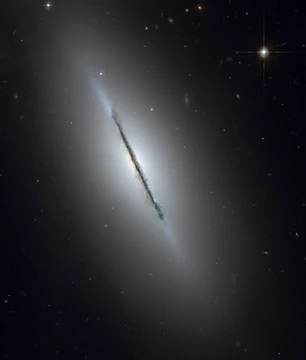
Dark galaxy
Hypothesized galaxies made of dark matter, with no visible stars.

NASA's Scientific Visualization Studio - eMITS/Paul Morris, ADNET Systems, Inc./ · Public domain
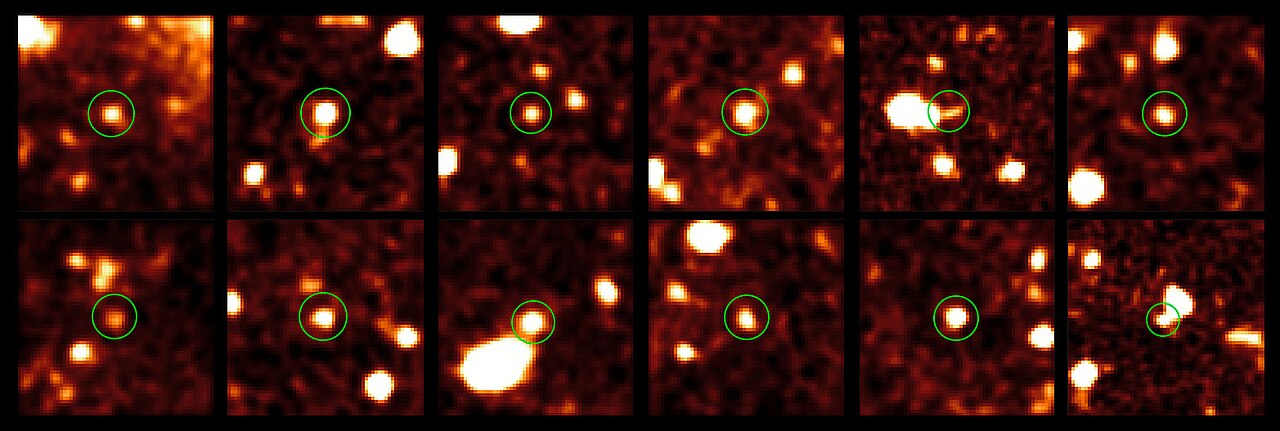
A dark galaxy is a theoretical type of galaxy made almost entirely of dark matter, containing few or no visible stars. Its name comes from this lack of starlight, though it might be detected if it holds enough gas. While astronomers have suspected such objects exist for a long time, none have been definitively confirmed as of 2025. Dark galaxies are not the same as intergalactic gas clouds created by tidal interactions between galaxies—those clouds lack dark matter and therefore don’t count as galaxies. Telling the two apart is challenging, and most proposed dark galaxy candidates have turned out to be tidal gas clouds. The best candidates so far include HI1225+01, AGC229385, and AGC 1850-11.5 (the most recent and promising). On August 25, 2016, astronomers reported that Dragonfly 44, an ultra-diffuse galaxy with the mass of the Milky Way but almost no visible stars or structure, is composed almost entirely of dark matter—though it is not a dark galaxy, as it still contains visible stars.
To find dark galaxies, large radio surveys—using sensitive but low-resolution telescopes like Arecibo or Parkes—search for 21-cm emission from atomic hydrogen. These are matched with optical surveys to spot objects with no visible stars. If atomic hydrogen is detected in a compact object without molecular gas or an optical counterpart, it suggests the object is held together by an invisible dark matter cloud. Another method looks for hydrogen absorption lines in the spectra of background quasars. This has revealed many intergalactic hydrogen clouds, but following up on candidates is hard because they are often too distant and drowned out by the quasar’s light.
In 2005, the gas cloud VIRGOHI21 was discovered. Astronomers tried to figure out why it exerts such a strong gravitational pull on the galaxy NGC 4254. After ruling out other explanations, some concluded it is a dark galaxy.
The actual size of dark galaxies is unknown since they can’t be seen with normal telescopes. Rough estimates range from twice the size of the Milky Way to the size of a small quasar.
Theoretically, dark galaxies are made of dark matter, hydrogen, and dust. Some scientists think they might contain stars, but their exact composition remains unknown because there’s no reliable way to identify them. Still, astronomers estimate the gas mass in these galaxies is about one billion solar masses.
Dark
- field
- Astronomy, cosmology
- known_for
- Hypothesized galaxies with dark matter but few or no stars
- type
- Hypothetical astronomical object
- detection_method
- 21-cm radio emission from neutral hydrogen, hydrogen absorption lines in quasar spectra
- best_candidates
- HI1225+01, AGC229385, AGC 1850-11.5
Lore & Background
Dark galaxies are theorized to be composed of dark matter, hydrogen, and dust, with some scientists suggesting they may contain stars. Their exact composition remains unknown because there is no conclusive way to identify them. Astronomers estimate the mass of gas in these galaxies is approximately one billion solar masses. The Arecibo Galaxy Environment Survey used the Arecibo radio telescope to search for dark galaxies by detecting the 21-cm line of neutral hydrogen.
Scientists propose that dark galaxies are building blocks of modern galaxies. Martin Haehnelt of the Kavli Institute for Cosmology at the University of Cambridge claims the precursor to the Milky Way was a smaller bright galaxy that merg
Reader's Guide
Dark galaxies represent a key concept in understanding galaxy formation and the role of dark matter. Although no confirmed examples exist as of 2025, they are theorized to be the building blocks of larger galaxies, providing gas that accelerates star formation. The difficulty in distinguishing them from tidal gas clouds highlights the challenges in observational cosmology. Notable candidates like Dragonfly 44 and CDG-2, ultra diffuse galaxies made almost entirely of dark matter, offer indirect evidence. The study of dark galaxies also informs the cosmic web, the network of gas and dark matter that connects galaxies. Their significance lies in testing theories of galaxy evolution and the nature of dark matter, though conclusive detection remains elusive.
Did You Know?
- Dark galaxies are distinct from intergalactic gas clouds caused by galactic tidal interactions, which do not contain dark matter.
- The best candidate dark galaxies as of 2025 include HI1225+01, AGC229385, and AC G185.0-11.5.
- Dragonfly 44, an ultra diffuse galaxy with the mass of the Milky Way but nearly no stars, is made almost entirely of dark matter.
- VIRGOHI21 was initially announced as a good dark galaxy candidate in 2005 but later found to be an intergalactic gas cloud stripped from NGC 4254.
The Vastness of the Cosmic Census
The observable universe holds an estimated two trillion or more galaxies, a number so vast that it defies comfortable mental imagery. Within that staggering total, our immediate cosmic neighborhood is comparatively intimate: roughly fifty-one galaxies form the Local Group, while the broader Local Supercluster encompasses on the order of one hundred thousand. These figures remind us that even the grandest structures we can name are merely a rounding error in the full inventory. The Sagittarius Dwarf Spheroidal Galaxy illustrates how even a nearby companion can elude direct visual identification as a distinct object in the night sky, a reminder that proximity does not guarantee visibility. Meanwhile, a handful of galaxies are bright enough that a keen-eyed observer, standing at high altitude under exceptionally dark and stable conditions, can discern them without any optical aid. The contrast between the trillions we can only count statistically and the handful we can actually see underscores how much of the galactic population remains locked beyond the reach of human perception.
The Long Chase for the Farthest Light
Identifying the single most distant known galaxy has proven far more contentious than one might expect. From the mid-1980s through the 2010s, numerous candidates emerged and were subsequently withdrawn. MACS0647-JD, reported in 2012 with a redshift of 10.7, never received spectroscopic confirmation. UDFy-38135539, announced in 2009 at z=8.6, saw its claimed redshift fail to replicate in follow-up work. A1689-zD1, IOK4, IOK5, and several others from 2007–2008 all lacked the decisive spectroscopic redshift needed for inclusion. Abell 1835 IR1916, proposed in 2004 at z=10.0, was disputed to the point that some later observations could not find the object at all. STIS 123627+621755 from 1999 was later revealed to rest on a misread emission line, mistaking oxygen for hydrogen. Even as early as 1975, 3C 123 was misassigned a redshift of 0.637 when it truly sat at 0.218. The pattern is clear: the frontier of distance is littered with false starts, and only the most rigorously verified objects earn a permanent place on the record.
From Slipher to Galaxy Zoo: Cataloguing the Cosmos
The systematic inventory of galaxies is a story of escalating ambition. Vesto Slipher's 1917 work marked the first catalogue of galaxy redshifts, followed by Milton Humason's 1936 list of one hundred extragalactic nebulae and the 1956 catalogue co-authored with Mayall and Sandage. The 1960s brought the first truly large-scale efforts: the Catalogue of Galaxies and Clusters of Galaxies recorded 29,418 entries, while the Morphological Catalogue of Galaxies aimed for completeness above photographic magnitude 15, listing 30,642. In the 1980s, the Lyons Groups of Galaxies organized 3,933 member galaxies into 485 groups. Then in July 2007, Galaxy Zoo launched a citizen-science initiative that has since classified over one million galaxy images drawn from the Sloan Digital Sky Survey, the Hubble Space Telescope, and the Cosmic Assembly Near-Infrared Deep Extragalactic Legacy Survey. Each generation of catalogue has pushed the boundary of what counts as known, transforming a handful of named objects into a statistical population measured in the millions.
A Taxonomy of the Extraordinary
Beyond simple enumeration, galaxies are sorted into a rich taxonomy of notable categories. Some earn their fame through a proper name rather than a catalogue number or coordinate set. Others serve as prototypes, becoming the defining example of an entire morphological class. The closest and most distant known galaxies of each type occupy their own sub-lists, while separate tables rank them by brightness, power, mass, density, and physical size. Interacting galaxies and those caught in the act of merging form yet another category, capturing the dynamic, violent side of galactic life. The Sagittarius Dwarf Spheroidal Galaxy, despite its proximity, is excluded from naked-eye lists because it cannot be resolved as a separate object in the sky. Meanwhile, a small subset of galaxies is visible to the unaided eye under the most demanding conditions—high altitude, deep darkness, and atmospheric stability. Together, these overlapping classifications reveal that a galaxy's significance is never measured by a single property but by the intersection of its distance, appearance, structure, and behavior within the larger cosmic web.
Gallery


Frequently Asked Questions
What exactly is a dark galaxy?
A dark galaxy is a hypothetical astronomical object composed predominantly of dark matter, with little to no visible starlight. It gets its name from the near-total absence of luminous stars, distinguishing it from ordinary galaxies we can see with telescopes.
How would astronomers even find something with no stars?
The main detection strategy relies on picking up 21-cm radio emission from neutral hydrogen gas or identifying hydrogen absorption lines in the light of background quasars. Because the dark matter halo would still gravitationally bind gas, those spectral signatures could betray the object's presence even without a single shining star.
Has anyone ever confirmed a dark galaxy exists?
As of 2025, no object has been definitively verified as a dark galaxy. Astronomers have long suspected they should exist, but every proposed candidate has ultimately failed to hold up under closer scrutiny.
How is a dark galaxy different from a tidal gas cloud?
Intergalactic gas clouds produced by tidal interactions between galaxies contain little or no dark matter, so they do not qualify as galaxies at all. A true dark galaxy, by contrast, is anchored by a massive dark matter halo that would keep its gas bound even after all stars vanished.
Which objects are the strongest dark-galaxy candidates right now?
The most frequently discussed prospects include HI1225+01, AGC 229385, and AGC 1850-11.5, each showing unusual gas-to-light ratios that hint at a large unseen dark matter component. None has yet been confirmed, and distinguishing them from ordinary faint galaxies or gas-rich systems remains an active challenge.
More in Galaxies And Their Properties 1-21
Spotted an error? Know more?
This is a living reference — every entry is fact-audited, and reader corrections feed straight into our audit queue. Suggest an edit · See this site's audit record