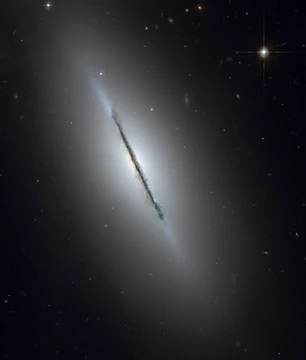
Hubble sequence
A morphological galaxy classification scheme published by Edwin Hubble in 1926.

H. Weaver (Johns Hopkins University) and NASA · Public domain
The Hubble sequence is a system for classifying galaxies by their shape, first published by Edwin Hubble in 1926. It is commonly called the Hubble tuning-fork diagram because its usual illustration looks like a tuning fork. The classification was originally devised by Edwin Hubble.
This tuning-fork scheme sorts regular galaxies into three broad categories—ellipticals, lenticulars, and spirals—based on how they appear visually, initially on photographic plates. A fourth category includes galaxies with irregular shapes. The Hubble sequence remains the most widely used galaxy classification system in both professional astronomy and amateur observing.
**Ellipticals**
On the left side of the diagram (as it is typically drawn) are elliptical galaxies. These have smooth, featureless light distributions and appear as ellipses in images. They are labeled with the letter E followed by an integer n, which represents their degree of ellipticity in the sky. By convention, n is ten times the galaxy’s ellipticity, rounded to the nearest integer, where ellipticity is defined as e = 1 − b/a for an ellipse with semi-major axis a and semi-minor axis b. Ellipticity increases from left to right on the diagram, with nearly circular E0 galaxies at the far left. A galaxy’s apparent ellipticity on the sky only indirectly relates to its true three-dimensional shape—for instance, a flattened, discus-shaped galaxy can look almost round if seen face-on or highly elongated if edge-on. The most flattened observed “elliptical” galaxies have an ellipticity of 0.7, designated E7. However, studies of light profiles and ellipticity profiles in the 1960s revealed that E5–E7 galaxies are likely misclassified lenticular galaxies with large-scale disks viewed at various inclinations. Kinematic observations of early-type galaxies later confirmed this. Examples of elliptical galaxies include M49, M59, M60, M87, and NGC 4125.
**Lenticulars**
At the center of the tuning fork, where the two spiral branches meet the elliptical branch, is an intermediate class called lenticulars, given the symbol S0. These galaxies have a bright central bulge, similar to an elliptical, surrounded by an extended disk. Unlike spirals, lenticular disks show no visible spiral structure and are not actively forming many stars. When viewed face-on, lenticulars can be hard to distinguish from E0–
- inventors
- Edwin Hubble
Lore & Background
The Hubble sequence divides regular galaxies into three broad classes – ellipticals, lenticulars, and spirals – based on their visual appearance on photographic plates, with a fourth class for irregular galaxies. Ellipticals are denoted by the letter E and an integer representing their ellipticity, ranging from near-circular E0 to E7. Lenticulars, given the symbol S0, consist of a bright central bulge surrounded by a disk-like structure with no visible spiral structure; at the time of Hubble's initial publication, they were purely hypothetical but later confirmed by observations. Spirals are split into two parallel branches: regular spirals (S) and barred spirals (SB), each subdivided by the tightness of their arms and bulge brightness, with types Sa, Sb, Sc, and later Sd added by Gérard de Vaucouleurs.
Reader's Guide
The Hubble sequence is the most commonly used system for classifying galaxies in both professional research and amateur astronomy. It organizes galaxies by visual appearance, with ellipticals on the left, lenticulars at the center, and spirals on two branches to the right. The sequence does not imply an evolutionary timeline, as Hubble emphasized that the classification is purely empirical. However, the terms 'early-type' (ellipticals and lenticulars) and 'late-type' (spirals and irregulars) persist, though current evidence suggests the early Universe was dominated by spirals and irregulars, with ellipticals forming later through mergers. The classification has been extended by de Vaucouleurs to include Sd spirals and Magellanic irregulars (Sm and Im). The sequence remains foundational for understanding galaxy morphology and evolution.
Did You Know?
- The Hubble sequence was invented by John Henry Reynolds and Sir James Jeans.
- Lenticular galaxies were purely hypothetical when Hubble first published the scheme.
- The Milky Way is generally classed as Sc or SBc, a barred spiral with well-defined arms.
- The Sd class of spiral galaxy was added by Gérard de Vaucouleurs.
Origins and the Evolution of the Scheme
The Hubble sequence traces its formal publication to Edwin Hubble in 1926, though the underlying morphological ideas were shaped earlier by John Henry Reynolds and Sir James Jeans. The scheme's enduring nickname—the Hubble tuning-fork diagram—comes from the distinctive forked shape of its traditional visual representation. What began as a three-branch division of regular galaxies (ellipticals, lenticulars, spirals) plus a catch-all irregular class has since become the single most widely adopted classification framework in both professional research and amateur stargazing. The system did not remain static: Gérard de Vaucouleurs later appended a fourth spiral subtype (Sd) for very loosely wound, fragmentary arms, and Allan Sandage produced what is regarded as the definitive written exposition of the sequence. Martha Liller identified a gap in the scheme in 1966, coining the label ES for early-type galaxies possessing intermediate-scale disks between E0 and S0. Each of these additions reflects how observational progress continually refined the original 1926 framework.
Ellipticals, Lenticulars, and the Misclassification Problem
On the left-hand side of the tuning-fork diagram sit the elliptical galaxies, identified by the letter E followed by an integer from 0 to 7. That integer encodes the galaxy's projected ellipticity on the sky—ten times the ratio (1 − b/a), rounded to the nearest whole number—so a perfectly round E0 sits at the far left while the most elongated E7 shows an ellipticity of 0.7. Crucially, this sky-projected shape only loosely reflects the true three-dimensional form; a flattened discus-shaped galaxy can look nearly circular when seen face-on yet highly stretched when viewed edge-on. A significant reclassification emerged in the 1960s when detailed light-profile and ellipticity-profile studies, later reinforced by kinematic observations, revealed that many E5–E7 objects are actually lenticular galaxies with large disks tilted at various angles. Lenticulars (S0) occupy the junction where the elliptical branch meets the two spiral arms. They feature a bright central bulge encircled by a disk that lacks visible spiral arms and shows little active star formation. Hubble originally postulated them as a necessary intermediate between flattened ellipticals and spirals, a hypothesis later confirmed by his own and others' observations.
The Two Spiral Branches and Their Grading
The right side of the tuning fork splits into two parallel arms: the upper branch holds unbarred spirals (S) and the lower branch holds barred spirals (SB). Both types share a flattened stellar disk, a central bulge, and—roughly half the time—a bar structure extending from the bulge with arms anchored at its ends. Within each branch, galaxies are graded by how tightly their arms are wound and how dominant the bulge appears. Sa (SBa) types show smooth, tightly coiled arms and a large, luminous bulge; Sb (SBb) types have somewhat looser arms and a fainter bulge; Sc (SBc) types display loosely wound arms resolved into individual clusters and nebulae with a smaller bulge. Gérard de Vaucouleurs added a fourth tier, Sd (SBd), for very loosely wound, fragmentary arms where most luminosity resides in the disk rather than the bulge. Intermediate appearances can be noted by combining two letters, such as Sbc. Our own Milky Way is generally assigned the Sc or SBc designation, placing it among barred spirals with well-defined arms.
Irregulars, Practical Use, and the Limits of Visual Classification
Galaxies that resist the tuning-fork structure—lacking any regular disk-like or ellipsoidal form—are grouped as irregulars. Hubble himself defined two subtypes, with Irr I galaxies showing asymmetric profiles and lacunae. Beyond this catch-all, the Hubble sequence remains the most commonly employed classification in both professional astronomy and amateur observation. Yet practical classification is fraught with ambiguity. A lenticular galaxy seen nearly face-on can be nearly indistinguishable from an E0–E3 elliptical, leaving many assignments uncertain. Only when the disk is viewed edge-on does it become prominent, sometimes revealing dust lanes in optical absorption. Similarly, the projected ellipticity of an elliptical galaxy bears only an indirect relationship to its true three-dimensional geometry. Lenticular and spiral galaxies together are often called disk galaxies, and the bulge-to-disk flux ratio varies across all morphological types, adding another layer of nuance to what is ultimately a visual, appearance-based system originally designed around photographic plates.
Gallery

Frequently Asked Questions
Who created the Hubble sequence and when?
Edwin Hubble devised this galaxy classification scheme and published it in 1926. It was originally designed to sort galaxies based on how they looked on photographic plates.
What exactly is the Hubble sequence?
It is a morphological system that groups galaxies into categories according to their visible shape. The most common visual representation of the scheme resembles a tuning fork, which is why fans often call it the Hubble tuning-fork diagram.
What are the main categories in the Hubble sequence?
Regular galaxies are sorted into three broad groups: ellipticals, lenticulars, and spirals. A fourth category is set aside for galaxies with irregular shapes that don't fit the other three.
Why is the Hubble sequence still important to astronomy fans?
Despite being nearly a century old, it remains the most widely used galaxy classification system in the field. Its simple visual logic makes it an accessible entry point for anyone exploring galactic morphology.
How does the Hubble sequence differ from just listing galaxy types?
Rather than a flat list, it arranges the categories in a structured progression that reflects gradual changes in shape and structure. This ordering helps observers and researchers quickly place a galaxy within a broader morphological context.
More in Galaxies And Their Properties 1-21
Spotted an error? Know more?
This is a living reference — every entry is fact-audited, and reader corrections feed straight into our audit queue. Suggest an edit · See this site's audit record