
BL Lacertae object
Active galactic nuclei with rapid variability and featureless spectra.

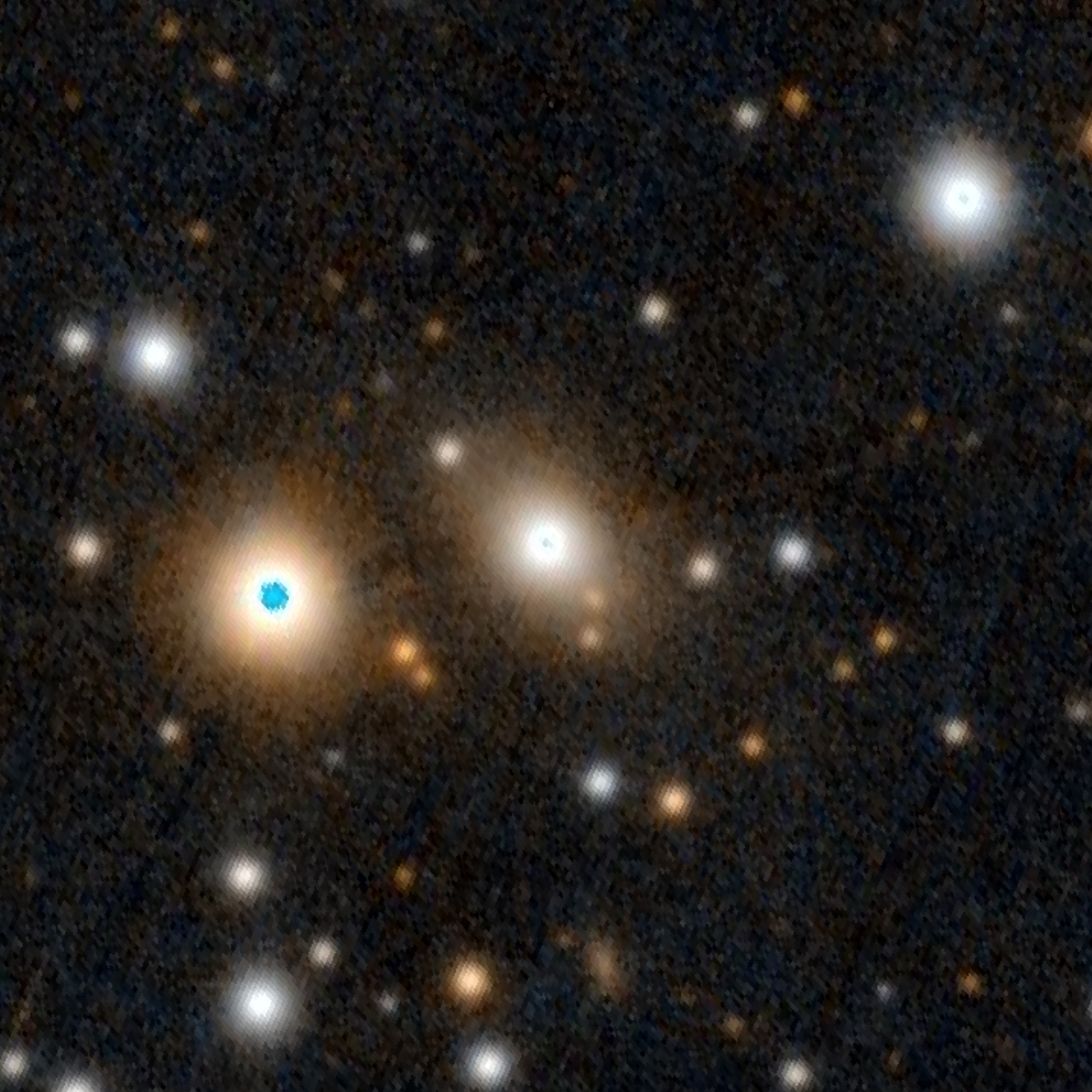
The Pan-STARRS1 Surveys (PS1) and the PS1 public science archive have been made · Public domain
BL Lacertae objects are a kind of active galactic nucleus—or a galaxy hosting one—named after the first example discovered, BL Lacertae. What sets them apart from other active galactic nuclei is their fast, dramatic changes in brightness and strong optical polarization. These traits initially led astronomers to mistake the prototype for a variable star. Unlike more luminous active nuclei such as quasars, which show strong emission lines, BL Lac objects display a spectrum dominated by a smooth, non-thermal glow across all wavelengths, with almost no spectral features. This lack of lines long made it difficult to figure out what they were or how far away they lay.
In the standard picture of radio-loud active galactic nuclei, the behavior we see from BL Lacs comes from a relativistic jet pointing almost directly at Earth. They are thought to be intrinsically the same as low-power radio galaxies. These active nuclei reside in massive elliptical galaxies. Within AGN classification, BL Lacs are a subtype of blazar. Every known BL Lac is linked to a core-dominated radio source, and many show apparent superluminal motion.
The blazar category includes all quasars whose relativistic jets are aimed at the observer, producing a distinctive radio spectrum. This group covers both BL Lacs and optically violent variable (OVV) quasars, though in everyday usage "blazar" and "BL Lac object" are often used as synonyms. OVV quasars tend to be brighter and have stronger emission lines than BL Lac objects. Examples include BL Lacertae itself, OJ 287, AP Librae, PKS 2155-304, PKS 0521-365, Markarian 421, 3C 371, W Comae Berenices, ON 325, and Markarian 501.
**Host galaxies**
Soon after this unusual class was recognized, astronomers noticed a faint haze around the sources. In the late 1970s, modern detectors like CCDs allowed closer study of that haze. A major survey using the Hubble Space Telescope in 2000 examined 132 BL Lac objects from seven complete radio, X-ray, and optically selected samples, looking at the shapes of possible host galaxies. The data showed that host galaxies were detected in two-thirds of the BL Lac images, including nearly all with redshifts below 0.5. For objects with re
- field
- Astronomy
- known_for
- Rapid flux variability, significant optical polarization, featureless non-thermal continuum, and being a blazar subtype
- prototype
- BL Lacertae
- host_galaxy_type
- Massive elliptical galaxies
- classification
- Blazar subtype
Lore & Background
John L. Schmitt identified the optical counterpart of BL Lac in 1968, matching it with the radio source VRO 42.22.01. Shortly thereafter, other astronomers noted its peculiar nature—rapid variability and strong polarization. The term 'BL Lac object' was already in use by 1972, and while Peter Albert Strittmatter contributed to the study of these objects, the specific claim that he 'proposed the class' and 'added four objects' is not standardly attributed as such. By 1976 there were 30 known objects. In 2017, a very high energy neutrino was detected by the IceCube project apparently coming from BL Lac object TXS 0506+056.
Soon after the discovery of this unusual class of objects it was noted that the sources were surrounded by a faint nebulosity. In the late 1970s the use of modern detectors (such as CCD) allowed observers to probe with better accuracy the nature of the nebulosity. The first resolved images of a BL Lac host galaxy, PKS 0548-322, were obtained later in the late 1970s, not in 1974; Michael John Disney's 1974 work did not resolve the host galaxy as a giant elliptical.
Reader's Guide
BL Lacertae objects are significant in astrophysics as a subtype of blazar, which are active galactic nuclei with relativistic jets aligned closely to the observer's line of sight. Their rapid and large-amplitude flux variability and significant optical polarization distinguish them from other AGN types. The lack of strong emission lines in their spectra historically made it difficult to determine their nature and distance, but they are now understood to be intrinsically identical to low-power radio galaxies hosted in massive elliptical galaxies. In the unified scheme of radio-loud AGN, their observed properties are interpreted as effects of the relativistic jet. All known BL Lacs are associated with core-dominated radio sources, many exhibiting apparent superluminal motion. The Hubble Space Telescope survey of 132 BL Lac objects in 2000 found that host galaxies are detected in two-thirds of images, with a de Vaucouleurs profile preferred at over 99% confidence, and that these ellipticals are very luminous, comparable to the brightest cluster galaxies. The detection of a very high energy neutrino from TXS 0506+056 in 2017 highlights their potential as sources of high-energy cosmic particles.
Did You Know?
- BL Lacertae objects are named after their prototype, BL Lacertae, which was originally thought to be a variable star.
- In the unified scheme of radio-loud AGN, BL Lacs are thought to be intrinsically identical to low-power radio galaxies.
- A 2000 Hubble Space Telescope survey of 132 BL Lac objects found that a de Vaucouleurs profile is preferred for host galaxies at over 99% confidence.
- In 2017, a very high energy neutrino was detected by the IceCube project apparently coming from BL Lac object TXS 0506+056.
From Curiosity to a Class of Its Own
In 1968, astronomer John L. Schmitt made a serendipitous connection that would reshape our understanding of the sky. While cross-referencing optical and radio catalogs, he matched the peculiar source BL Lacertae with the radio object designated VRO 42.22.01, revealing that this odd star-like smudge was something far stranger than a simple variable star. Within a year of that identification, other observers confirmed that the radio emission from the source fluctuated noticeably and that its visible light carried a measurable degree of polarization—traits that set it apart from ordinary stellar objects. Peter Albert Strittmatter took the next critical step in 1972 by formally proposing that BL Lacertae represented an entirely new class of active galaxy and by cataloguing four additional members alongside the prototype. The community's enthusiasm was immediate: by 1976, the known population had already swelled to thirty objects. What began as one puzzling entry in a catalog thus became, in barely a decade, a recognized family of extragalactic phenomena demanding its own theoretical framework.
A Spectrum Without a Fingerprint
What makes BL Lacertae objects so visually striking—and so historically confusing—is the character of their light. Unlike quasars, whose spectra blaze with bright emission lines from ionized gas, a BL Lac's output across the entire electromagnetic spectrum is dominated by a smooth, featureless non-thermal continuum. There are no obvious spectral lines to anchor a redshift measurement, no familiar atomic fingerprints to identify the source's composition or distance. This spectral barrenness meant that for years after the class was recognized, astronomers struggled to pin down even the basic nature and location of these objects. Compounding the difficulty, BL Lacs display rapid, large-amplitude flux variability and significant optical polarization—behaviors that, in the prototype BL Lacertae, initially led observers to classify it as nothing more than a variable star. It was only through the radio cross-identification and the recognition of the broader class that the true extragalactic identity of these sources became clear. The very properties that make BL Lacs so photometrically dramatic are the same ones that made them so hard to place in the cosmic landscape.
Pointing the Jet at Us
In the modern unified picture of radio-loud active galactic nuclei, a BL Lac object is essentially a low-power radio galaxy whose relativistic jet happens to be aimed almost directly at Earth. This near-perfect alignment between the jet axis and the observer's line of sight is what produces the distinctive phenomenology: the boosted, Doppler-shifted emission that gives BL Lacs their characteristic radio spectrum and their rapid variability. Every known BL Lac is associated with a core-dominated radio source, and many display apparent superluminal motion—evidence of material moving at relativistic speeds along the jet. Within the broader blazar category, which also includes optically violent variable (OVV) quasars, BL Lacs occupy the lower-luminosity, weaker-emission-line end of the spectrum. OVV quasars, by contrast, shine more brightly and show stronger line features. In everyday astronomical usage, however, the terms "blazar" and "BL Lac object" are frequently treated as synonyms, reflecting how tightly the two concepts have become intertwined in the literature.
The Elliptical Cradles
Almost immediately after BL Lac objects were recognized as a distinct class, observers noted a faint nebulosity surrounding the bright nuclear source. In 1974, Michael John Disney's multi-filter images of PKS 0548-322 revealed that this glow belonged to a giant elliptical galaxy with a luminous core. The late 1970s brought CCD detectors, which allowed much more precise characterization of these host systems. The definitive test came in 2000, when a Hubble Space Telescope survey examined 132 BL Lac objects drawn from seven complete radio, X-ray, and optical samples. In roughly two-thirds of the images, a host galaxy was clearly detected, and nearly all sources at redshifts below 0.5 showed one. For the 72 resolved hosts, a de Vaucouleurs brightness profile was strongly preferred at over 99 percent confidence, and the survey placed an upper limit of just 8 percent on the fraction of disk-shaped hosts. The median K-corrected absolute magnitude of about −23.7 places these ellipticals among the most luminous galaxies known, rivaling the brightest members of rich clusters.
Gallery
Frequently Asked Questions
What is a BL Lacertae object?
A BL Lacertae object is a type of active galactic nucleus characterized by rapid brightness fluctuations, strong optical polarization, and a smooth, featureless non-thermal spectrum. It is one of the recognized subtypes of blazars, named after the prototype galaxy BL Lacertae, the first of its kind ever identified.
How are BL Lacertae objects different from quasars?
While both are active galactic nuclei, quasars typically display bright, prominent emission lines in their spectra, whereas BL Lac objects show almost no identifiable spectral features at all. Instead, BL Lac spectra are dominated by a continuous, non-thermal glow that stretches across the electromagnetic spectrum without the line signatures you'd expect from a quasar.
Why did astronomers originally mistake BL Lacertae for a variable star?
The prototype's rapid and dramatic shifts in brightness, combined with its strong optical polarization, made it look remarkably like a nearby variable star rather than a distant galaxy. It was only later that its true nature as an active galactic nucleus within a massive elliptical galaxy was confirmed.
What kind of galaxies host BL Lacertae objects?
BL Lacertae objects reside in massive elliptical galaxies, which are large, round systems dominated by older stellar populations. The active nucleus at their center powers the extreme variability and the smooth continuum emission that define this blazar subtype.
What does it mean that BL Lacertae objects are a blazar subtype?
Being a blazar subtype means the relativistic jet from the central black hole is pointed almost directly toward Earth, amplifying the observed brightness and variability. BL Lac objects occupy a specific niche within blazars, distinguished by their nearly featureless spectra and the absence of strong emission lines that other blazar classes, like FSRQs, do show.
More in Galaxies And Their Properties 1-21
Spotted an error? Know more?
This is a living reference — every entry is fact-audited, and reader corrections feed straight into our audit queue. Suggest an edit · See this site's audit record