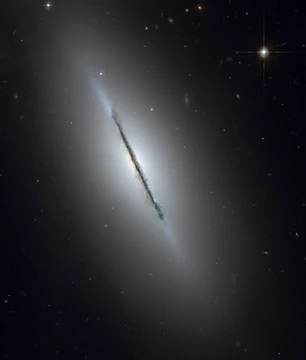
Interacting galaxy
Galaxies whose gravity disturbs one another.

NASA, ESA, the Hubble Heritage (STScI/AURA)-ESA/Hubble Collaboration, and A. Eva · Public domain
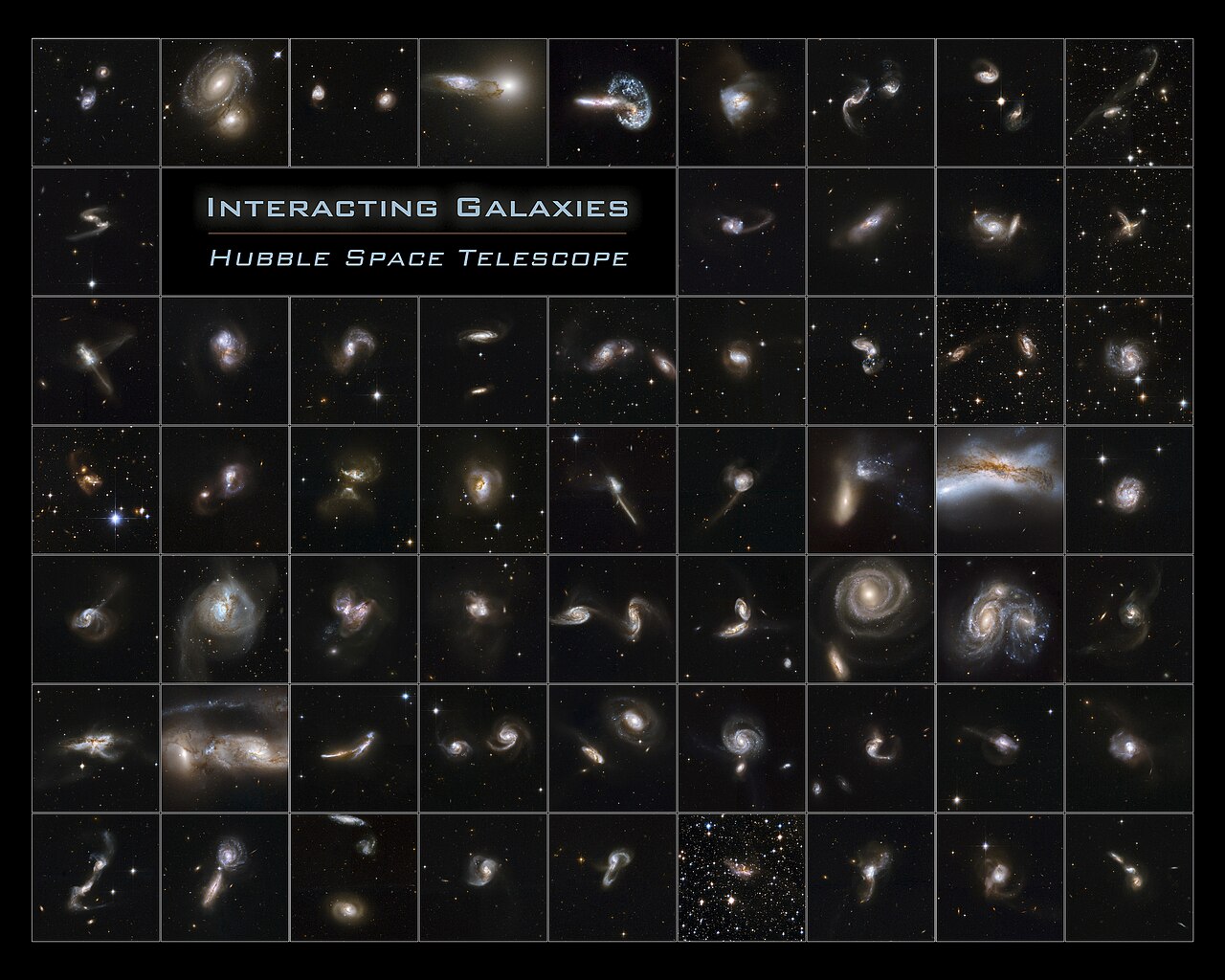
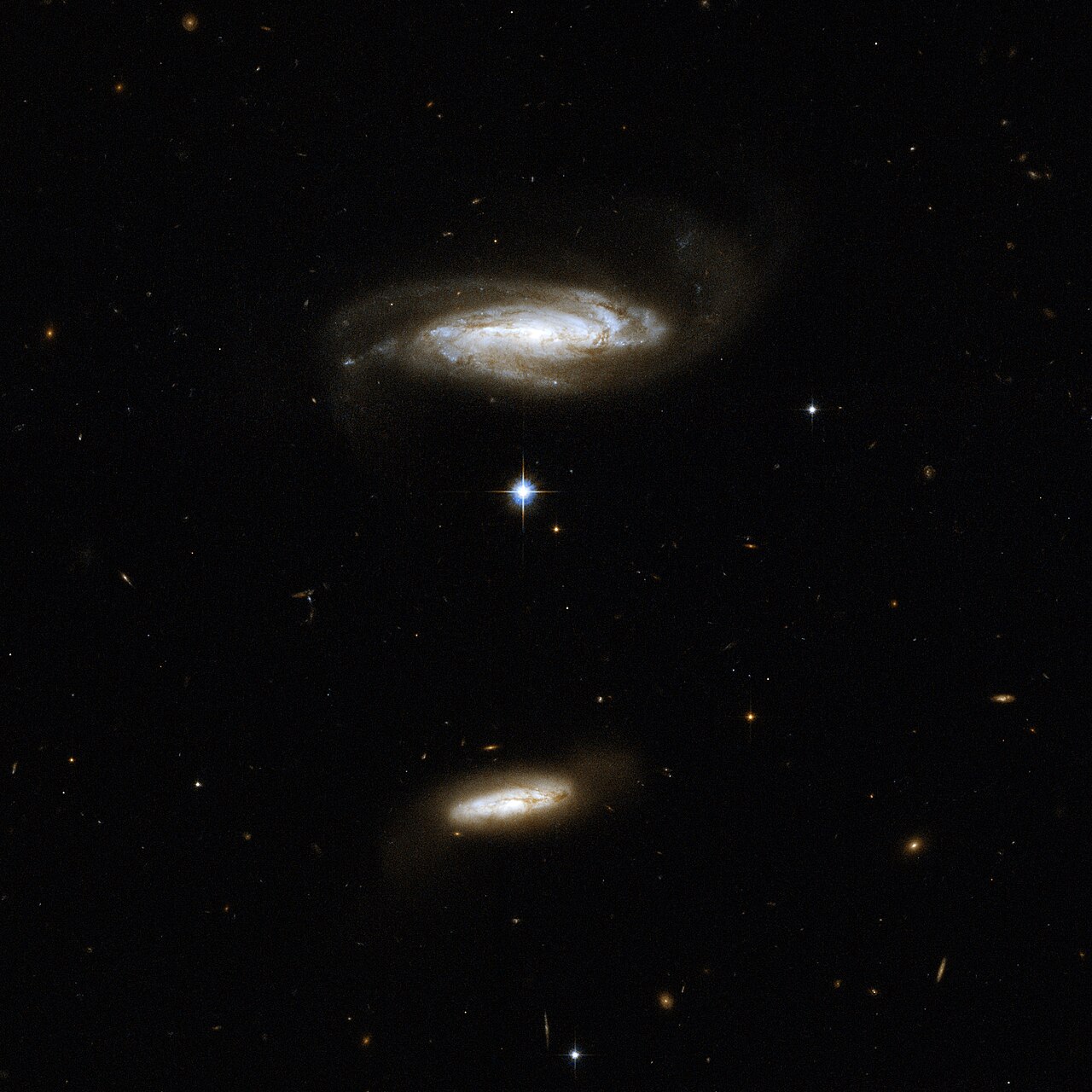
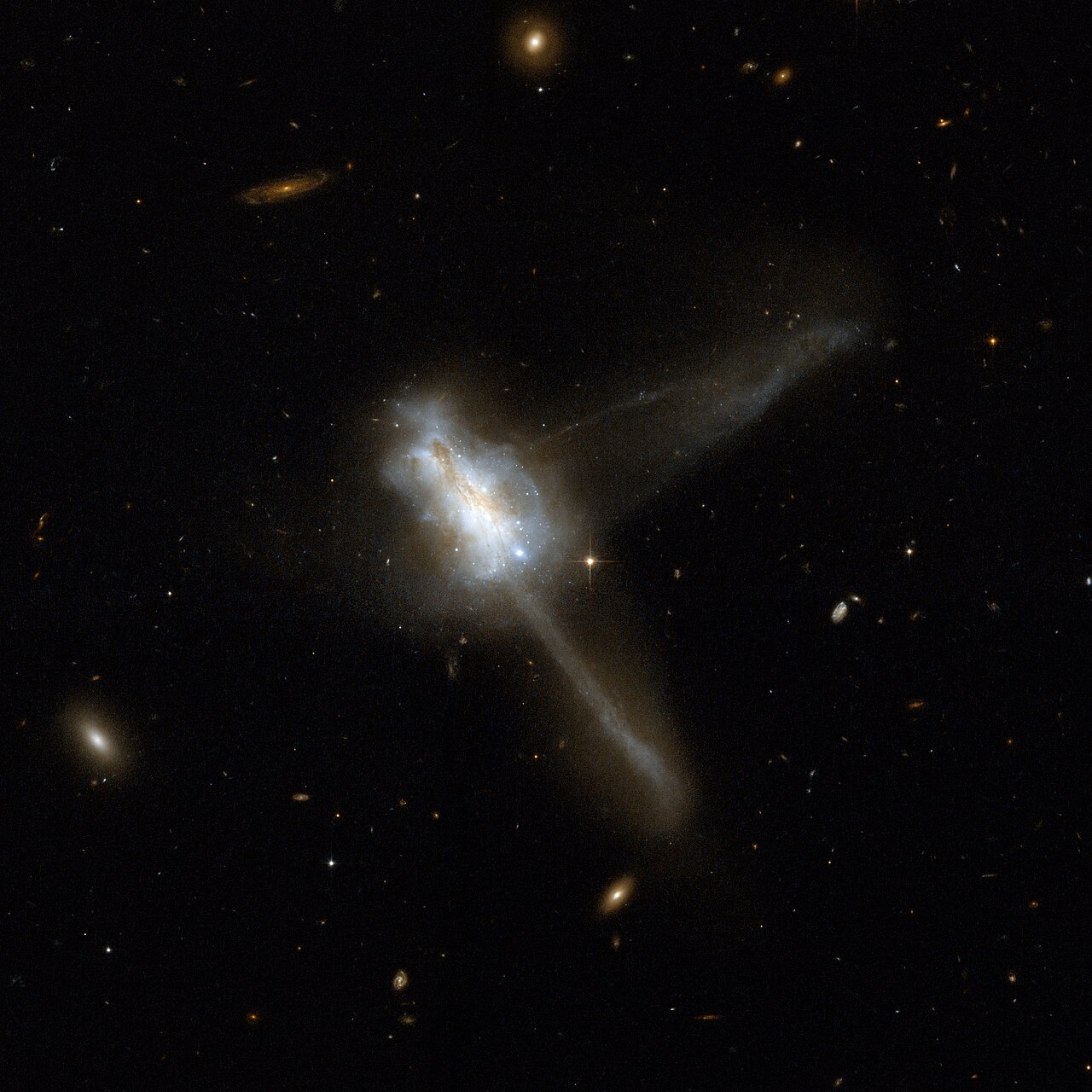
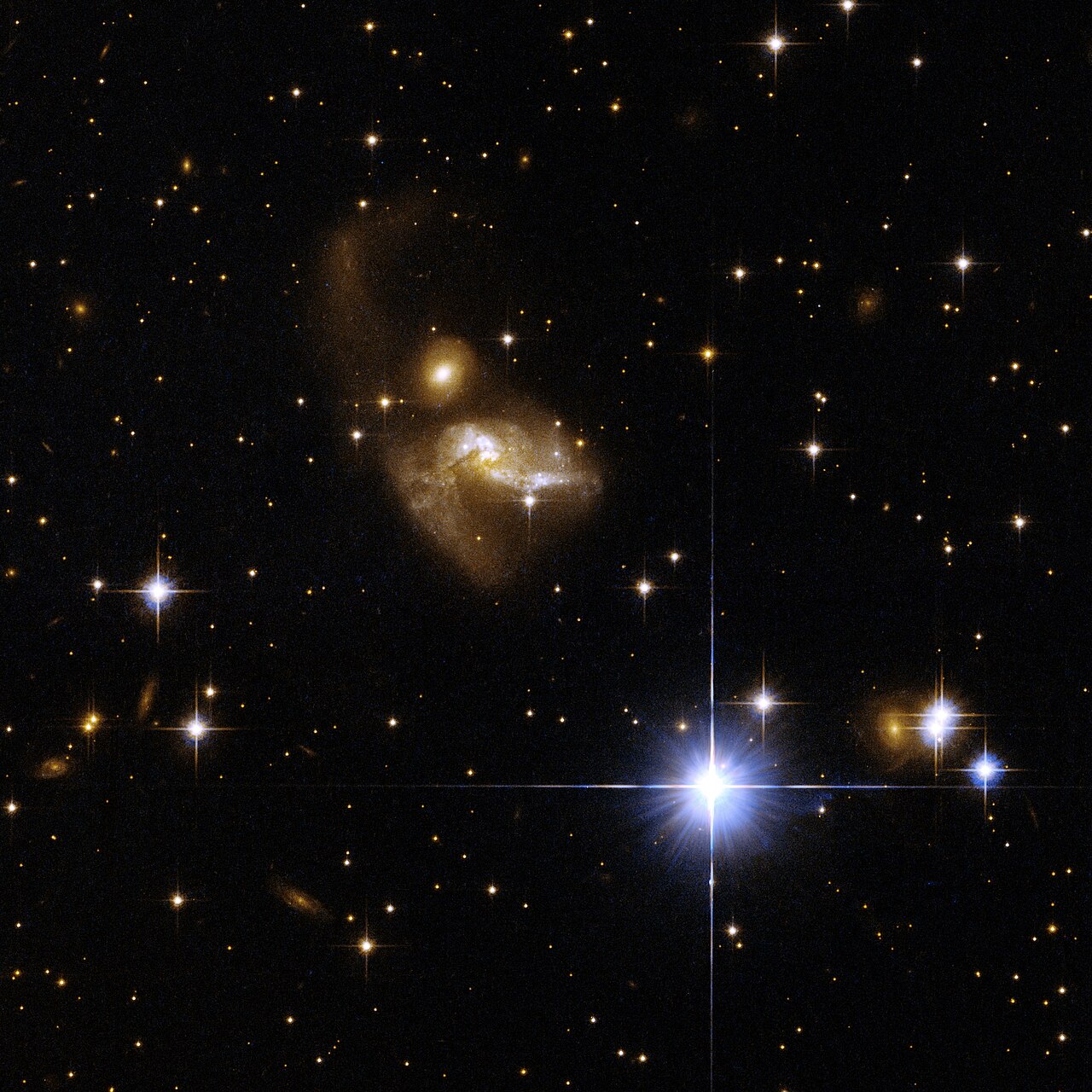
Interacting galaxies, also called colliding galaxies, occur when two or more galaxies affect each other through their gravitational fields. These interactions are a normal part of galaxy evolution and can trigger star formation, black hole activity, and mergers.
There are several types of interactions. Major interactions happen between galaxies of roughly equal mass, while minor interactions involve galaxies with very different masses. In a minor interaction, a satellite galaxy might disturb the spiral arms of a larger galaxy. A major interaction, like the future collision predicted between the Milky Way and Andromeda, can lead to a merger.
Satellite interactions are common. A satellite’s gravity can pull on one of the larger galaxy’s spiral arms, or the satellite can dive into the larger galaxy, as the Sagittarius Dwarf Elliptical Galaxy is doing into the Milky Way. This may trigger a small amount of star formation. Clusters of stars formed this way were once called "blue blobs" before their origin was understood.
Galaxy collisions are not collisions in the usual sense, because galaxies are mostly empty space. Instead, they are gravitational interactions that can change a galaxy’s shape, size, and star formation. If two colliding galaxies lack enough momentum to keep moving apart, they may merge. Mergers can create a starburst region of new stars. A 2024 study found that the increase in star formation rate depends on the masses of the galaxies: if they are similar in mass, the increase is greater. After many passes through each other, the galaxies eventually merge into one. If one galaxy is much larger, it stays mostly intact while the smaller one is stripped and absorbed. When galaxies simply pass through each other without merging, they keep most of their material and shape.
Computer simulations now model galaxy collisions using realistic physics, including gravity, gas dissipation, star formation, and feedback. Dynamical friction slows the relative motion of galaxy pairs, which may eventually merge depending on their initial orbital energy. A library of such simulations is available on the GALMER website at the Paris Observatory.
Galaxy harassment happens in rich galaxy clusters like Virgo and Coma, where galaxies move at high speeds and have frequent encounters due to the high density. Computer simulations show that these interactions turn galaxy d
- type
- Astronomical phenomenon
- field
- Astronomy
- known_for
- Gravitational interactions between galaxies
- key_types
- Major interactions, minor interactions, galaxy harassment
- notable_example
- Milky Way–Andromeda collision
Lore & Background
Interacting galaxies include major interactions between galaxies of similar mass and minor interactions where masses vary significantly. An example of a minor interaction is a satellite galaxy disturbing the primary galaxy's spiral arms. A major interaction, such as a galactic collision, can lead to mergers and other phenomena like star formation and black hole activity. Collisions are not traditional impacts but gravitational interactions due to the tenuous distribution of matter in galaxies.
Galaxy harassment is a well-supported mechanism in rich galaxy clusters, where high relative speeds and frequent encounters convert low-luminosity spiral galaxies into dwarf spheroidals and dwarf ellipticals. This hypothesis remains robust, as isolated dwarf ellipticals are rare, and the presence of similar structures in such isolated cases does not undermine the consensus that harassment is a key driver of galaxy evolution in dense cluster environments.
Reader's Guide
Interacting galaxies are significant because they shape galaxy evolution through gravitational disturbances, leading to star formation, mergers, and black hole activity. The study of these interactions helps astronomers understand how galaxies change over time, including the future collision of the Milky Way and Andromeda. Computer simulations, such as those on the GALMER website, model these processes using realistic physics. The 2024 study highlighted that the masses of colliding galaxies determine the increase in star formation rate, with similar-mass galaxies producing greater starbursts. Galaxy harassment in clusters explains the transformation of spiral galaxies into dwarf ellipticals, though evidence remains debated. Overall, interacting galaxies provide a key framework for understanding cosmic evolution.
Did You Know?
- Galactic collisions are not traditional impacts but gravitational interactions due to the extremely tenuous distribution of matter in galaxies.
- A 2024 study suggests that if two colliding galaxies are of similar mass, the increase in star formation rate will be greater.
- Galaxy harassment occurs within rich galaxy clusters like Virgo and Coma, where galaxies move at high relative speeds.
- The Milky Way is estimated to collide with the Andromeda Galaxy in about 4.5 billion years.
Discovery and the Long Road to Recognition
The Whirlpool Galaxy entered the astronomical record on October 13, 1773, when Charles Messier catalogued it as M51 while scanning the sky for objects that might be mistaken for comets. For nearly a century it remained just another faint smudge until William Parsons, the 3rd Earl of Rosse, peered through his 72-inch reflector at Birr Castle in Ireland and resolved a spiral pattern, making M51 the first nebula ever confirmed to possess one. Yet these spiral nebulae were still assumed to be gaseous clouds within our own Milky Way. That misconception finally collapsed when Edwin Hubble identified Cepheid variable stars inside several spiral nebulae, proving their distances were far too great for them to belong to our galaxy. The true nature of M51's relationship with its neighbor NGC 5195 was not settled until the radio era. Radio observations mapped the distribution of gas between the two systems and demonstrated that they are physically connected, confirming beyond doubt that they are gravitationally interacting. In that context the pair is sometimes collectively called M51, with the individual members labeled M51a (NGC 5194) and M51b (NGC 5195).
Spiral Arms Forged by Collision
The Whirlpool Galaxy displays two bold spiral arms that wind in a clockwise direction, with one arm deviating noticeably from a steady pitch angle. Astronomers attribute this striking grand-design pattern not to internal dynamics alone but to the gravitational tug of its companion, NGC 5195. In the leading scenario, NGC 5195 threaded through the main disk of M51 roughly 500 to 600 million years ago, arriving from behind and emerging toward the observer. A second disk crossing may have occurred as recently as 50 to 100 million years ago, leaving NGC 5195 in its present position slightly behind M51. The encounter left a spectacular trail of tidal debris. The most prominent of these is the Northwest plume, a vast stream of diffuse gas stretching 43 kiloparsecs, about 140,000 light-years, from the galactic center, its uniform color suggesting it originated in the Whirlpool itself. Two slightly bluer Western plumes sit adjacent to it. A 2015 study identified yet another pair, the Northeast and South plumes, and noted that a simulation modeling only a single disk passage cannot reproduce the Northeast tail, reinforcing the multi-encounter history.
A Galaxy for Every Kind of Eye
Locating M51 is straightforward for northern-hemisphere observers: find Alkaid, the easternmost star of the Big Dipper, and look roughly 3.5 degrees southwest. Its declination near +47 degrees makes it circumpolar for anyone above the 43rd parallel, and it rides high in the sky from early November through late May. Under a dark sky, even binoculars reveal the pair. A 100 mm telescope brings out the basic 5-by-6-arcminute outlines of both galaxies, while a 150 mm instrument with a moderate eyepiece can coax the intrinsic spiral pattern into view. Apertures above 300 mm, under the darkest conditions, expose individual spiral bands, glowing H II regions, and the visible attachment between M51a and M51b. The full extent of the system is only apparent in long-exposure photographs, which reveal a vast nebulous halo far beyond the bright circular core. In 1984, Hua and colleagues used a high-speed image-photon-counting detector at the 3.6-metre Canada-France-Hawaii Telescope on Mauna Kea to resolve the double component of the nucleus. A January 2005 Hubble Heritage composite, built from ACS data at 11,500 by 8,000 pixels, rendered the spiral arms in remarkable detail. In 2022, the James Webb Space Telescope added mid-infrared observations through MIRI for the FEAST project.
Mass, Age, and the Active Heart
At a distance of roughly 23 to 31 million light-years, the Whirlpool Galaxy is close enough by galactic standards to be a workhorse for interaction studies. Its diameter, measured from the 1991 Third Reference Catalogue of Bright Galaxies using the B-band D25 isophote, spans 23.58 kiloparsecs, about 76,900 light-years, making it roughly 88 percent the size of the Milky Way. Its total mass is estimated at 160 billion solar masses, approximately 10.3 percent of our own galaxy's, and its age is placed at around 400 million years. At the very center lies a Seyfert 2 active galactic nucleus powered by a black hole. Early interpretations suggested the black hole was encircled by a complete ring of dust, but current understanding favors a geometry in which the dust only partially obscures the engine. A pair of ionization cones projects outward from the nucleus, carving visible signatures into the surrounding gas. Because of its proximity, its well-defined spiral structure, and its ongoing gravitational dialogue with NGC 5195, the M51 pair has become one of the most frequently modeled interacting systems in the field, serving as a benchmark for theories of galaxy evolution and arm formation.
Gallery
Frequently Asked Questions
What is an interacting galaxy?
An interacting galaxy refers to a situation where two or more galaxies gravitationally influence one another, sometimes called a colliding galaxy. Rather than a physical crash, it is the mutual gravitational pull that reshapes their structures and dynamics.
What types of interacting galaxies are there?
Astronomers classify them into major interactions (between galaxies of similar mass), minor interactions (where a much smaller satellite disturbs a larger host), and galaxy harassment (repeated close encounters that strip material over time).
What does a galaxy interaction actually trigger?
The gravitational stirring can ignite bursts of new star formation, wake dormant supermassive black holes into active states, and ultimately drive the two systems to merge into a single larger galaxy.
What is the most famous example of an interacting galaxy pair?
The Milky Way and Andromeda (M31) are predicted to undergo a major interaction in roughly 4.5 billion years, eventually coalescing into one large elliptical galaxy.
Why do astronomers care about interacting galaxies?
These encounters are a routine stage in galactic evolution, so studying them reveals how spiral arms get distorted, how star-formation rates spike, and how the universe's largest structures grow over cosmic time.
More in Galaxies And Their Properties 1-21
Spotted an error? Know more?
This is a living reference — every entry is fact-audited, and reader corrections feed straight into our audit queue. Suggest an edit · See this site's audit record