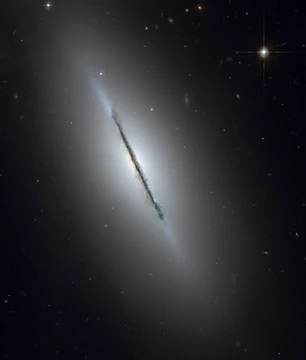
Dwarf elliptical galaxy
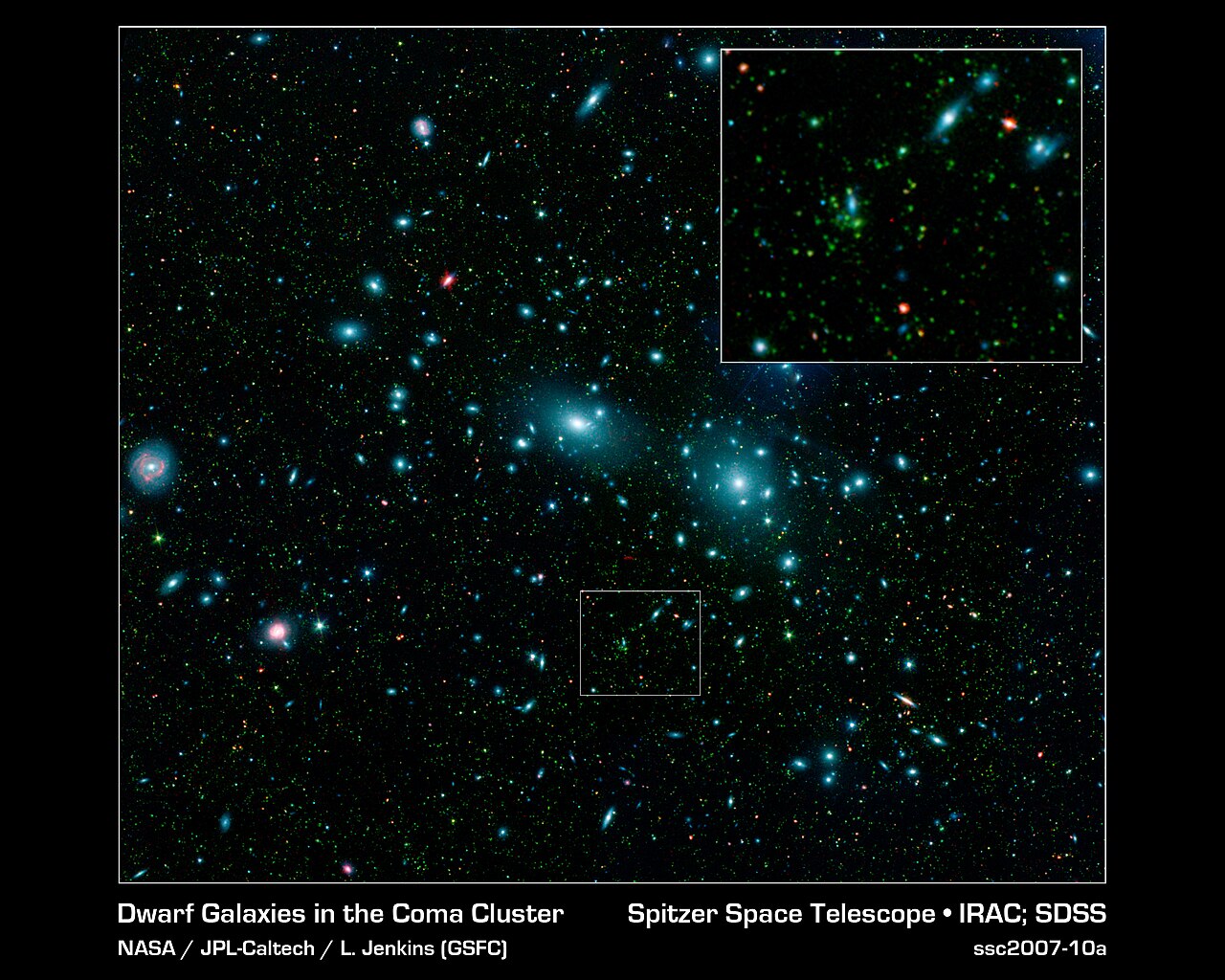
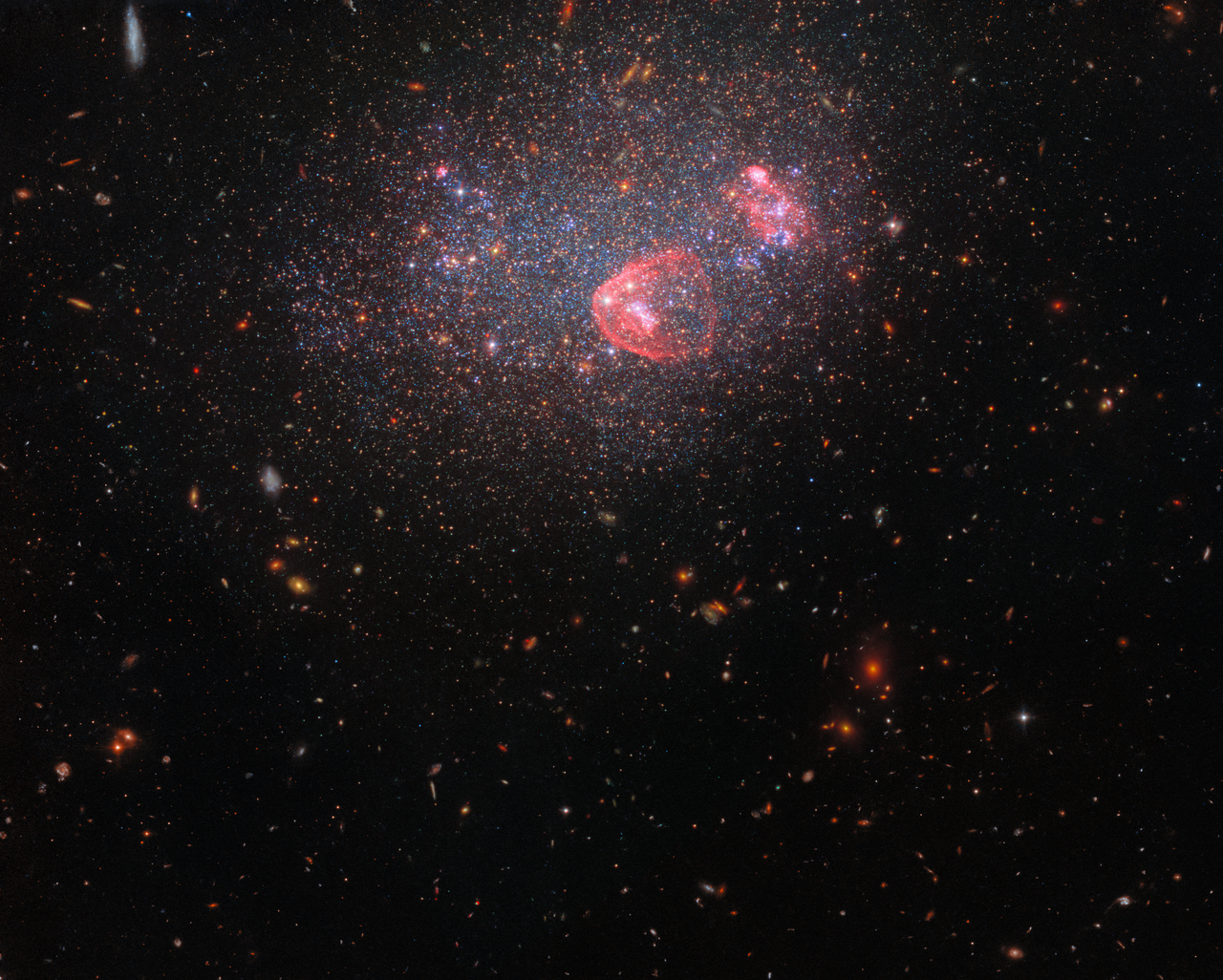
Small elliptical galaxies common in groups and clusters.

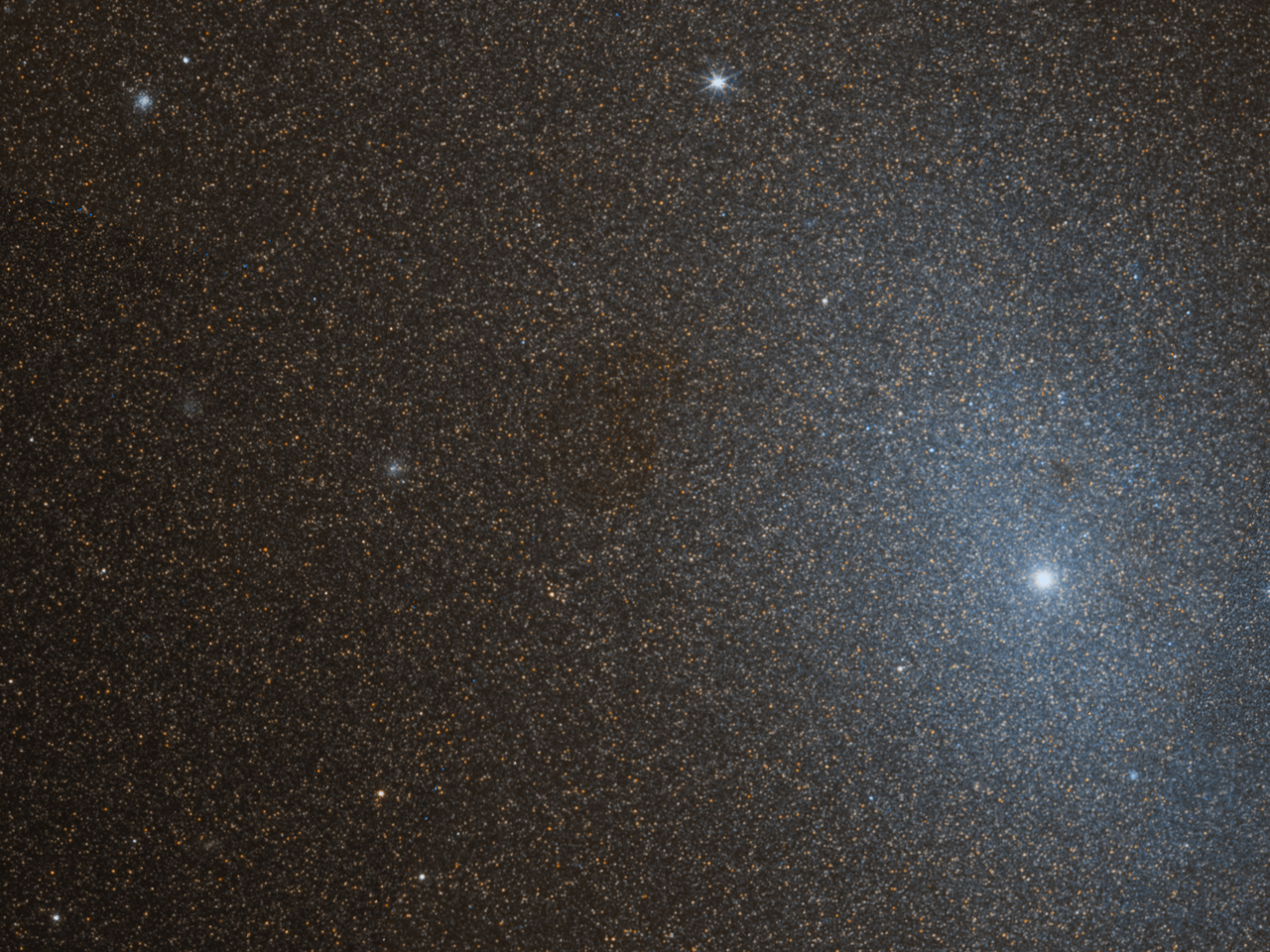
NASA Hubble · CC BY 2.0
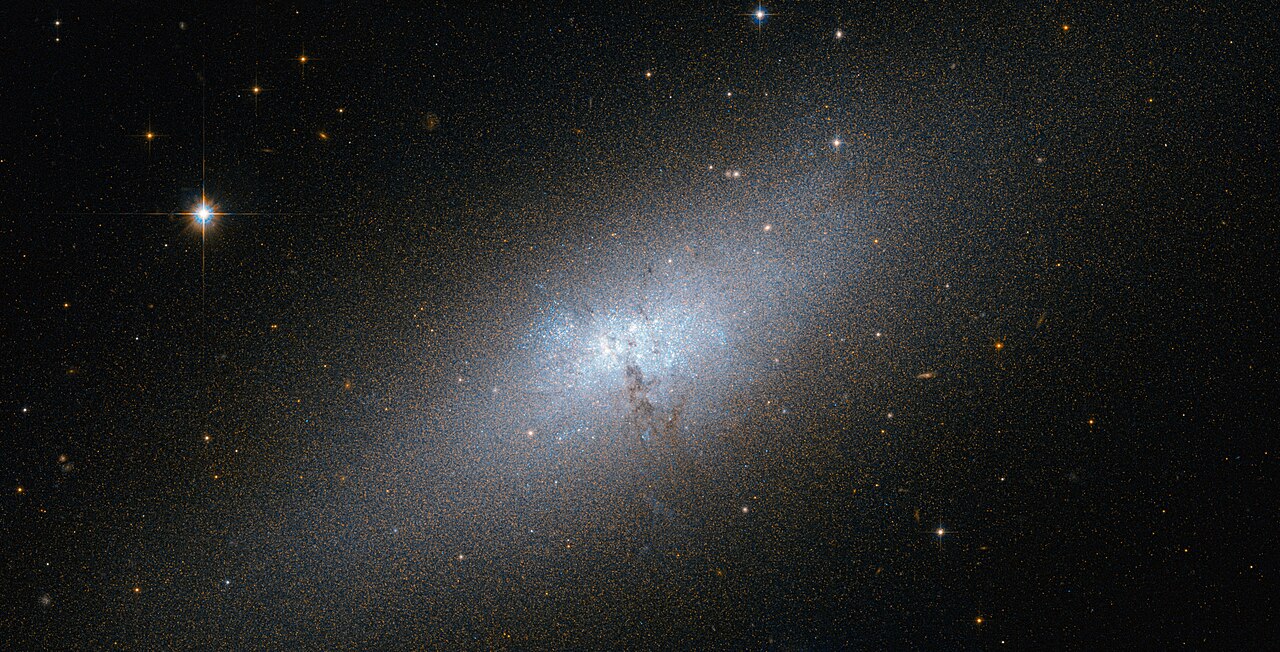
Dwarf elliptical galaxies, or dEs, are a smaller type of elliptical galaxy. They are frequently found in galaxy groups and clusters, often as companions to larger galaxies. It is important not to confuse them with the rare "compact elliptical" class, whose prototype is M32, a satellite of the Andromeda Galaxy. In 1944, Walter Baade confirmed that NGC 147 and NGC 185 were dwarf ellipticals in the Local Group by resolving them into individual stars, thanks to their relative proximity. During the 1950s, similar galaxies were discovered in the Fornax and Virgo clusters.
These galaxies have blue absolute magnitudes between −18 and −14, making them fainter than ordinary ellipticals. While ordinary ellipticals were once described using de Vaucouleur's surface brightness model and dEs with an exponential profile, both types now fit well with the more general Sérsic model. The continuity of the Sérsic index with galaxy luminosity suggests that dwarf and ordinary ellipticals belong to a single sequence. An even fainter type, dwarf spheroidal galaxies, may be a genuinely distinct class.
The origins of dwarf ellipticals are debated. In the Lambda-CDM cosmological model, small objects of dark matter and gas formed first, then coalesced and merged into larger structures—a process called hierarchical merging. If correct, dwarf galaxies could be the building blocks of today's large spirals, which themselves merge to form giant ellipticals. Alternatively, dEs might be the remnants of low-mass spiral galaxies reshaped by repeated gravitational interactions within a cluster, a process known as "galaxy harassment." Evidence for this includes stellar disks and weak spiral arms seen in some dEs. However, the highly isolated dwarf elliptical CG 611 shows the same features—coherent rotation and faint spiral arms—plus a gas disk counter-rotating to its stellar disk, indicating growth via accretion. If CG 611 entered a cluster, ram-pressure stripping would remove its gas, leaving a gas-poor dE without needing to remove stars or reshape the galaxy. This undermines the idea that all dEs were once spirals.
- type
- Galaxy class
- magnitude_range
- Blue absolute magnitudes −18 < MV < −14
- common_locations
- Galaxy groups and clusters
- distinct_from
- Compact elliptical galaxies (e.g., M32) and dwarf spheroidal galaxies
- key_discoverers
- Walter Baade (1944, confirmed NGC 147 and NGC 185 as Local Group members)
Lore & Background
An alternative suggestion is that dEs could be the remnants of low-mass spiral galaxies that obtained a rounder shape through the action of repeated gravitational interactions with ordinary galaxies within a cluster. This process of changing a galaxy's morphology by interactions, and the removal of much of its stellar disk, has been called 'galaxy harassment'. Evidence for this latter hypothesis has been claimed due to stellar disks and weak spiral arms seen in some dEs. However, the highly isolated dwarf elliptical galaxy CG 611 possesses the same physical attributes as dE galaxies in clusters – such as coherent rotation and faint spiral arms – attributes that were previously assumed to provide evidence that dE galaxies were once spiral galaxies prior to a transformation process requiring immersion with a cluster of galaxies. CG 611 has a gas disk which counter-rotates to its stellar disk, clearly revealing that this dE galaxy's disk is growing via accretion events. If CG 611 was to fall into a galaxy cluster, ram-pressure stripping by the cluster's halo of hot X-ray gas would strip away CG 611's gas disk and leave a gas-poor dE galaxy that immediately resembles the other dEs in the cluster, undermining the idea that dE galaxies were once spiral galaxies.
Reader's Guide
Dwarf elliptical galaxies are significant because they represent a common but poorly understood class of galaxies that may hold clues to the earliest stages of galaxy formation. Their surface brightness profiles were formerly approximated using an exponentially declining model, while ordinary ellipticals used de Vaucouleur's model; however, both types fit well by Sersic's model, showing a continuity of Sersic index as a function of galaxy luminosity. This is interpreted as showing that dwarf elliptical and ordinary elliptical galaxies belong to a single sequence. The debate over their origins—whether they are primordial building blocks in hierarchical merging or transformed spiral galaxies via harassment—remains unresolved. The discovery of CG 611, an isolated dE with a counter-rotating gas disk, challenges the harassment scenario by showing that gas accretion and subsequent stripping could produce dE-like properties without requiring a spiral progenitor. An even-fainter type, dwarf spheroidal galaxies, may be a genuinely distinct class. Understanding dEs thus informs models of galaxy evolution, dark matter structure, and the role of environment in shaping galaxies.
Did You Know?
- Dwarf elliptical galaxies have blue absolute magnitudes within the range −18 < MV < −14, fainter than ordinary elliptical galaxies.
- In 1944 Walter Baade confirmed dwarf ellipticals NGC 147 and NGC 185 as members of the Local Group by resolving them into individual stars.
- The isolated dwarf elliptical galaxy CG 611 has a gas disk that counter-rotates to its stellar disk, indicating growth via accretion events.
- Dwarf elliptical and ordinary elliptical galaxies fit well by Sersic's model, showing a continuity of Sersic index as a function of galaxy luminosity.
Classification & Taxonomic Place
Dwarf elliptical galaxies occupy a specific niche within the broader family of elliptical galaxies, which Edwin Hubble identified as one of three principal galaxy classes alongside spirals and lenticulars in his 1936 work The Realm of the Nebulae. Together with lenticular (S0) galaxies and ES galaxies possessing intermediate-scale disks, ellipticals form what astronomers call the "early-type" population. Dwarf ellipticals sit at the smallest end of the elliptical spectrum, containing only tens of millions of stars compared to the supergiants that exceed one hundred trillion. They are not the dominant galaxy type in the universe overall, and in the Virgo Supercluster they account for roughly 10 to 15 percent of all galaxies. Their placement within this early-type group distinguishes them from the more structured, disk-dominated spiral galaxies, though the boundary between categories can blur, as some objects once classified as ellipticals turned out to be inclined lenticular disks viewed at particular angles.
Stellar Composition & Visual Character
Dwarf elliptical galaxies are dominated by older, low-mass stars, giving them a distinctly red hue compared to the bluer stellar populations found in spiral galaxies. Their interstellar medium is remarkably sparse, containing very little gas or dust, which means star formation activity is typically minimal. This scarcity of star-making material also results in few open star clusters and very few young stars. When star formation does occur, it is generally brief and triggered by interactions such as mergers with other galaxies. Unlike the organized, flat disks of spiral galaxies, dwarf ellipticals are more three-dimensional in structure, with their stars following somewhat random orbits around the galactic center rather than tracing orderly spiral arms. The overall appearance is smooth and nearly featureless, lacking the dramatic structural elements that characterize disk galaxies. This combination of ancient stellar populations, minimal interstellar material, and random orbital dynamics gives dwarf ellipticals their characteristic quiet, featureless look.
Size, Dark Matter & Structural Distinctiveness
Dwarf elliptical galaxies represent the smallest members of the elliptical class, with diameters that can be as little as 3,000 light years, a scale comparable to a typical globular cluster. Yet despite their modest stellar content of tens of millions of stars, they harbor a considerable amount of dark matter, a feature not found in globular clusters of similar size. This dark matter component sets them apart from the compact star clusters they may resemble in dimensions. The Hubble classification system assigns ellipticals an integer based on the ratio of their major to minor axes, ranging from E0 for spherical shapes up to E7. However, research since 1966 has revealed that many galaxies in the E4-to-E7 range are actually lenticular galaxies with disks tilted at various angles to our line of sight, a fact confirmed through spectral observations of stellar disk rotation. This means the shape-based classification captures both intrinsic geometry and viewing angle, complicating straightforward identification of true dwarf ellipticals versus misclassified disk systems.
Location, Prevalence & Formation Questions
Dwarf elliptical galaxies are preferentially found in the dense environments of galaxy clusters and compact groups, often residing close to cluster centers rather than scattered through the cosmic void. Their dynamical properties closely resemble those of the bulges found in disk galaxies, leading some researchers to propose that both structures may originate from similar physical processes, though this connection remains controversial. The luminosity profiles of ellipticals, including dwarf members, are well described by Sersic's law, and a range of scaling relations between structural parameters helps unify the population. Hubble originally hypothesized that elliptical galaxies evolved into spiral galaxies, a notion later shown to be incorrect. However, the accretion of gas and smaller galaxies can build a disk around a pre-existing ellipsoidal structure, suggesting a more complex evolutionary pathway. Whether most dwarf ellipticals are truly related to their larger elliptical cousins or represent a distinct class of object remains an open question in galactic astronomy.
Gallery
Frequently Asked Questions
What is a dwarf elliptical galaxy?
A dwarf elliptical galaxy (dE) is a smaller variant of the elliptical galaxy class, sitting below full-sized ellipticals in both mass and luminosity. It is a distinct category that should not be conflated with either compact ellipticals or dwarf spheroidals.
Where do dwarf elliptical galaxies tend to be found?
They are most commonly encountered as members of galaxy groups and clusters, frequently orbiting as companions to much larger galaxies. Well-known examples reside in the Local Group, the Fornax cluster, and the Virgo cluster.
How do dwarf ellipticals differ from compact ellipticals like M32?
Although both are small and elliptical in shape, compact ellipticals form a rarer structural class; M32, the prototype compact elliptical orbiting Andromeda, is not classified as a dwarf elliptical. The two categories have different physical properties and should never be merged.
Who first confirmed that dwarf elliptical galaxies exist in the Local Group?
In 1944, Walter Baade resolved NGC 147 and NGC 185 into individual stars, proving they were nearby dwarf ellipticals rather than distant objects. Their relative proximity to Earth made this stellar resolution possible.
What is the typical brightness range for dwarf elliptical galaxies?
Their blue absolute magnitudes fall between roughly −18 and −14, placing them dimmer than large ellipticals but generally brighter than many dwarf spheroidals. This luminosity window helps astronomers separate dEs from other compact galaxy types.
More in Galaxies And Their Properties 1-21
Spotted an error? Know more?
This is a living reference — every entry is fact-audited, and reader corrections feed straight into our audit queue. Suggest an edit · See this site's audit record