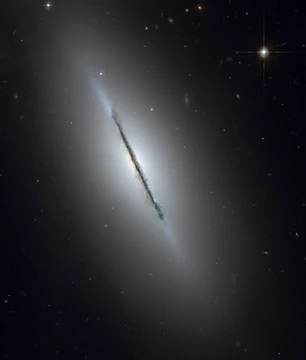
Galactic tide
Tidal force from a galaxy's gravitational field.

A galactic tide is the tidal force that acts on objects within a galaxy’s gravitational field, like that of the Milky Way. Key areas of study include galaxy collisions, the breakup of dwarf or satellite galaxies, and how the Milky Way’s tide affects the Solar System’s Oort cloud.
Tidal forces depend on the change in gravitational pull across a distance, not just its strength, so they are strongest near a galaxy. When two large galaxies collide or pass close by, these forces become extreme, often creating dramatic visual effects. Head-on collisions are rare; instead, each galaxy gets stretched along a line toward and away from the other. As they briefly orbit, these stretched regions are pulled from the galaxies’ outer discs (not their dense centers) and sheared by rotation, forming curved tidal tails flung into intergalactic space. Straight tails are likely seen edge-on. Famous examples include the Mice Galaxies and the Antennae Galaxies.
Just as the Moon creates two tidal bulges on Earth, a galaxy raises two arms in its companion. If the perturbed galaxy is about the same mass or smaller, a large tail forms; if it is much more massive, the trailing arm is small and the leading arm—called a bridge—is more prominent. Bridges are harder to spot than tails: they may be absorbed quickly by the passing or merged galaxy, or hidden if one galaxy lies in front of the other. Tidal loops, where a tail reconnects to its parent galaxy at both ends, are even rarer.
Satellite galaxies are especially vulnerable because tides are strongest nearby. These forces can stir up internal motions, causing rotation or an odd mass-to-light ratio. Tidal stripping, like in collisions, tears stars and gas from a satellite’s edges, possibly absorbing them into the host. For example, Andromeda’s satellite M32 may have lost its spiral arms this way, while its core’s high star formation could come from tidally compressed gas clouds. If the satellite is tiny compared to its host, the debris tails are symmetric and trace its orbit. But if the satellite is larger—over one ten-thousandth the host’s mass—its own gravity can break that symmetry, accelerating tails differently. The resulting shape depends on the satellite’s mass and orbit and the host’s dark matter halo, offering a way to probe the Milky Way’s unseen mass. Over many orbits, a dwarf satellite may be completely torn apart, formin
- field
- Astrophysics
- known_for
- Tidal forces in galaxy collisions, satellite disruption, and Oort cloud perturbations
- type
- Astronomical phenomenon
Lore & Background
Galactic tides arise from the gradient of a galaxy's gravitational field, not its strength, so effects are strongest near the galaxy. In collisions, two galaxies rarely hit head-on; tidal forces distort each along an axis toward and away from the perturber. As they orbit, distorted regions are sheared by differential rotation and flung into intergalactic space, forming curved tidal tails. If a tail appears straight, it is likely viewed edge-on. Stars and gas in tails come from galactic discs or extremities, not the gravitationally bound centers. Examples include the Mice Galaxies and the Antennae Galaxies. A perturbed galaxy equal to or less massive than its partner produces a large tail; if more massive, the trailing arm is minor and the leading arm (a bridge) is more prominent. Tidal bridges are harder to distinguish because they may be absorbed or obscured. Tidal loops, where a tail joins its parent at both ends, are rarer.
Reader's Guide
Galactic tides are significant for understanding galaxy evolution and the dynamics of satellite galaxies. In collisions, tidal forces create striking structures like tails and bridges, which reveal interaction histories. Satellite galaxies, being close, are especially vulnerable: tidal stripping can remove stars and gas, as seen in M32, a satellite of Andromeda that may have lost its spiral arms. Tidal forces can also induce star formation by compressing molecular clouds. Over many orbits, a dwarf satellite may be completely disrupted into a tidal stream, possibly explaining extended discs around galaxies like Andromeda. Within the Solar System, the galactic tide deforms the Oort cloud, stretching it toward the galactic center and compressing it along other axes. This perturbation dislodges planetesimals, sending them toward the Sun as comets; up to 90% of Oort cloud comets may result from the galactic tide. The tide may also aid Oort cloud formation by increasing perihelia of distant planetesimals.
Did You Know?
- Galactic tides depend on the gradient of a gravitational field, not its strength.
- The Mice Galaxies and Antennae Galaxies are prominent examples of collisions producing tidal tails.
- Up to 90% of all comets originating from an Oort cloud may be the result of the galactic tide.
- Tidal loops, where a tail joins its parent galaxy at both ends, are rarer than tidal tails.
Defining the Zone: Where Life Gets a Chance
The galactic habitable zone represents a specific region within a galaxy where conditions align most favorably for life to originate and progress. Rather than a single fixed boundary, the concept weaves together multiple variables—metallicity, the frequency and proximity of catastrophic events like supernovae, and the overall density of stellar activity—to identify areas where terrestrial planets are more probable, where simple organisms can take root, and where those organisms have a realistic path toward greater complexity. In our own Milky Way, researchers commonly describe this zone as a ring-shaped annulus stretching outward to roughly ten kiloparsecs, approximately thirty-three thousand light-years, with its inner edge sitting relatively close to the Galactic Center. Neither boundary is sharp; both fade gradually. A 2015 study added another dimension, suggesting that very large galaxies may offer more favorable conditions for the birth and maturation of habitable worlds than their smaller counterparts, hinting that galactic scale itself plays a role in the equation.
From Circumstellar Ideas to Galactic Frameworks
The intellectual lineage of galactic habitability stretches back to 1953, when Hubertus Strughold and Harlow Shapley first articulated the idea of a circumstellar habitable zone—the orbital band around a star where a planet could retain liquid water on its surface. Su-Shu Huang echoed this notion in 1959. Through the 1970s, planetary scientists began layering in additional threats, particularly the sterilizing potential of nearby supernovae. In 1981, computer scientist Jim Clarke proposed that Seyfert-type outbursts from an active galactic nucleus might explain the conspicuous absence of detected extraterrestrial civilizations, with Earth's particular galactic position shielding it from such radiation. That same year, Wallace Hampton Tucker explored galactic habitability more broadly, though later work moved beyond his specific proposals. The modern framework crystallized in 1986 when L.S. Marochnik and L.M. Mukhin at the Russian Space Research Institute defined the zone specifically as the region where intelligent life could flourish. Donald Brownlee and paleontologist Peter Ward then broadened the discussion in their 2000 book Rare Earth, arguing that the convergence of galactic and circumstellar factors makes intelligent life a rare outcome rather than an inevitable one.
Chemical Prerequisites: Metallicity and Radioactive Heat
Identifying a truly habitable galactic neighborhood demands far more than a safe distance from the core. The chemical inventory of a region determines whether it can even assemble a terrestrial planet of sufficient mass. Elements such as iron, magnesium, titanium, carbon, oxygen, and silicon must be present in the right concentrations, and their ratios shift dramatically from the galactic bulge outward. The bulge peaks at roughly −0.2 dex in iron-to-hydrogen abundance relative to the Sun, while the thin disk near the Sun's orbit sits at about −0.02 dex, declining by 0.07 dex for each additional kiloparsec. The extended thick disk averages −0.6 dex, and the distant halo drops to approximately −1.5 dex. Beyond simple metallicity, ratios like magnesium-to-iron and silicon-to-iron are slowly declining over cosmic time, meaning future rocky worlds will likely harbor proportionally larger iron cores. Equally critical is the presence of long-lived radionuclides—potassium-40, uranium-235, uranium-238, and thorium-232—which power plate tectonics, volcanism, and the geomagnetic dynamo essential for shielding a biosphere. The distribution of prebiotic molecules across the galaxy adds yet another layer of constraint.
Challenges and the Limits of the Model
Despite its intuitive appeal, galactic habitable-zone theory faces substantial methodological and physical objections. A central criticism is that the theory struggles to quantify with precision the very factors it invokes—supernova rates, metallicity gradients, cometary impact frequencies—making it difficult to draw firm conclusions about which regions are genuinely more hospitable. Compounding this uncertainty, computer simulations of stellar dynamics reveal that individual stars can migrate significantly over long periods, shifting their orbital distances from the galactic center by substantial amounts. This mobility undermines the assumption that a star's current position reliably reflects the long-term environmental conditions its planetary system has experienced. If a star that now orbits in what we would call the habitable annulus has spent significant portions of its history closer to the core, or vice versa, then the neat ring-shaped model becomes less predictive than it first appears. These limitations do not invalidate the concept entirely, but they do caution against treating the galactic habitable zone as a fixed, well-mapped territory rather than a probabilistic and dynamically shifting landscape.
Frequently Asked Questions
What is a galactic tide in simple terms?
A galactic tide is the stretching tidal force produced by a galaxy's gravitational field acting unevenly across an extended object. Rather than pulling everything equally, the gravity is slightly stronger on the near side than the far side, creating a differential pull that distorts or disrupts the object.
Why are galactic tides strongest near a galaxy rather than far away?
Tidal force depends on how much the gravitational pull changes over a given distance, not on the absolute strength of gravity. Near a galaxy, that gradient is steep, so the difference in pull between two points is large; far away the field is nearly uniform and the tidal effect fades.
What happens when two large galaxies collide under extreme tidal forces?
True head-on impacts are rare, so the galaxies usually pass close enough for their mutual tides to stretch each other into long tidal tails and bridges. The dramatic warped shapes seen in collision images are essentially the visible signature of those extreme tidal distortions.
How do galactic tides break up dwarf or satellite galaxies?
As a small galaxy orbits a larger host, the host's tide pulls harder on the side facing the host than on the far side, gradually stripping away stars and gas. Over many orbits this tidal stripping can completely dissolve the dwarf galaxy into a stream of stars around its host.
Does the Milky Way's galactic tide affect the Solar System?
Yes—the Milky Way's tidal field gently perturbs the distant Oort cloud of comets surrounding the Sun, nudging some objects into new orbits that can occasionally send them plunging inward. The effect is tiny compared with the Sun's own gravity but accumulates over millions of years.
More in Galaxies And Their Properties 1-21
Spotted an error? Know more?
This is a living reference — every entry is fact-audited, and reader corrections feed straight into our audit queue. Suggest an edit · See this site's audit record