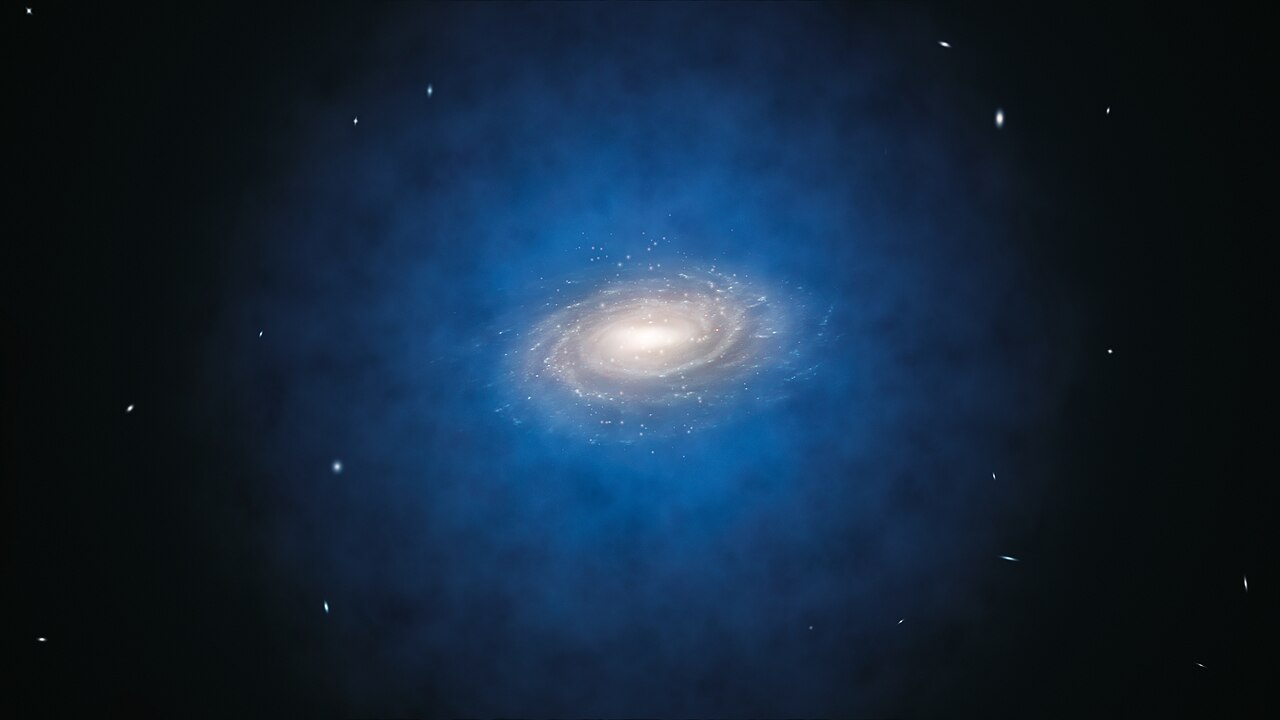
Dark matter halo
Hypothetical region of gravitationally bound dark matter enveloping galaxies.

ESO/L. Calçada · CC BY 4.0
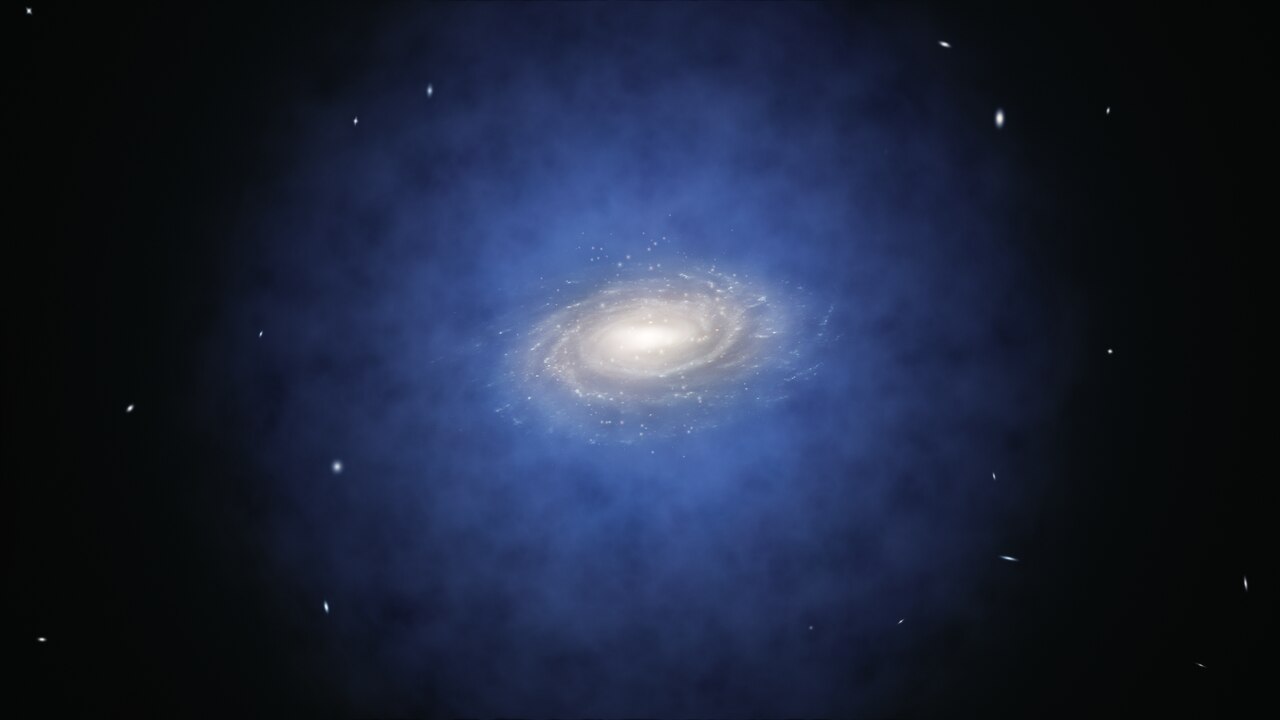
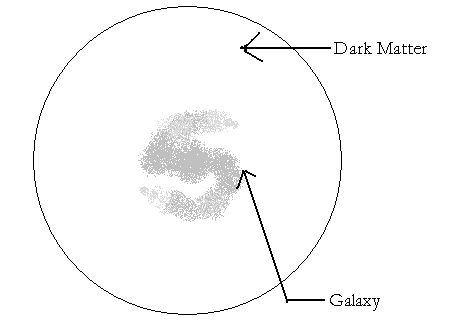
In physical cosmology, a dark matter halo is considered a fundamental building block of the universe's large-scale structure. It is a theoretical region that has stopped expanding with the universe and holds matter bound together by gravity. A single halo can contain multiple smaller, gravitationally bound clumps of dark matter called subhalos. According to models like ΛCDM, these halos and subhalos may host galaxies. A galaxy's dark matter halo wraps around its disk and stretches far beyond the visible galaxy. Although halos have never been directly observed, their presence is deduced from how they affect the motion of stars and gas within galaxies and from gravitational lensing. They are central to current theories of how galaxies form and evolve. Various ideas attempt to explain what dark matter halos are made of, with different levels of success, including cold dark matter, warm dark matter, and massive compact halo objects.
Evidence for a dark matter halo comes from the rotation curves of spiral galaxies. Without a large amount of unseen mass in a roughly spherical halo, a galaxy's rotational speed should drop off at large distances from its center, similar to how outer planets orbit the Sun more slowly. Yet observations—especially radio measurements of neutral hydrogen’s 21 cm line—show that the rotation curves of most spiral galaxies stay flat, meaning the rotational velocity doesn’t decline with distance. Since no visible matter accounts for this, it suggests either that invisible dark matter exists or that our theory of gravity is incomplete. The first proposal of dark matter to explain flat rotation curves is credited to Vera Rubin and Kent Ford, building on earlier work by Horace Babcock. Many studies have since reinforced the dark matter hypothesis.
Dark matter halos are thought to have been crucial in early galaxy formation. In the beginning, baryonic matter was too hot to collapse under its own gravity, so dark matter structures had to form first to provide extra gravitational pull. The leading hypothesis involves cold dark matter, which began as tiny density fluctuations in the early universe. These fluctuations grew linearly until they reached a critical density, stopped expanding, and collapsed into gravitationally bound halos—a process described by the spherical collapse model. Halos then grew by pulling in nearby material or merging with
- field
- Physical cosmology
- known_for
- Basic unit of cosmological structure; inferred from rotation curves and gravitational lensing
- composition
- Hypothetical dark matter; may contain subhalos and galaxies
- evidence
- Flattening of spiral galaxy rotation curves; 21 cm hydrogen line observations
- models
- Cold dark matter (CDM), warm dark matter, massive compact halo objects (MACHOs)
- density_profiles
- Pseudo-isothermal halo; NFW (Navarro–Frenk–White) profile
Lore & Background
The presence of dark matter in the halo is inferred from its gravitational effect on a spiral galaxy's rotation curve. Without large amounts of mass throughout the roughly spherical halo, the rotational velocity of the galaxy would decrease at large distances from the galactic center. However, observations of spiral galaxies, particularly radio observations of the 21 cm hydrogen line, show that the rotation curve of most spiral galaxies flattens out, meaning rotational velocities do not decrease with distance. The absence of any visible matter to account for these observations suggests the presence of dark matter, a hypothesis first advanced by Vera Rubin and Kent Ford, with earlier hints from Horace Babcock.
Reader's Guide
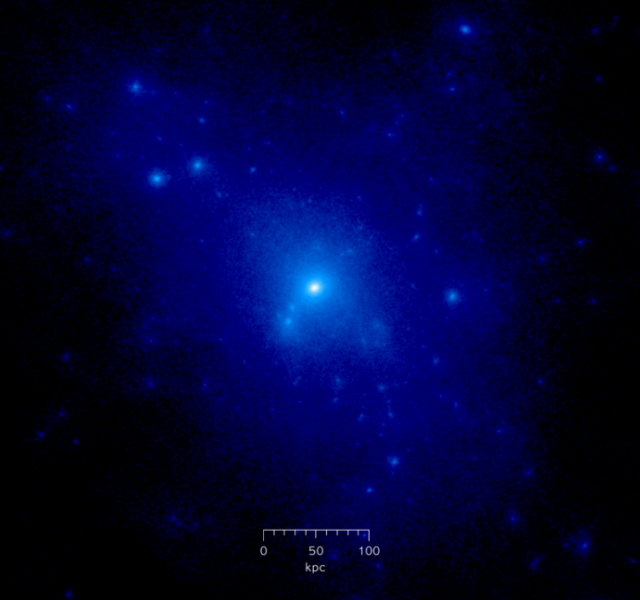
Dark matter halos are central to modern cosmological models such as ΛCDM, as they provide the gravitational scaffolding for galaxy formation. The formation of dark matter halos is believed to have played a major role in the early formation of galaxies. During initial galactic formation, the temperature of baryonic matter was too high for it to form gravitationally self-bound objects, thus requiring the prior formation of dark matter structure to add additional gravitational interactions. The cold dark matter (CDM) hypothesis overcomes issues associated with normal baryonic matter because it removes most of the thermal and radiative pressures that prevented collapse. Simulations of CDM structure formation show that small halos merge to form a single virialized dark matter halo with an ellipsoidal shape, containing substructure in the form of subhalos. Density profiles such as the pseudo-isothermal halo and the NFW profile are used to model halos, though neither is a complete description. The NFW profile is called 'universal' because it works for a large variety of halo masses, from individual galaxies to galaxy clusters.
Did You Know?
- A single dark matter halo may contain multiple virialized clumps of dark matter bound together by gravity, known as subhalos.
- The presence of dark matter in the halo is inferred from its gravitational effect on a spiral galaxy's rotation curve, particularly from 21 cm hydrogen line observations.
- Ken Freeman in 1970 first proposed undetected mass to explain the flat rotation curves of NGC 300 and M33.
- The NFW density profile is called 'universal' because it works for halo masses spanning four orders of magnitude, from individual galaxies to galaxy clusters.
Evidence from Rotation Curves
The existence of dark matter halos remains one of the most compelling yet indirect claims in modern astrophysics. No telescope has ever captured a halo directly; instead, astronomers piece together their presence by watching how stars and gas move within galaxies. In a spiral galaxy, one would expect orbital speeds to fall off with distance from the center, much like the outer planets of our solar system orbit the Sun more slowly than the inner ones. Yet radio observations of the 21 cm hydrogen line emission reveal that rotation curves in most spiral galaxies flatten out rather than decline. Ken Freeman first flagged this anomaly in 1970 when studying NGC 300 and M33, noting that the anticipated velocity drop was simply absent. His proposed explanation—that an undetected mass distributed throughout a roughly spherical region surrounding the galaxy was responsible—has since been reinforced by numerous independent studies. The alternative, that general relativity itself is incomplete, has not gained comparable traction, making the dark matter hypothesis the dominant interpretation.
Formation and Hierarchical Growth
In the ΛCDM framework, dark matter halos are not static shells but dynamic structures that assemble over cosmic time. The story begins with tiny density perturbations in the early universe. As long as these perturbations remain below a critical threshold, they simply expand along with the rest of the cosmos. Once they cross that threshold, expansion halts and gravitational collapse takes over, producing the first small, gravitationally bound clumps of cold dark matter. These primordial halos then grow through two principal channels: they accrete material from their immediate surroundings, and they merge with neighboring halos. Over billions of years, this hierarchical process builds larger and larger structures. Numerical simulations show that the end product is typically an ellipsoidal halo with visible substructure—smaller virialized clumps, or subhalos, embedded within the larger body. Crucially, this cold dark matter scaffolding forms before baryonic matter can cool enough to collapse on its own. The gravitational pull of the dark matter subhalos overcomes the thermal energy of the gas, allowing the first stars and galaxies to ignite within the pre-existing dark matter framework.
Density Profiles and Modeling Challenges
Describing the internal mass distribution of a dark matter halo is a nontrivial task, and no single formula captures the full picture. The pseudo-isothermal model, which assigns a finite central density and a characteristic core radius, fits a great deal of rotation-curve data and has become a workhorse in galactic dynamics. However, it carries a fundamental flaw: the enclosed mass diverges as radius approaches infinity, meaning the model cannot represent a physically bounded object. It is, at best, a local approximation. Numerical simulations of structure formation in an expanding universe have produced the more empirically grounded NFW (Navarro–Frenk–White) profile, which better accounts for the hierarchical merging history. Even so, several physical effects can push real halos away from any smooth, spherical prediction. Collapse in the outer regions may never settle into equilibrium, non-radial motions of particles can distort the density distribution, and the very mergers that build halos in the hierarchical picture can invalidate the assumptions of simple spherical-collapse models. The result is that halo density profiles remain an active area of refinement.
Role in Cosmological Structure and Galaxy Evolution
In contemporary cosmology, the dark matter halo occupies a foundational position: it is the basic building block from which all larger structure is assembled. Under the ΛCDM paradigm, halos and their subhalos serve as the gravitational cradles within which galaxies form and evolve. A galaxy's visible disc—its stars, gas, and dust—is embedded within a far more extended halo of dark matter that stretches well beyond the outermost luminous regions. This enveloping structure is not merely a passive backdrop; it actively shapes the dynamics of the visible galaxy, governing the motions of stars and interstellar gas and contributing to the gravitational lensing of background light. Several theoretical frameworks attempt to explain the physical nature of the halo material with varying degrees of success. Cold dark matter, warm dark matter, and massive compact halo objects (MACHOs) each offer different mechanisms for how the unseen mass might be distributed and behave. The choice among these models carries direct implications for how we interpret the observed substructure, the timing of galaxy formation, and the broader narrative of cosmic evolution.
Gallery
Frequently Asked Questions
What is a Dark matter halo?
A dark matter halo is a vast, invisible region of space that has decoupled from the cosmic expansion and holds matter together through gravity alone. It serves as the fundamental structural unit in the universe's large-scale architecture, typically wrapping around a galaxy's visible disk and stretching far beyond its edge.
What are Dark matter halo's powers/role?
The halo provides the gravitational scaffolding that lets galaxies form, stay bound, and rotate at the speeds we observe. It can also host numerous smaller gravitationally bound clumps called subhalos, and in ΛCDM models these nested structures are the seeds from which stars and gas eventually assemble into visible galaxies.
How does Dark matter halo's story end?
There is no single finale, but over cosmic time halos gravitationally merge with one another, growing larger and reshaping the galaxies they cradle. This hierarchical merging—where small halos accrete into bigger ones—is a central prediction of cold dark matter cosmology.
Why is Dark matter halo important?
Without halos, visible matter would lack the gravitational wells needed to clump into galaxies in the first place. They are the invisible framework that explains why spiral rotation curves flatten at large radii and why gravitational lensing reveals far more mass than any luminous matter can account for.
How do we know Dark matter halo exists if we can't see it?
Astronomers deduce their presence through multiple independent observations, including the flattening of spiral galaxy rotation curves, 21 cm hydrogen line measurements, and gravitational lensing patterns. Their spatial density is typically described by theoretical profiles such as the Navarro–Frenk–White or pseudo-isothermal shapes.
More in Galaxies And Their Properties 1-21
Spotted an error? Know more?
This is a living reference — every entry is fact-audited, and reader corrections feed straight into our audit queue. Suggest an edit · See this site's audit record