Grand design spiral galaxy
Spiral galaxy with prominent, well-defined continuous arms.

ESA/Hubble & NASA · CC BY 4.0
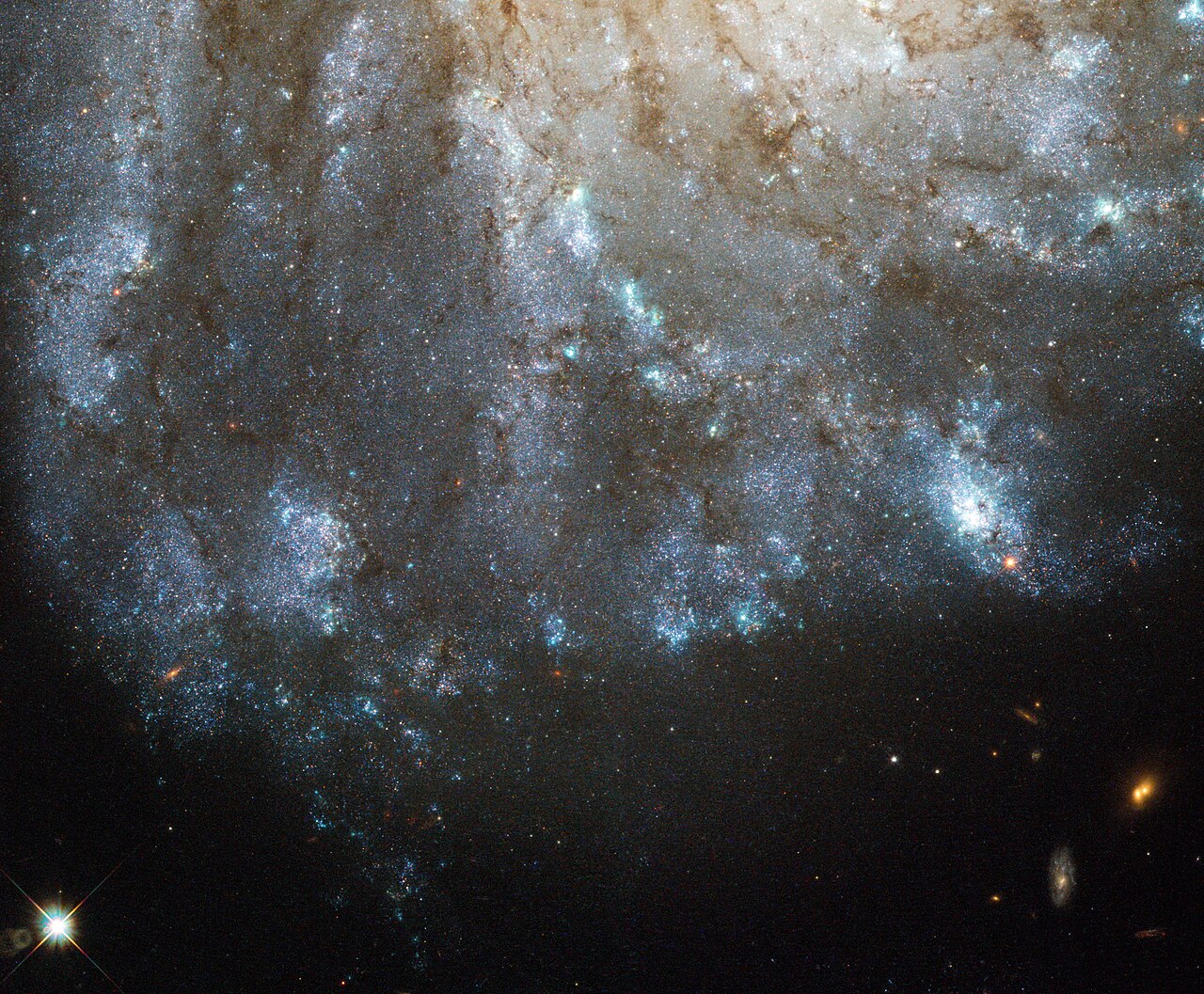
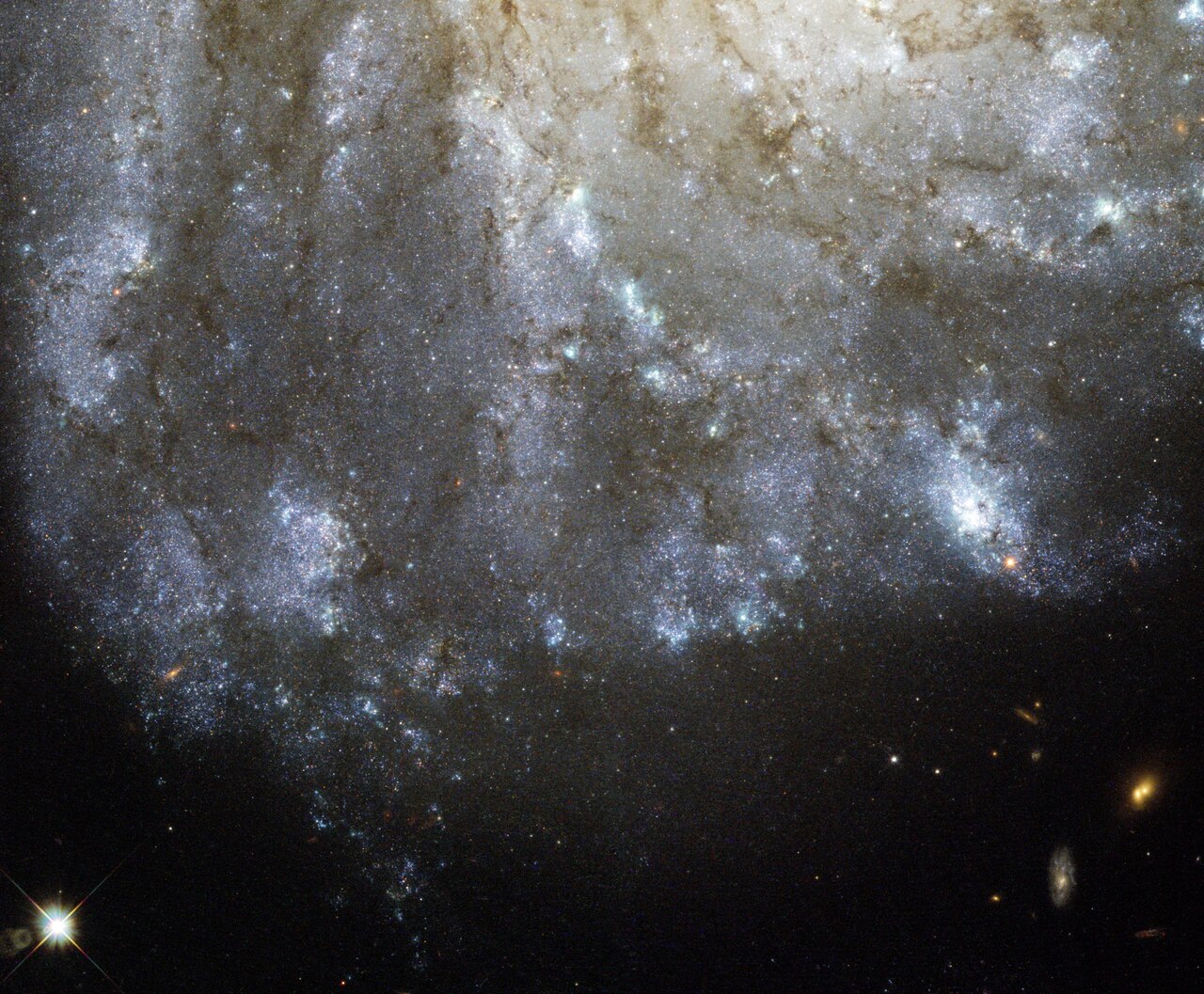
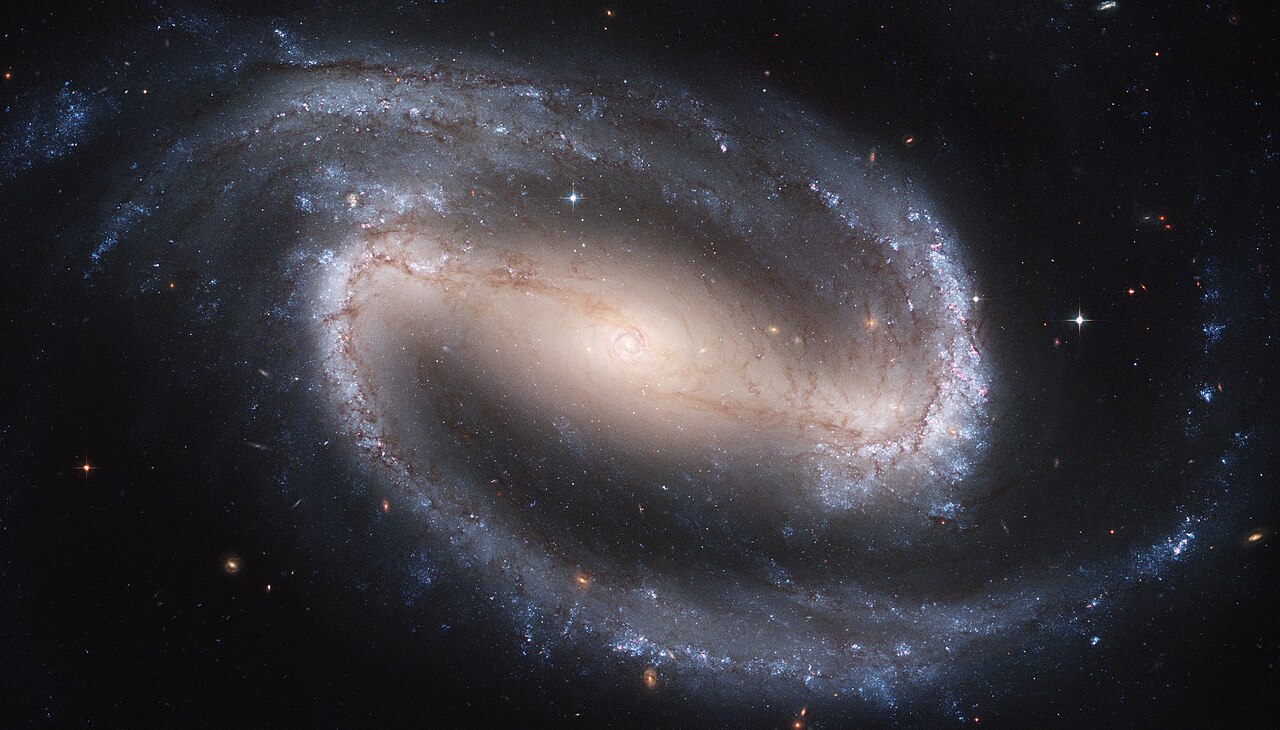
A grand design spiral galaxy is a type of spiral galaxy defined by its clear, continuous, and well-defined spiral arms. This sets it apart from flocculent or multi-arm spirals, which have more irregular and subtle structures. The arms of a grand design galaxy stretch distinctly around a large part of the galaxy's disk. These arms are active sites of star formation, filled with many bright, hot, massive stars that burn through their fuel quickly.
As of 2002, only about 10 percent of known spiral galaxies are classified as grand design spirals. Examples include M51 (the Whirlpool Galaxy), M74 (the Phantom Galaxy), M81 (Bode’s Galaxy), M83 (the Southern Pinwheel Galaxy), M101 (the Pinwheel Galaxy), NGC 6946 (the Fireworks Galaxy), and IC 342 (the Hidden Galaxy).
**Origin of structure**
The leading explanation for the sharp structure of grand design spirals is density wave theory, first proposed by Chia-Chiao Lin and Frank Shu in 1964. The term "grand design" itself did not appear in that initial work but was introduced in a follow-up paper in 1966, and Lin (along with Yuan and Shu) is generally credited with coining it.
According to this theory, the spiral arms form within density waves that rotate around the galaxy at a different speed than the stars in the disk. Gravity pulls stars and gas toward these dense regions, though their position within a spiral arm is not permanent. As material approaches an arm, gravity draws it in; as it passes through, the same gravitational pull slows its exit. This causes gas to accumulate in the dense areas, leading to the collapse of gas clouds and the birth of new stars.
- classification
- Spiral galaxy subtype
- percentage_of_known_spirals
- Approximately 10 percent as of 2002
- examples
- M51, M74, M81, M83, M101, NGC 6946, IC 342
- explanation_for_structure
- Density wave theory
- theory_proposed_by
- Chia-Chiao Lin and Frank Shu in 1964
- term_coined_in
- 1966 continuation paper by Lin, Yuan, and Shu
Lore & Background
Density wave theory is the preferred explanation for the well-defined structure of grand design spirals, first suggested by Chia-Chiao Lin and Frank Shu in 1964. The term 'grand design' was not used in this work, but appeared in the 1966 continuation paper; Lin (along with Yuan and Shu) is usually credited with coining of the term. According to the density wave theory, the spiral arms are created inside density waves that turn around the galaxy at different speeds from the stars in the galaxy's disk. Stars and gas are clumped in these dense regions due to gravitational attraction toward the dense material, though their location in the spiral arm may not be permanent. When they come close to the spiral arm, they are pulled toward the dense material by the force of gravity; and as they travel through the arm, they are slowed from exiting by the same gravitational pull. This causes the gas in particular to clump in the dense regions, which in turn causes gas clouds to collapse, resulting in star formation.
Reader's Guide
Grand design spiral galaxies represent a distinct morphological class within spiral galaxies, characterized by their clear, continuous spiral arms that host abundant star formation. As of 2002, only about 10 percent of known spiral galaxies are classified as grand design, making them relatively rare but visually striking. Their structure is best explained by density wave theory, proposed by Lin and Shu in 1964, which describes how density waves moving at different speeds from the stars create and maintain the spiral arms. This theory accounts for the clumping of gas and stars, leading to star formation in the arms. Notable examples include M51 (Whirlpool Galaxy), M74 (Phantom Galaxy), M81 (Bode’s Galaxy), M83 (Southern Pinwheel Galaxy), M101 (Pinwheel Galaxy), NGC 6946 (Fireworks Galaxy), and IC 342 (The Hidden Galaxy). The term 'grand design' was introduced in a 1966 paper by Lin, Yuan, and Shu. Understanding these galaxies helps astronomers study spiral structure dynamics and star formation processes.
Did You Know?
- Approximately 10 percent of all currently known spiral galaxies are classified as grand design type spirals as of 2002.
- The term 'grand design' was coined in a 1966 continuation paper by Lin, Yuan, and Shu.
- Density wave theory, first suggested by Chia-Chiao Lin and Frank Shu in 1964, is the preferred explanation for grand design spiral structure.
- Examples of grand design spirals include M51, M74, M81, M83, M101, NGC 6946, and IC 342.
A Pioneering Milestone in Galactic Astronomy
The Whirlpool Galaxy holds a singular place in the history of astronomy as the very first object ever identified as a spiral galaxy. Its story begins on October 13, 1773, when Charles Messier, cataloguing faint objects that might be mistaken for comets, logged it as M51. For over a century it remained a puzzling smudge until William Parsons, the 3rd Earl of Rosse, peered through his 72-inch reflector at Birr Castle in Ireland and revealed the swirling spiral pattern within — the first such structure ever detected in a nebula. Yet even this breakthrough did not settle the question of what these objects truly were. It was not until Edwin Hubble detected Cepheid variable stars in several spiral nebulae that the astronomical community accepted they were distant, self-contained galaxies rather than gaseous clouds within our own. The Whirlpool's status as the prototype spiral thus rests on a chain of observational firsts spanning more than two centuries of human curiosity.
The Gravitational Dance with NGC 5195
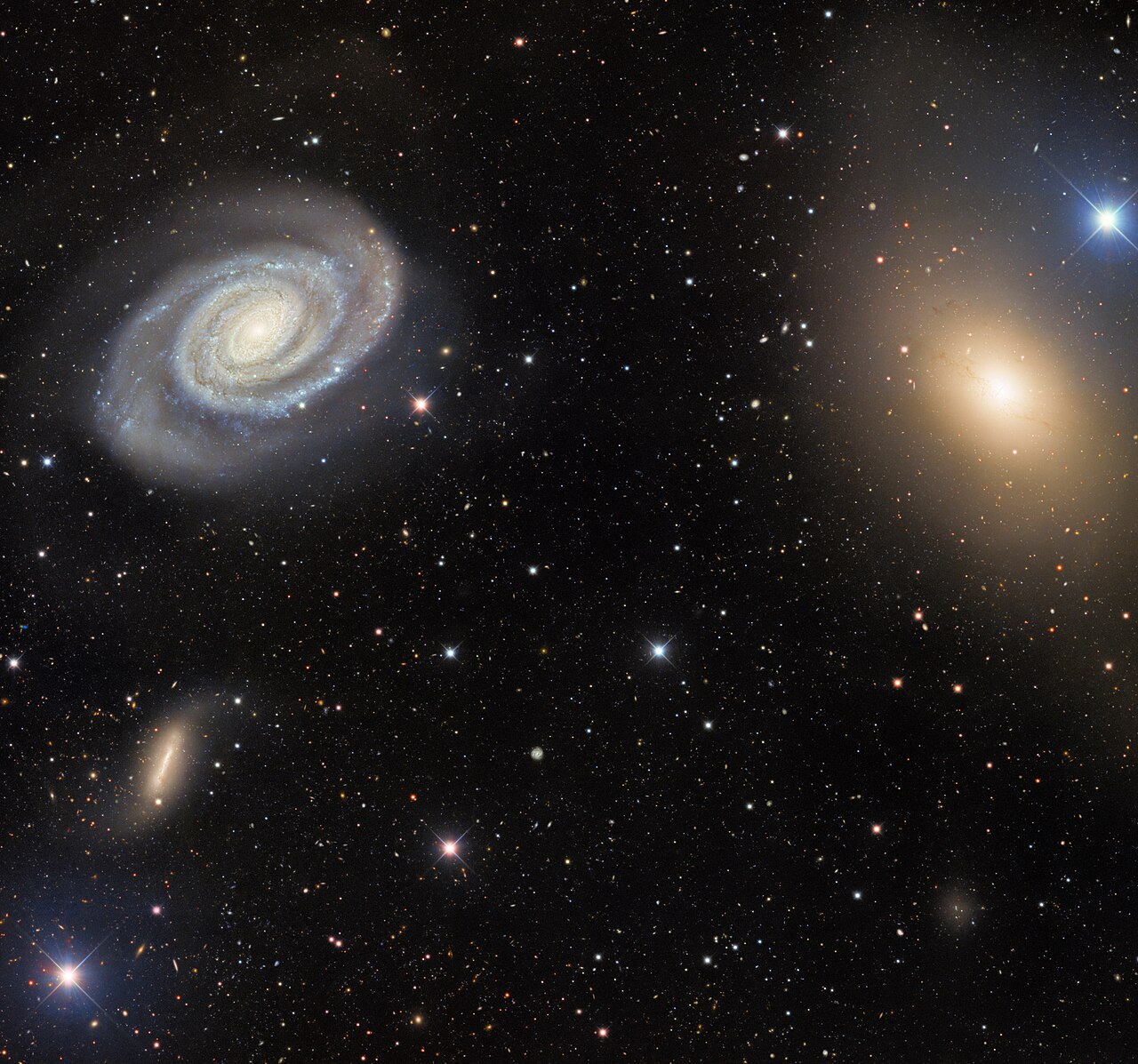
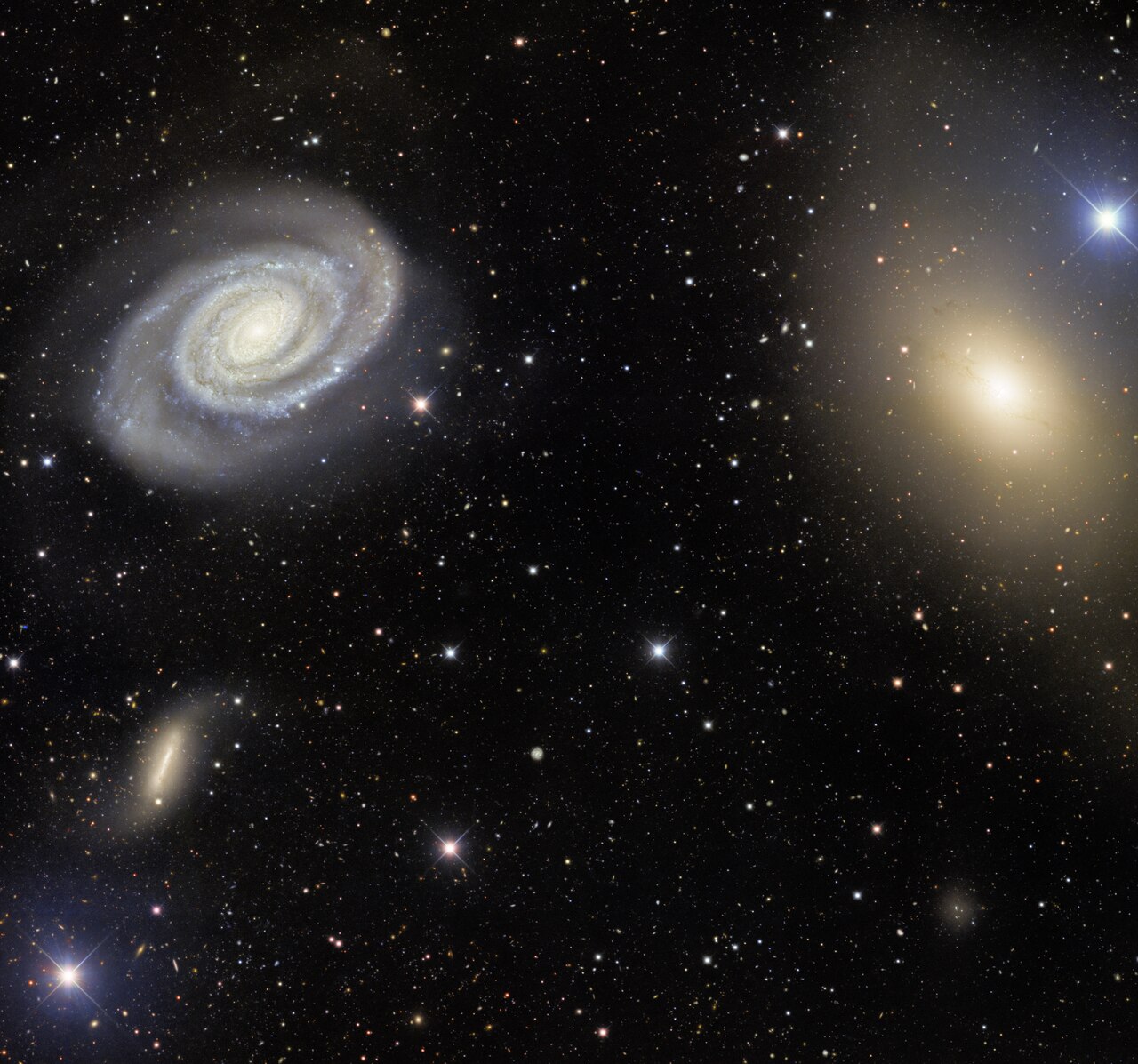
The Whirlpool Galaxy's most striking architectural feature — its two bold, clockwise-winding spiral arms — is widely attributed to a prolonged gravitational encounter with its smaller companion, NGC 5195. Astronomers propose that this companion threaded through the main disk of M51a roughly 500 to 600 million years ago, approaching from behind and emerging toward the observer, before making a second disk crossing as recently as 50 to 100 million years ago. This repeated passage sculpted the pronounced spiral pattern and left behind a family of tidal features. The most extensive is the Northwest plume, stretching 43 kiloparsecs, about 140,000 light-years, from the galactic center, composed of diffuse gas likely stripped from the Whirlpool itself. Two bluer Western plumes sit adjacent, while a 2015 study identified two additional structures, the Northeast plume and the South plume. Notably, simulations incorporating only a single disk crossing cannot reproduce the Northeast tail, reinforcing the case for multiple passages.
From Binoculars to Webb: A Story in Light
Situated in Canes Venatici just 3.5 degrees southwest of Alkaid, the easternmost star of the Big Dipper, the Whirlpool Galaxy rewards observers across a wide range of equipment. Under truly dark skies, a pair of binoculars can reveal the two galaxies as soft smudges. A 100-millimeter telescope brings out their basic outlines spanning roughly five by six arcminutes, while a 150-millimeter instrument with a moderate eyepiece begins to hint at the intrinsic spiral pattern. Larger apertures exceeding 300 millimeters expose the individual spiral bands, glowing HII regions, and the physical attachment between M51a and its companion. Professional imaging has pushed the detail far beyond human vision: in 1984, Hua and colleagues used a photon-counting detector at the 3.6-meter Canada-France-Hawaii Telescope to resolve the double nucleus. In January 2005, the Hubble Heritage Project assembled an 11,477-by-7,965-pixel mosaic with the ACS instrument, and in 2022 the James Webb Space Telescope's MIRI instrument turned its infrared eye on the galaxy for the FEAST project, probing star-forming clusters.
Mass, Age, and the Hidden Engine at Its Core
The Whirlpool Galaxy spans 23.58 kiloparsecs, or roughly 76,900 light-years, making it about 88 percent the diameter of the Milky Way. Its total mass is estimated at 160 billion solar masses, approximately 10.3 percent of our own galaxy's mass, and its age is thought to be around 400 million years. At a distance of 23 to 31 million light-years, it sits close enough for detailed study yet far enough to preserve its structure. At the very heart of the spiral lies a Seyfert 2 active galactic nucleus powered by a supermassive black hole. Earlier interpretations suggested a ring of dust encircled the black hole, but current understanding holds that dust partially occludes it instead. A pair of ionization cones projects outward from this active core, carving channels through the surrounding gas. Radio observations have been particularly revealing here: by mapping the distribution of neutral gas across both galaxies, radio astronomers provided definitive proof that the Whirlpool and NGC 5195 are physically connected and genuinely interacting, rather than merely aligned by chance along our line of sight.
Gallery
Frequently Asked Questions
What is a grand design spiral galaxy?
It is a subtype of spiral galaxy whose disk is dominated by two or more smooth, continuous arms that trace a clean path around a large fraction of the galaxy. The bold, symmetrical arm pattern is what separates it from the patchier, more fragmented structures seen in flocculent spirals.
How does a grand design spiral differ from a flocculent or multi-arm spiral?
Grand design arms are long, well-defined, and visually continuous, whereas flocculent and multi-arm types show short, clumpy, or irregular arm segments. The key distinction is the degree of arm coherence and how prominently the structure stands out in the disk.
What are the most famous examples of grand design spiral galaxies?
Well-known members include M51 (the Whirlpool Galaxy), M74, M81, M83, M101, NGC 6946, and IC 342. These objects are frequently featured in both professional surveys and amateur deep-sky photography.
What physical mechanism explains the smooth arm structure of grand design spirals?
The leading explanation is the density wave theory, originally put forward by Chia-Chiao Lin and Frank Shu in 1964 and expanded in a 1966 follow-up paper with Yuan. In this model, gravitational density waves travel through the galactic disk, compressing interstellar gas and igniting star formation along the arm ridges.
How common are grand design spirals among all known spiral galaxies?
They are a relatively rare class, accounting for only about 10 percent of catalogued spiral galaxies as of 2002. The vast majority of spirals instead display flocculent or multi-arm morphologies.
More in Galaxies And Their Properties 1-21
Spotted an error? Know more?
This is a living reference — every entry is fact-audited, and reader corrections feed straight into our audit queue. Suggest an edit · See this site's audit record