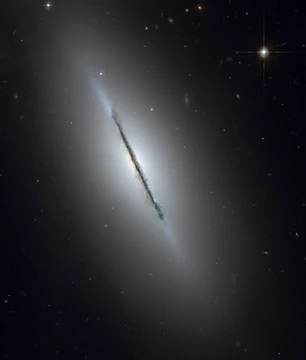
Type-cD galaxy
Supergiant elliptical galaxies at the centres of rich clusters.

A type-cD galaxy, also called a cD-type, cD, supergiant elliptical, or central dominant galaxy, is a subtype of the D-type giant elliptical galaxy in the Yerkes classification scheme. These galaxies are defined by their enormous stellar halos and are typically found at the centers of rich galaxy clusters. The "c" in "cD" denotes their supergiant size, while the "D" indicates their diffuse appearance; the abbreviation is often back-formed to mean "central dominant galaxy." They are frequently considered the largest galaxies known.
cD galaxies resemble lenticular (S0) or elliptical (E#) galaxies but are many times larger, with some envelopes exceeding a million light-years in radius. They appear elliptical-like but possess extensive, low-surface-brightness envelopes that may belong as much to the surrounding galaxy cluster as to the galaxy itself. They are thought to form through galaxy mergers, and some contain multiple galactic nuclei. cD galaxies are a common type of brightest cluster galaxy (BCG), making up about 20% of BCGs. Many fossil group galaxies resemble cD BCGs, leading to the theory that a cD forms from a fossil group, around which a new cluster later accumulates; however, cDs are never found as field galaxies, unlike fossil groups.
These massive galaxies are important for understanding cosmic evolution because they, along with other large early-type galaxies, account for half of the universe's stellar mass, contribute significantly to its chemical enrichment, and offer clues to its star formation history.
cD galaxies are believed to grow through mergers of galaxies that spiral into a cluster's center, a process first proposed by Herbert J. Rood in 1965. This "cannibalistic" growth produces the cD's large diameter and luminosity. The second-brightest cluster galaxy is usually under-luminous, a consequence of being "eaten." Remains of consumed galaxies sometimes appear as diffuse halos of gas and dust, tidal streams, or off-center nuclei. The envelope or halo may also consist of intra-cluster light from stripped stars, reaching up to 3 million light-years in diameter. A cD galaxy alone contributes 1–7% of the total baryon mass within 12.5 virial radii, depending on cluster mass.
Dynamical friction plays a key role in cD formation. As a large galaxy moves through a cluster, it attracts smaller galaxies and dark matter into a wake behind it. This
- classification
- cD-type (supergiant elliptical, central dominant galaxy)
- typical location
- Centres of rich galaxy clusters
- size
- Envelopes can exceed one million light years in radius; up to 3 million light years in diameter
- frequency among BCGs
- Form around 20% of brightest cluster galaxies
- proposed growth mechanism
- Galaxy mergers (cannibalistic mode, proposed by Herbert J. Rood in 1965)
- contribution to baryon mass
- 1–7% of total baryon mass within 12.5 virial radii
Lore & Background
The cD-type is a classification in the Yerkes galaxy classification scheme, one of two Yerkes classifications still in common use, along with D-type. The 'c' in 'cD' refers to the fact that the galaxies are very large, hence the adjective supergiant, while the 'D' refers to the fact that the galaxies appear diffuse. A back-formation of 'cD' is frequently used to indicate 'central Dominant galaxy'. cDs are also frequently considered the largest galaxies. It is currently thought that cDs are the result of galaxy mergers. Some cDs have multiple galactic nuclei. cD galaxies are one of the types frequently found to be the brightest cluster galaxy (BCG) of a cluster. Many fossil group galaxies are similar to cD BCG galaxies, leading some to theorize that the cD results from the creation of a fossil group, and then the new cluster accumulating around the fossil group. However, cDs themselves are not found as field galaxies, unlike fossil groups.
Reader's Guide
cD galaxies are believed to grow via mergers of galaxies that spiral in to the center of a galaxy cluster, a theory first proposed by Herbert J. Rood in 1965. This 'cannibalistic' mode of growth leads to the large diameter and luminosity of the cDs. The second-brightest galaxy in the cluster is usually under-luminous, a consequence of its having been 'eaten'. Remains of 'eaten' galaxies sometimes appear as a diffuse halo of gas and dust, or tidal streams, or undigested off-center nuclei in the cD galaxy. The envelope or halo may also consist of the 'intra-cluster light', originating from stars stripped away from their original galaxy. Dynamical friction is believed to play an important role in the formation of cD galaxies at the centres of galaxy clusters. This process begins when the motion of a large galaxy in a cluster attracts smaller galaxies and dark matter into a wake behind it. This over-density follows behind the larger galaxy and exerts a constant gravitational force on it, causing it to slow down. As it loses kinetic energy, the large galaxy gradually spirals toward the centre of the cluster. Once there, the stars, gas, dust and dark matter of the large galaxy and its trailing galaxies will join with those of other galaxies who preceded them in the same fate. A giant or supergiant diffuse or elliptical galaxy will result from this accumulation. The centers of merged or merging galaxies can remain recognizable for long times, appearing as multiple 'nuclei' of the cD galaxy. Massive galaxies such as supergiant elliptical galaxies are important to understanding the evolution of the universe, because they, along with other large-early type galaxies, account for half of the Universe's stellar mass, contribute significantly to its chemical enrichment and provide clues to the star formation history of the universe.
Did You Know?
- cD galaxies are also known as supergiant ellipticals or central dominant galaxies.
- Some cD galaxies have envelopes that exceed one million light years in radius.
- cD galaxies form around 20% of brightest cluster galaxies (BCGs).
- The 'c' in 'cD' stands for supergiant, and 'D' for diffuse appearance.
More in Galaxies And Their Properties 1-21
Spotted an error? Know more?
This is a living reference — every entry is fact-audited, and reader corrections feed straight into our audit queue. Suggest an edit · See this site's audit record