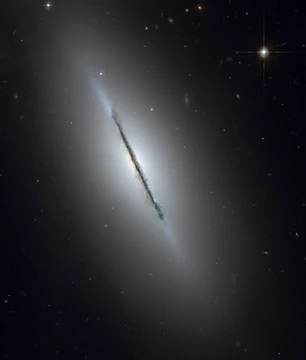
Satellite galaxy
Smaller galaxies bound to larger hosts, key to cosmology.

A satellite galaxy is a smaller galaxy that orbits a larger, brighter host galaxy, held in place by the host’s gravity. This relationship is similar to how planets orbit the Sun. While most satellite galaxies are dwarf galaxies, those orbiting large galaxy clusters can be much more massive. The Milky Way has over 60 known satellite galaxies, with the Large Magellanic Cloud being the largest.
Satellite galaxies are distinct from other gravitationally bound objects, like globular clusters. Astronomers define galaxies as collections of stars whose behavior cannot be fully explained by ordinary matter and Newton’s laws alone. For instance, the orbital speeds of stars and gas in spiral galaxies produce a velocity curve that differs from theoretical predictions, leading to explanations such as dark matter or modifications to Newtonian dynamics. Unlike globular clusters, satellite galaxies are larger, more diffuse, and surrounded by massive dark matter halos, thought to have formed during their creation.
Satellite galaxies often have chaotic lives due to interactions with their host galaxy and other satellites. The host can strip away cold gas from a satellite through tidal forces and ram pressure, cutting off the fuel for star formation and causing the satellite to become quiescent. Satellites can also collide with the host in a minor merger, or merge with each other in a major merger. Since galaxies are mostly empty space, these mergers don’t involve direct collisions between stars, but they do produce much larger galaxies. Astronomers study the rates of these mergers to understand how larger structures, like galaxy groups and clusters, form.
**History**
In the early 20th century, the idea of galaxies beyond the Milky Way was controversial. This led to the Shapley-Curtis Great Debate in 1920, where Harlow Shapley argued the Milky Way was the entire universe, while Heber Curtis argued that observed “nebulae” were separate galaxies. The debate was settled in 1923, when Edwin Hubble measured the distance to the Andromeda galaxy using Cepheid variable stars. By calculating their intrinsic brightness from their pulsation periods and comparing it to their apparent brightness, he found a distance of 300 kiloparsecs—far larger than Shapley’s estimated size of the universe. This proved the universe was much bigger than thought and that the nebulae were distant gal
- type
- Astronomical object
- common_host
- Milky Way
- known_satellites_of_Milky_Way
- 59
- largest_satellite_of_Milky_Way
- Large Magellanic Cloud
- primary_classification
- Dwarf galaxy
- key_characteristic
- Enshrouded in massive dark matter halos
Lore & Background
Satellite galaxies are bound to their host galaxy similarly to planets orbiting the Sun. While most are dwarf galaxies, those in large clusters can be more massive. The Milky Way is orbited by over 60 known satellite galaxies, with the Large Magellanic Cloud being the largest. Astronomers distinguish satellite galaxies from globular clusters by their extended, diffuse structure and dark matter halos, which globular clusters lack.
Satellite galaxies lead tumultuous lives due to interactions with their host and other satellites. Host galaxies can strip cold gas via tidal and ram pressure stripping, causing satellites to cease star formation. Satellites can also merge with their host (minor merger) or with each other (major merger), producing more massive galaxies. These processes hel
Reader's Guide
Satellite galaxies are essential for testing cosmological models, particularly the ΛCDM model, which predicts a hierarchical formation of structure. Their spectroscopic, photometric, and kinematic observations provide insights into galaxy formation, environmental effects on star formation, and dark matter distribution within halos. The study of satellite galaxies helps constrain merger rates, which are key to understanding the assembly of massive structures like galactic groups and clusters. The missing satellites problem—where fewer satellites are observed than predicted—has driven refinements in simulations, but recent high-resolution simulations indicate the observed number is consistent with theory. Satellite galaxies also serve as natural laboratories for studying dark matter, as their high mass-to-light ratios (especially in dwarf spheroidals) indicate dark matter dominance. Their classification into dwarf irregular, dwarf elliptical, dwarf spheroidal, and transitional types reflects their varied evolutionary paths, influenced by mergers and environmental stripping. Overall, satellite galaxies are indispensable for linking small-scale galaxy physics to large-scale cosmic evolution.
Did You Know?
- The Milky Way is orbited by about fifty satellite galaxies, the largest being the Large Magellanic Cloud.
- Satellite galaxies are enshrouded in massive dark matter halos, unlike globular clusters.
- The Large Magellanic Cloud is considered to be transitioning from a dwarf spiral to a dwarf irregular galaxy.
- The missing satellites problem refers to cosmological models predicting more satellite galaxies than are observed.
More in Galaxies And Their Properties 1-21
Spotted an error? Know more?
This is a living reference — every entry is fact-audited, and reader corrections feed straight into our audit queue. Suggest an edit · See this site's audit record