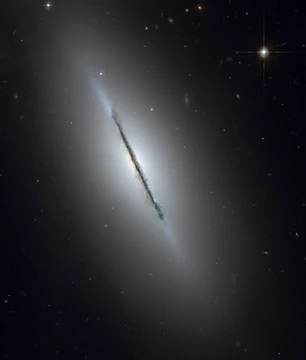
Ring galaxy
A galaxy with a ring-shaped structure of stars and gas.

A ring galaxy is a galaxy with a large, ring-shaped structure. Its center can be either separate from the ring or part of a continuous disk. These galaxies are known for their bright rings of star formation, which contain massive, young blue stars. The central region, in contrast, may contain little luminous matter or, as in Hoag's Object, a bright core of old stars.
Several theories explain how ring galaxies form. One idea involves bar instability in a barred spiral galaxy. If the bar’s rotational speed increases enough, density waves that normally create spiral arms instead get pushed outward into a ring by the gravitational forces of orbiting baryonic and dark matter. This forces stars, gas, and dust into a torus, often triggering star formation. In some cases, the bar dominates and carves out the ring; in others, the bar collapses into a flattened bulge. Other instabilities from spiral-arm asymmetries can create a torque that drives matter both outward and inward, forming the ring and core. Observations show that bars, rings, and spiral arms can break apart and reform over hundreds of millions of years, especially in dense galaxy groups and clusters where gravitational influences are strong.
Another formation method is galactic collisions. In a pass-through or bullseye collision, a smaller galaxy moves through the disk of a larger one. The smaller galaxy’s gravity pushes the larger galaxy’s arms outward, like a rock dropped in water. This can either launch the core away from the disk, leaving an almost empty ring, or shove the core toward the disk, creating an oval ring with a partial bulge. Side-swipe and head-on collisions tend to produce chaotic, warped shapes rather than perfect rings, and the original galaxies often remain visible. Rings formed this way are temporary, lasting only tens to hundreds of millions of years before disintegrating, reforming into spiral arms, or being further disturbed.
A third theory is ring accretion from intergalactic medium. This is inferred from Hoag’s Object and UV observations of large spiral galaxies. UV light shows faint, ring-like structures of hot young stars forming along cooled, inflowing gas far from the visible disk. Under favorable conditions, a ring can form instead of a spiral. Polar-ring galaxies may arise from cold accretion, where gas from a galaxy filament flows into the disk and halo early in a gal
- type
- Galactic morphology
- notable_example
- Hoag's Object
- discoverer
- Arthur Hoag
- discovery_year
- 1950
- key_features
- Annular structure, high star formation rate, high metallicity in ring
- formation_theories
- Bar instability, galactic collisions, ring accretion
Lore & Background
Ring galaxies are theorized to form through several processes. One proposed mechanism is bar instability, where the rotational velocity of the bar in a barred spiral galaxy increases, causing density waves to migrate outward into a ring structure. This migration forces stars, gas, and dust into a torus-like region, often igniting star formation. Observations suggest that bars, rings, and spiral arms can fall apart and reform over hundreds of millions of years, particularly in dense intergalactic environments.
Reader's Guide
Another formation theory involves galactic collisions. In pass-through or bullseye collisions, a smaller donor galaxy passes directly through the disc of a larger spiral galaxy, causing an outward push of the arms due to gravity, similar to dropping a rock into still water. This can create an almost empty ring appearance or an oval-shaped ring with the bulge intact. Rings formed through collisions are believed to be transient, lasting only tens to hundreds of millions of years before disintegrating or reforming into spiral arms.
Did You Know?
- Hoag's Object, discovered by Arthur Hoag in 1950, is an example of a ring galaxy.
- The ring of a ring galaxy contains many massive, relatively young blue stars that are extremely bright.
- Some astronomers believe ring galaxies form when a smaller galaxy passes through the center of a larger galaxy, with gravitational disruptions causing a wave of star formation.
- Other astronomers think rings form around some galaxies when external accretion takes place, with star formation occurring due to shocks and compressions of the accreted material.
More in Galaxies And Their Properties 1-21
Spotted an error? Know more?
This is a living reference — every entry is fact-audited, and reader corrections feed straight into our audit queue. Suggest an edit · See this site's audit record