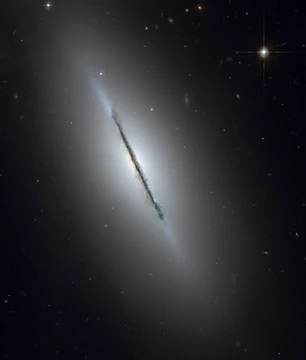
Peculiar galaxy
Galaxies of unusual size, shape, or composition.

A peculiar galaxy is defined by its unusual size, shape, or makeup. Such galaxies make up roughly five to ten percent of all known galaxies. Astronomers classify them into two main categories: interacting galaxies and those with active galactic nuclei (AGN). When two galaxies draw near, their mutual gravity can warp them into highly irregular forms. The terms "peculiar galaxy" and "interacting galaxy" are now used interchangeably, since gravitational interactions are responsible for the odd shapes seen in most of these objects.
Scientists believe many peculiar galaxies result from the collision of two or more galaxies. Because of this, they tend to host more active galactic nuclei than normal galaxies, a sign that they contain supermassive black holes. Many also experience starbursts—rapid bursts of star formation—triggered by the merger. The combination of heightened star formation and the brightness from active galactic nuclei gives peculiar galaxies a slightly bluer color than other galaxies.
Studying peculiar galaxies can shed light on how other types of galaxies form and evolve. In his 1966 Atlas of Peculiar Galaxies, Halton Arp mapped these objects, noting that their "perturbations, deformations, and interactions" allow astronomers to analyze the nature of real galaxies that are too distant to experiment on directly.
In notation, a peculiar galaxy is marked with an additional "p" or "pec" after its Hubble type.
- category
- Galaxy type
- percentage_of_known_galaxies
- 5–10%
- types
- Interacting galaxies and active galactic nuclei (AGN)
- common_cause
- Gravitational interactions or collisions
- notable_feature
- Often host supermassive black holes and experience starbursts
Lore & Background
When two galaxies come close to each other, their mutual gravitational forces can cause them to acquire highly irregular shapes. The terms 'peculiar galaxy' and 'interacting galaxy' have now become synonymous because the majority of peculiar galaxies attribute their forms to such gravitational forces. Scientists hypothesize that many peculiar galaxies are formed by the collision of two or more galaxies.
Reader's Guide
Peculiar galaxies tend to host more active galactic nuclei than normal galaxies, indicating that they contain supermassive black holes. Many peculiar galaxies experience starbursts, or episodes of rapid star formation, due to the galaxies merging. The periods of elevated star formation and the luminosity resulting from active galactic nuclei cause peculiar galaxies to be slightly bluer in color than other galaxies. Studying peculiar galaxies can offer insights on other types of galaxies by providing useful information on galactic formation and evolution. Arp mapped peculiar galaxies in his 1966 Atlas of Peculiar Galaxies. Arp states that 'the peculiarities of the galaxies pictured in this Atlas represent perturbations, deformations, and interactions which should enable us to analyze the nature of the real galaxies which we observe and which are too remote to experiment on directly.' Peculiar galaxies are notated by an additional 'p' or 'pec' after the Hubble type of the galaxy.
Did You Know?
- Between five and ten percent of known galaxies are categorized as peculiar.
- The terms 'peculiar galaxy' and 'interacting galaxy' have become synonymous.
- Many peculiar galaxies experience starbursts due to merging.
- Peculiar galaxies are notated by an additional 'p' or 'pec' after the Hubble type.
More in Galaxies And Their Properties 1-21
Spotted an error? Know more?
This is a living reference — every entry is fact-audited, and reader corrections feed straight into our audit queue. Suggest an edit · See this site's audit record