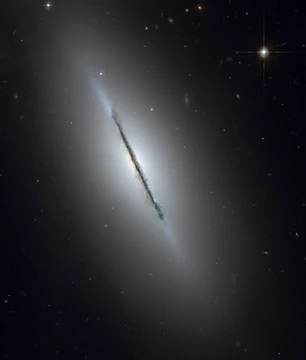
Magellanic spiral
Dwarf spiral galaxies with a single prominent arm, often complex.

A Magellanic spiral is a type of spiral galaxy, often a dwarf, that typically exhibits a single prominent spiral arm, though some, like the Large Magellanic Cloud, have more complex structures including multiple arms and a bar. Astronomers classify it as type Sm, with subcategories SAm (unbarred), SBm (barred), and SABm (intermediate). The Large Magellanic Cloud, an SBm galaxy, serves as the prototype and gives this class its name. These galaxies are typically small dwarfs, falling somewhere between dwarf spirals and irregular galaxies in terms of structure. They tend to appear near larger spiral galaxies, like the Milky Way, which is the case for both the Large and Small Magellanic Clouds.
The classification system was introduced by Gerard de Vaucouleurs, who also defined Magellanic irregulars (Im), as part of his revision of the Hubble sequence. Type Sm and Im galaxies are sometimes grouped with irregular galaxies that have some structure (type Irr-1), and Sm galaxies are often disrupted and asymmetrical. Dwarf versions, called dSm, may be classified as either dwarf spirals or dwarf irregulars depending on the scheme used.
- classification
- Sm (SAm, SBm, SABm)
- prototype
- Large Magellanic Cloud (SBm)
- introduced_by
- Gerard de Vaucouleurs
- related_type
- Magellanic irregular (Im)
- typical_size
- dwarf galaxies
Lore & Background
Magellanic spiral galaxies are often described as having a single prominent spiral arm, but in reality their structure can be more complex—the Large Magellanic Cloud itself has multiple arms and a bar. They are classified under the Sm type, with subcategories for barred (SBm), unbarred (SAm), and intermediate (SABm) forms. The Large Magellanic Cloud serves as the prototype for this class, and the Small Magellanic Cloud is another prominent example.
Stellar populations in these galaxies are varied and not uniformly stratified; the idea that main sequence stars occupy a single arm while supergiants cluster in a rectangular bar is an oversimplification. Sm galaxies are typically disrupted and asymmetric, and they have also been categorized as irregular galaxies with some structure (type Irr-1).
The Magellanic spiral classification was introduced by Gerard de Vaucouleurs, along with the Magellanic irregular (Im) type, when he revamped the Hubble classification of galaxies. The dSm designation is used for dwarf spiral or dwarf irregular galaxies, depending on the categorization scheme.
Reader's Guide
Magellanic spiral galaxies hold significance as a morphological bridge between dwarf spiral galaxies and irregular galaxies. Their single-arm structure and proximity to larger galaxies like the Milky Way make them valuable for studying galaxy interactions and evolution. The Large Magellanic Cloud, as the prototype, is a key object for understanding star formation and stellar populations in a low-mass, disturbed system.
The classification system introduced by Gerard de Vaucouleurs refined the Hubble sequence, acknowledging that not all spirals fit the classic multi-armed pattern. The existence of barred (SBm), unbarred (SAm), and intermediate (SABm) subtypes shows the diversity within this class. Their asymmetric and disrupted nature suggests they are often influenced by tidal forces from larger companions, providing insights into galactic dynamics. The legacy of Magellanic spirals lies in their role as a distinct category that highlights the continuum of galactic forms, from orderly spirals to chaotic irregulars.
Did You Know?
- Magellanic spiral galaxies are often described as having a single spiral arm, but the Large Magellanic Cloud has a more complex structure with multiple arms and a bar.
- The Large Magellanic Cloud is the prototype Magellanic spiral, classified as SBm.
- Stellar populations in Magellanic spirals are diverse and not simply divided between a single arm and a rectangular bar.
- Sm galaxies have also been categorized as irregular galaxies with some structure (type Irr-1).
Frequently Asked Questions
What is a Magellanic spiral galaxy?
It is a dwarf spiral galaxy classified as type Sm, distinguished by having just one dominant spiral arm rather than the multiple arms typical of larger spirals. Structurally it occupies a middle ground between a classic dwarf spiral and an irregular galaxy.
Who introduced the Magellanic spiral classification?
French astronomer Gerard de Vaucouleurs carved this category out of his extended Hubble sequence to capture galaxies that fit awkwardly between standard spirals and irregulars. His work gave the Sm type its formal place in the classification scheme.
Which galaxy is the prototype for the Magellanic spiral class?
The Large Magellanic Cloud, a barred example (SBm), serves as the namesake and reference point for the entire Sm category. Its mix of multiple arms and a central bar made it the anchor astronomers use when defining the type.
What subcategories exist within Magellanic spirals?
The class splits into SAm (unbarred), SBm (barred), and SABm (intermediate between barred and unbarred). These subcategories simply reflect whether the galaxy possesses a central bar structure.
How do Magellanic spirals differ from ordinary spiral galaxies?
They are typically much smaller, falling in the dwarf size range, and usually show only a single prominent spiral arm. They also tend to be found in the vicinity of larger spiral or elliptical galaxies rather than floating alone in intergalactic space.
More in Galaxies And Their Properties 1-21
Spotted an error? Know more?
This is a living reference — every entry is fact-audited, and reader corrections feed straight into our audit queue. Suggest an edit · See this site's audit record