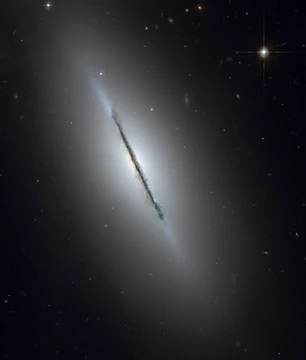
Luminous infrared galaxy
Galaxies that outshine the Sun by 100 billion times in infrared.

Luminous infrared galaxies (LIRGs) are galaxies with luminosities above 10¹¹ L☉, emitting more energy in the infrared than at all other wavelengths combined. They were first discovered in 1983 by the Infrared Astronomical Satellite (IRAS). Many LIRGs are mergers of two or more gas-rich spiral galaxies, and their high luminosity is driven by intense star formation or an active galactic nucleus (AGN).
- luminosity threshold
- > 10¹¹ L☉
- discovery mission
- IRAS (1983)
- typical star formation rate
- ~100 stars per year
- emission dominance
- infrared
- common cause
- mergers of gas-rich spiral galaxies
Lore & Background
LIRGs were first identified in 1983 by the Infrared Astronomical Satellite (IRAS), which detected tens of thousands of galaxies emitting the bulk of their energy in the far infrared. Initially thought to be single, gas-rich spirals, many LIRGs were later found to be mergers of two or more spiral galaxies. The fraction of mergers increases with infrared luminosity. LIRGs are brighter in the infrared because visible light is absorbed by gas and dust, which re-emits thermal energy in the infrared spectrum.
Reader's Guide
LIRGs are significant because they represent a key stage in galaxy evolution, often transitioning into ultraluminous infrared galaxies (ULIRGs) and eventually quasars and elliptical galaxies. They are more abundant than starburst galaxies, Seyfert galaxies, and quasars at comparable luminosity. Their study, particularly through the Great Observatories All-sky LIRG Survey (GOALS), has revealed that they span a range of nuclear types and interaction stages. LIRGs also help explain the growth of supermassive black holes and the high star formation rates in the early universe, as seen in the most luminous examples like ELIRGs.
Did You Know?
- LIRGs emit more energy in the infrared than at all other wavelengths combined.
- Many LIRGs are mergers of two or more gas-rich spiral galaxies.
- LIRGs spawn about 100 new stars per year, compared to the Milky Way's one.
- The first all-sky survey that detected LIRGs was IRAS in 1983.
Frequently Asked Questions
What exactly is a Luminous Infrared Galaxy?
A LIRG is a galaxy whose infrared output exceeds 100 billion times the Sun's total luminosity, meaning it radiates more energy in infrared wavelengths than across every other band combined.
How did astronomers first identify Luminous Infrared Galaxies?
They were spotted in 1983 when data from the IRAS satellite flagged a population of galaxies glowing far brighter in infrared than optical surveys had ever suggested.
What typically turns a galaxy into a LIRG?
The most common trigger is a collision or merger between two gas-rich spiral galaxies, which ignites extreme star-formation rates of roughly 100 new stars per year or supercharges a central active galactic nucleus.
How does a LIRG differ from an ordinary starburst galaxy?
While both involve vigorous star formation, a LIRG is specifically defined by crossing the 10¹¹ solar-luminosity infrared threshold, placing it in its own distinct class rather than simply being a particularly bright starburst.
Why do astronomers consider LIRGs important to study?
They act as natural laboratories for watching how mergers and extreme star formation reshape a galaxy, and their infrared dominance exposes processes that dust clouds would otherwise hide from optical telescopes.
More in Galaxies And Their Properties 1-21
Spotted an error? Know more?
This is a living reference — every entry is fact-audited, and reader corrections feed straight into our audit queue. Suggest an edit · See this site's audit record