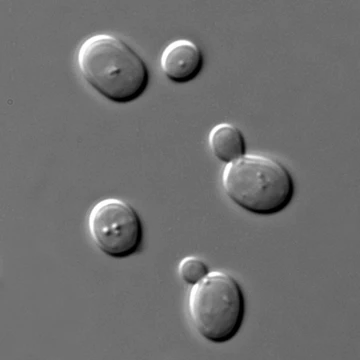
Yeast
Yeasts are unicellular fungi used in fermentation and research.

A yeast is any species of fungus that grows primarily in a unicellular form and reproduces via budding or fission. These eukaryotic microorganisms originated hundreds of millions of years ago, with at least 1,500 species currently recognized, constituting about 1% of all described fungal species. Yeasts are notable for their single-celled growth habit, contrasting with molds that grow hyphae, and some species can develop multicellular characteristics such as pseudohyphae or true hyphae.
- Minimum species count
- 1500
- Typical diameter micrometers
- 3–4
- Maximum diameter micrometers
- 40
- Earliest domestication evidence
- 4,000-year-old bakeries and breweries in Egyptian ruins
- First microscopic observation year
- 1680
- First recognition as fungi year
- 1837
- Pasteur effect demonstration year
- 1857
Lore & Background
The word yeast comes from Old English 'gist' and the Indo-European root '*yes-', meaning 'boil', 'foam', or 'bubble'. Yeast microbes are probably one of the earliest domesticated organisms. Archaeologists have found early grinding stones and baking chambers for yeast-raised bread in Egyptian ruins, along with drawings of 4,000-year-old bakeries and breweries. Vessels from archaeological sites in Israel, dating to around 5,000, 3,000, and 2,500 years ago, contained yeast colonies that had survived, providing direct biological evidence of early yeast use. In 1680, Dutch naturalist Anton van Leeuwenhoek first microscopically observed yeast, though he did not consider them living organisms; Theodor Schwann recognized them as fungi in 1837. In 1857, Louis Pasteur showed that bubbling oxygen into yeast broth increased cell growth but inhibited fermentation—the 'Pasteur effect'—and proved that alcoholic fermentation was conducted by living yeasts.
Reader's Guide
Yeasts are significant for their roles in food production, science, and industry. The species Saccharomyces cerevisiae converts carbohydrates to carbon dioxide and alcohols through fermentation, a reaction used for thousands of years in baking and alcoholic beverage production. S. cerevisiae is also a key model organism in modern cell biology, thoroughly studied to understand eukaryotic and human biology. Other yeasts, such as Candida albicans, are opportunistic pathogens causing human infections. Recently, yeasts have been used to generate electricity in microbial fuel cells and to produce ethanol for biofuel. Yeasts do not form a single taxonomic group; they are placed in two phyla: Ascomycota and Basidiomycota. The budding yeasts, or 'true yeasts', are classified in the order Saccharomycetales within Ascomycota. Yeasts are chemoorganotrophs, obtaining carbon from hexose sugars, and most grow best in neutral or slightly acidic pH. They vary in temperature preferences, with some species growing at −2 °C and others up to 45 °C. Yeasts are common in sugar-rich environments like fruit skins and plant exudates, and are found in soil, insect associations, human skin flora, gut flora, and deep-sea environments.
Did You Know?
- Some yeast species can grow up to 40 μm in diameter.
- The yeast Saccharomyces cerevisiae has been sold commercially for bread-making since 1780.
- Yeasts have been found living between people's toes as part of skin flora.
More in Yeasts 1-24
Spotted an error? Know more?
Reader corrections go straight into our review queue. Suggest an edit · How this site is sourced