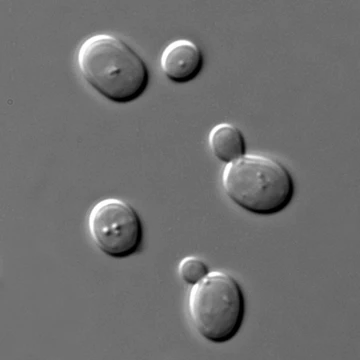
Baker's yeast
A leavening agent that makes bread rise by fermenting sugars.

Baker's yeast is the common name for strains of yeast used in baking bread and other bakery products, serving as a leavening agent that causes dough to rise by converting fermentable sugars into carbon dioxide and ethanol. It is of the species Saccharomyces cerevisiae, the same species as brewer's yeast and nutritional yeast, though a different strain. Baker's yeast is also a single-cell microorganism found on and around the human body.
- Species
- Saccharomyces cerevisiae
- Earliest definite records
- Ancient Egypt
- Year vienna process developed
- 1846
- Year great britain introduced specialize
- 1879
- Year instant yeast created
- 1973
- Developer of granulated active dry yeast
- Fleischmann's
- Creator of instant yeast
- Lesaffre
Lore & Background
It is not known when yeast was first used to bake bread; the earliest definite records come from Ancient Egypt. Researchers speculate that a mixture of flour meal and water left longer than usual on a warm day caused natural yeasts in the flour to ferment, producing lighter bread. The earliest forms of leavening were likely similar to modern sourdough, with yeast cultivated separately or transferred via old dough. The development of leavened bread seems to have occurred in close proximity to beer brewing, and barm from beer fermentation was also used in bread making.
Without an understanding of microbiology, early bakers kept local yeast cultures by reusing doughs and starters. Eventually, it became possible to isolate and propagate favored yeast strains, using a slurry similar to beer wort. Such cultures, sometimes called 'emptins' from beer or cider dregs, became ancestors of modern baker's yeast. In the 19th century, bakers obtained yeast from beer brewers, leading to sweet-fermented breads lacking sourness. When brewers switched to bottom-fermenting yeast, the Vienna Process was developed in 1846, which included better processes for growing and harvesting top-fermenting yeasts known as press-yeast.
Refinements following Louis Pasteur's work led to pure strain culturing. In 1879, Great Britain introduced specialized growing vats for S. cerevisiae, and in the United States around the turn of the century, centrifuges were used for concentrating yeast. Slurry yeast became cream yeast, then compressed yeast. During World War II, Fleischmann's developed granulated active dry yeast for the U.S. armed forces. In 1973, Lesaffre created instant yeast, which rises faster and can be added directly to dry ingredients.
Reader's Guide
Baker's yeast is significant as the primary leavening agent in bread baking, transforming dough through fermentation. Its history reflects a shift from natural, uncontrolled fermentation to industrial production. The development of different forms—cream, compressed, active dry, and instant yeast—allowed for longer storage, easier use, and adaptation to various baking needs. The Vienna Process addressed a yeast shortage when brewers changed yeast types, and later innovations like centrifuges and specialized vats enabled mass production. Active dry yeast, developed for military use during World War II, offered shelf stability without refrigeration. Instant yeast, created in 1973, further simplified baking by eliminating the need for proofing. Modern baker's yeast is notable for being uninhibited by propionates (used to prevent mold) while sorbates inhibit its activity. The choice of yeast form depends on recipe requirements and cook training, with dry forms offering longer storage. Despite advances, wild yeasts like Kazachstania exigua are still used in sourdough starters, preserving traditional methods.
Did You Know?
- Baker's yeast is the same species as brewer's yeast and nutritional yeast, but a different strain.
- The earliest definite records of yeast use in bread come from Ancient Egypt.
- Instant yeast, created by Lesaffre in 1973, can be added directly to dry ingredients without proofing.
More in Yeasts 1-24
Spotted an error? Know more?
Reader corrections go straight into our review queue. Suggest an edit · How this site is sourced