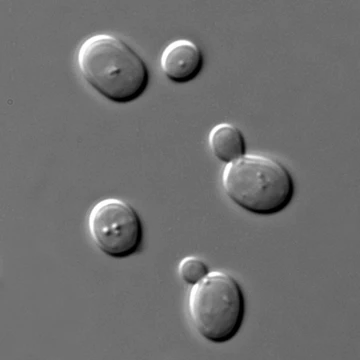
Blastobotrys adeninivorans
A dimorphic yeast with unusual biochemical and biotechnological traits.

Blastobotrys adeninivorans, also known as Arxula adeninivorans, is a dimorphic yeast first described in 1984. It is notable for its unusual biochemical activities, including the ability to assimilate amines, adenine, and other purine compounds as sole energy and carbon sources, as well as its temperature-dependent dimorphism and thermotolerance up to 48 °C.
- First description year
- 1984
- Initial designation
- Trichosporon adeninovorans
- Locations found
- Netherlands, Siberia, South Africa
- Habitats
- soil, wood hydrolysates
- Maximum growth temperature
- 48 °C (118 °F)
- Dimorphism transition temperature
- 42 °C (108 °F)
Lore & Background
The first description of Blastobotrys adeninivorans was provided in 1984, initially designated as Trichosporon adeninovorans. After its first identification in the Netherlands, strains were later found in Siberia and South Africa, in soil and wood hydrolysates. Recently, the species was renamed from Arxula adeninivorans to Blastobotrys adeninivorans following a detailed phylogenetic comparison with other related yeast species, though many scientists desire to maintain the popular name A. adeninivorans.
All strains share unusual biochemical activities, including assimilation of a range of amines, adenine, and several other purine compounds as sole energy and carbon sources, as well as nitrate assimilation. They are thermotolerant, able to grow at temperatures up to 48 °C. A special feature of biotechnological impact is a temperature-dependent dimorphism: at temperatures above 42 °C, a reversible transition from budding cells to mycelial forms is induced, and budding is re-established when the temperature is decreased below 42 °C.
The unusual characteristics render B. adeninivorans attractive for biotechnological applications. It is a source for many enzymes and their genes, such as glucoamylase, tannase, lipase, and phosphatases. It is also a robust and safe organism that can be genetically engineered to produce foreign proteins, with suitable host strains transformable with plasmids similar to those described for Hansenula polymorpha and other yeast expression platforms.
Reader's Guide
The significance of Blastobotrys adeninivorans lies in its biotechnological potential, as described in the source article. It serves as a source for many enzymes with interesting properties, including glucoamylase, tannase, lipase, and phosphatases, and their respective genes. Additionally, it is a robust and safe organism that can be genetically engineered to produce foreign proteins. Two special examples of recombinant strains are provided. In the first, a recombinant strain acquired the capability to produce natural plastics, specifically polyhydroxyalkanoates (PHA), by introducing a new synthetic pathway consisting of three enzymes. The genes phbA, phbB, and phbC were isolated from the bacterium Ralstonia eutropha and integrated into plasmids, which were then introduced into the organism. In the second example, a biosensor for detecting estrogenic activities in wastewater was developed. This involved introducing a gene for the human estrogen receptor alpha (hERalpha) on a first plasmid, and a reporter gene fused to a responsive promoter on a second plasmid. Such strains can be cultured with wastewater, and estrogens present can be quantified by the amount of reporter gene product. These examples illustrate the organism's utility in producing valuable materials and environmental monitoring.
Did You Know?
- Blastobotrys adeninivorans was first described in 1984 and initially designated as Trichosporon adeninovorans.
- It can grow at temperatures up to 48 °C and exhibits reversible dimorphism above 42 °C.
- Recombinant strains have been engineered to produce natural plastics (PHA) using genes from Ralstonia eutropha.
- A biosensor for detecting estrogens in wastewater was developed using this yeast with human estrogen receptor alpha and a reporter gene.
More in Yeasts 1-24
Spotted an error? Know more?
Reader corrections go straight into our review queue. Suggest an edit · How this site is sourced