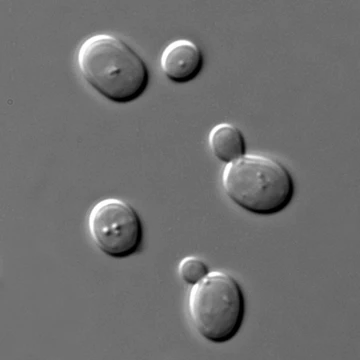
Candida (fungus)
A genus of yeasts causing most fungal infections worldwide.

Candida is a genus of yeasts and the largest genus of medically important yeasts, encompassing about 200 species. It is the most common cause of fungal infections worldwide. Many species are harmless commensals or endosymbionts of hosts including humans, but when mucosal barriers are disrupted or the immune system is compromised, they can cause opportunistic infections.
Quick Facts
- Taxon
- Candida
- Type Species
- Candida vulgaris
- Type Species Authority
- Berkh. (1923)
Facts from the source article.
Lore & Background
Candida species are located on most mucosal surfaces, mainly the gastrointestinal tract and skin. When grown in a laboratory, they appear as large, round, white or cream colonies that emit a yeasty odor on agar plates at room temperature. C. albicans ferments glucose and maltose to acid and gas, and sucrose to acid, but does not ferment lactose, which helps distinguish it from other species. Recent molecular phylogenetic studies show that the genus Candida, as currently defined, is extremely polyphyletic, encompassing distantly-related species that do not form a natural group. For example, Candida glabrata, Candida guilliermondii, and Candida lusitaniae are clearly misclassified and will be placed in other genera once phylogenetic reorganization is complete. Some species of Candida use a non-standard genetic code in which the codon CUG, normally encoding leucine, is translated as serine. This is the only known such alteration in cytoplasmic mRNA involving reassignment of a sense codon.
Reader's Guide
Candida is the most common cause of fungal infections worldwide and the largest genus of medically important yeasts. Many species are harmless commensals, but when mucosal barriers are disrupted or the immune system is compromised, they can cause opportunistic infections. C. albicans is responsible for the majority of Candida bloodstream infections (candidemia), though infections caused by C. glabrata and C. rugosa are increasing, possibly due to lower susceptibility to azole antifungals. Systemic infections affect over 90,000 people a year in the US. Antibiotics promote yeast infections, including gastrointestinal Candida overgrowth. People with diabetes or immunocompromised individuals, such as those with HIV, are more susceptible. In winemaking, some Candida species can spoil wines. Industrially, Candida antarctica and Candida rugosa are sources of lipases, and Candida krusei is used to ferment cacao during chocolate production. C. albicans has also been used with carbon nanotubes to produce electrically conductive bio-nano-composite materials for temperature sensing.
Did You Know?
- Some Candida species use a non-standard genetic code where the codon CUG is translated as serine instead of leucine.
- Candida krusei is prominently used to ferment cacao during chocolate production.
- Candida albicans has been used with carbon nanotubes to create temperature-sensing materials.
More in Yeasts 1-24
Spotted an error? Know more?
Reader corrections go straight into our review queue. Suggest an edit · How this site is sourced