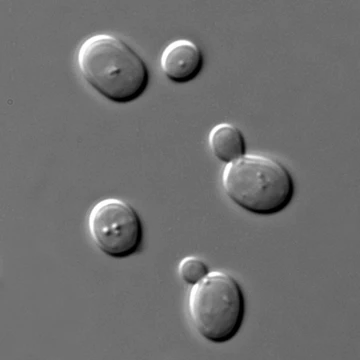
Brettanomyces bruxellensis
A yeast key to Belgian beers but often a wine spoiler.

Brettanomyces bruxellensis (the asexual form of Dekkera bruxellensis) is a yeast originally linked to the Senne valley near Brussels, Belgium, though its name suggests a limited range, it actually appears worldwide. In nature, it commonly lives on fruit skins.
In beer making, this yeast is essential for several traditional Belgian styles, including lambic, Flanders red ale, gueuze, and kriek, and it is part of the spontaneous fermentation process. The Trappist beer Orval contains only small amounts. It naturally inhabits breweries, especially inside oak barrels used for beer during secondary conditioning. There, it carries out a slow, extended fermentation that breaks down more sugars than typical yeast, often working alongside Pediococcus bacteria. When visible, its colonies look whitish and dome-shaped, depending on their age and size. American craft brewers, particularly in Maine, California, and Colorado, are increasingly using it. Breweries such as Jolly Pumpkin Artisan Ales, Allagash Brewing Company, Port Brewing Company, Sierra Nevada Brewing Company, Russian River Brewing Company, and New Belgium Brewing Company have all made beers with B. bruxellensis. These beers have a slightly sour, earthy taste, sometimes described as "barnyard" or "wet horse blanket."
In winemaking, B. bruxellensis is usually seen as a spoilage yeast, often called "brett." Its byproducts can give wine aromas like sweaty saddle leather, barnyard, burnt plastic, or band-aid. Some French winemakers, and occasionally others, view it as desirable—for example, at Château de Beaucastel—but New World vintners mostly consider it a flaw. Some experts blame brett for 90% of spoilage issues in premium red wines. To prevent contamination, producers can avoid grapes from vineyards where it is common and be cautious with used barrels bought from other vintners. Some sanitize used barrels with ozone, steam or soak them in very hot water for hours, or wash them with citric acid or peroxycarbonate. If wine becomes contaminated, vintners may use sterile filtration, add sulfur dioxide, or treat it with dimethyl dicarbonate. Knowledge and experience are key to avoiding brett and its problems.
Biochemically, B. bruxellensis contains the enzyme vinylphenol reductase.
Quick Facts
- Taxon
- Brettanomyces bruxellensis
Facts from the source article.
Lore & Background
Brettanomyces bruxellensis plays a key role in the production of typical Belgian beer styles such as lambic, Flanders red ales, gueuze and kriek, and is part of spontaneous fermentation biota. The Trappist Orval has very little in it as well. It is naturally found in the brewery environment living within oak barrels used for storage of beer during secondary conditioning, where it completes long slow fermentation or super-attenuation, often in symbiosis with Pediococcus sp. Macroscopically visible colonies look whitish and show a dome-shaped aspect, depending on age and size.
In the wine industry, B. bruxellensis is generally considered a spoilage yeast, often referred to as Brettanomyces ('brett'). Its metabolic products can impart 'sweaty saddle leather', 'barnyard', 'burnt plastic' or 'band-aid' aromas to wine. Some winemakers in France, and occasionally elsewhere, consider it a desirable addition to wine, e.g., in Château de Beaucastel, but New World vintners generally consider it a defect. Some authorities consider brett responsible for 90% of spoilage problems in premium red wines.
Defenses against brett include limiting contamination sources, avoiding grapes from affected vineyards, sanitizing used barrels with ozone, steam, hot water, citric acid, or peroxycarbonate. If wine becomes contaminated, vintners may sterile filter it, add SO2, or treat it with dimethyl dicarbonate. Both knowledge and experience are considered helpful in avoiding brett.
Reader's Guide
Brettanomyces bruxellensis holds a dual legacy in fermentation. In beer, it is celebrated as an essential microbe for traditional Belgian styles like lambic, gueuze, and kriek, contributing to spontaneous fermentation and super-attenuation in oak barrels. Its use has spread to American craft brewers, particularly in Maine, California, and Colorado, where breweries such as Allagash, Russian River, and Sierra Nevada produce beers with a slightly sour, earthy character described as 'barnyard' or 'wet horse blanket.'
In wine, however, B. bruxellensis is predominantly viewed as a spoilage organism, responsible for up to 90% of spoilage problems in premium red wines according to some authorities. Its metabolic byproducts create undesirable aromas like 'sweaty saddle leather' and 'burnt plastic.' While a minority of French winemakers, such as at Château de Beaucastel, consider it desirable, New World vintners generally treat it as a defect. Control measures include sourcing grapes from unaffected vineyards, sanitizing barrels with ozone or hot water, and treating contaminated wine with sterile filtration, sulfur dioxide, or dimethyl dicarbonate. The yeast's biochemistry includes the enzyme vinylphenol reductase, which contributes to its characteristic phenolic compounds.
Did You Know?
- Brettanomyces bruxellensis is the anamorph of Dekkera bruxellensis.
- It is naturally found on the skins of fruit in the wild.
- The yeast contains the enzyme vinylphenol reductase.
More in Yeasts 1-24
Spotted an error? Know more?
Reader corrections go straight into our review queue. Suggest an edit · How this site is sourced