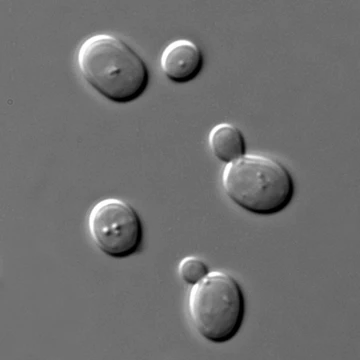
Brettanomyces claussenii
A wild yeast with a negative Pasteur effect, used in fermentation.

Brettanomyces claussenii is a wild yeast of the genus Brettanomyces, known as the anamorph of Dekkera claussenii. It is notable for its negative Pasteur effect, meaning its alcohol fermentation rate is reduced under anaerobic conditions and stimulated by oxygen. The yeast is found on fruit skins and has been used in wine and beer fermentation as well as ethanol production.
Quick Facts
- Taxon
- Brettanomyces claussenii
Facts from the source article.
Lore & Background
In 1889, Seyffert of the Kalinkin Brewery in St. Petersburg first isolated a 'Torula' from English beer that produced a typical English taste in lager beer. In 1899, JW Tullo at Guinness described two types of 'secondary yeast' in Irish stout. However, N. Hjelte Claussen at the Carlsberg brewery published the first description in 1904, following a 1903 patent (UK patent GB190328184A) that was the first patented microorganism in history. Claussen named the genus Brettanomyces, Greek for 'British Fungus,' though an alternative theory holds he named it after his 'beloved' Brittany, not Britain.
Brettanomyces claussenii is used for brewing beer, originally isolated from strong English stock beer. It is a key component in some Belgian ales and sour beers, and fermentation with it is said to help a beer achieve English character. For the most part, Brettanomyces is viewed as a contaminant because it forms compounds that lead to off-flavors in both wine and beer, though several wines and beers use strains in low concentrations for desired taste.
Taxonomically, Brettanomyces claussenii is in kingdom fungi, phylum Ascomycota, subphylum Saccharomycotina (true yeasts), which reproduce asexually through budding. The genus Dekkera can be used interchangeably with Brettanomyces; Dekkera species are the teleomorphic (spore-forming) versions. Dekkera claussenii differs from other Dekkera species in its lack of blastesis and inability to ferment lactose. Examination of mitochondrial DNA showed identical genomes in three pairs of species, including Brettanomyces anomalus and Brettanomyces claussenii.
Reader's Guide
Brettanomyces claussenii holds significance in both traditional and industrial fermentation. Historically, it was first isolated from English beer and later described by Claussen, becoming the first patented microorganism. In brewing, it is valued for imparting English character to beers and is a key component in Belgian ales and sour beers, despite being often viewed as a contaminant due to off-flavor compounds. Its negative Pasteur effect distinguishes it from many other yeasts: fermentation rate decreases without oxygen and increases with oxygen, and it is sensitive to alkali concentrations—potassium accelerates fermentation while sodium slows it. Beyond beverages, Brettanomyces claussenii has been shown to produce ethanol from lignocellulosic material when combined with Pichia Stipitis R, yielding 360–370 liters per ton of prehydrolysed material, though it cannot convert lactose to ethanol. Its identical mtDNA with Brettanomyces anomalus suggests taxonomic redundancy within the genus. The yeast's ability to ferment a variety of substances and its unique metabolic traits make it notable for both traditional fermentation and alternative fuel production.
Did You Know?
- Brettanomyces claussenii was the first patented microorganism in history (UK patent GB190328184A, 1903).
- It shares identical mitochondrial DNA with Brettanomyces anomalus.
- It cannot ferment lactose, unlike several other yeasts.
More in Yeasts 1-24
Spotted an error? Know more?
Reader corrections go straight into our review queue. Suggest an edit · How this site is sourced