Hanseniaspora
Apiculate yeasts with gene losses, thriving in early wine fermentation.

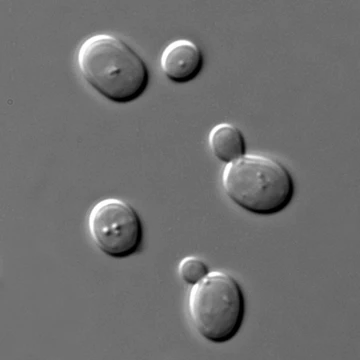
Hanseniaspora is a yeast genus. Its asexual form is called *Kloeckera*. These yeasts are typically lemon-shaped (apiculate) and commonly appear in grape must before fermentation begins. The genus is named after Emil Christian Hansen, a Danish mycologist and fermentation physiologist. H. Zikes first described the genus in 1911, but the name was not validly published until Albert Klöcker did so the following year.
A key feature of Hanseniaspora is the loss of many highly conserved genes that control cell cycle regulation and genome integrity. This loss has led to faster evolution rates and a reduction in genome size. The genus splits into two lineages: a faster-evolving lineage (FEL) that began diversifying around 87 million years ago, and a slower one that started diversifying about 52 million years ago. The FEL has lost even more of these regulatory genes, causing more dramatic genomic changes and the inactivation of several metabolic pathways. Despite this, the FEL has diversified and thrived, demonstrating that life can function without such regulation.
**Role in Fermentation**
Because they occur naturally and resist osmotic pressure, several Hanseniaspora species—especially *H. vineae* and *H. oenarum*—play a significant role in early wine fermentation. As fermentation continues and ethanol levels rise, Hanseniaspora is outcompeted, though *H. osmophila* can tolerate ethanol concentrations up to 11%. Using *H. vineae* in wine fermentation notably affects the final flavors. Compared to *Saccharomyces cerevisiae*, *H. vineae* produces more monoterpenes, sesquiterpenes, and acetoin. Its main olfactory contribution is 2-phenylethyl acetate, which gives a floral, honey-like scent. Additionally, *H. vineae* fermentation results in lower levels of higher alcohols, ethyl esters, and medium-chain fatty acids. Co-inoculations of *Lachancea thermotolerans* with *H. vineae* have been shown to inhibit acidification, producing up to 0.41 g/L of lactic acid. In contrast, a synergistic effect occurs when *L. thermotolerans* is combined with *H. opuntiae*, reaching 2.44 g/L of lactic acid and reducing pH by up to 0.16.
Quick Facts
- Taxon
- Hanseniaspora
- Type Species
- Hanseniaspora valbyensis
- Type Species Authority
- Klöcker (1912)
Facts from the source article.
Lore & Background
The genus name Hanseniaspora honors Emil Christian Hansen (1842–1909), a Danish mycologist and fermentation physiologist. It was initially circumscribed by H. Zikes in 1911, but not validly published; Albert Klöcker published the name validly the following year. The genus can be divided into two lineages: a faster-evolving lineage (FEL) diversifying about 87 mya, and a slower one diversifying about 52 mya. The FEL has more gene losses, resulting in more dramatic changes in the genome and inactivation of multiple metabolic pathways, yet it has managed to diversify and thrive, showing that life can function without such regulation.
Reader's Guide
Due to their natural prevalence and resistance to osmotic pressure, several species of Hanseniaspora, particularly H. vineae and H. oenarum, are significant contributors to early wine fermentation. However, as fermentation progresses and ethanol increases, Hanseniaspora is outcompeted, although H. osmophila is tolerable to ethanol concentrations of up to 11%. The use of H. vineae in wine fermentations has significant effects on end-product flavors. Compared to S. cerevisiae, H. vineae produces more monoterpenes, sesquiterpenes, and acetoin. The primary olfactory contribution is 2-phenylethyl acetate, characterized by a floral (roses), honey scent. In addition, H. vineae fermentation is marked by lower higher alcohols, ethyl esters, and medium chain fatty acids. Co-inoculations with L. thermotolerans/H. vineae showed inhibition of acidification, generating up to 0.41 g/L of lactic acid. In contrast, a synergistic effect was observed when L. thermotolerans/H. opuntiae was used, reaching 2.44 g/L of lactic acid and a pH reduction of up to 0.16.
Did You Know?
- The anamorph form of Hanseniaspora is called Kloeckera.
- Hanseniaspora yeasts are typically apiculate (lemon-shaped).
- The faster-evolving lineage of Hanseniaspora diversified about 87 million years ago.
More in Yeasts 1-24
Spotted an error? Know more?
Reader corrections go straight into our review queue. Suggest an edit · How this site is sourced