Hanseniaspora meyeri
A yeast species with worldwide distribution and apiculate cells.

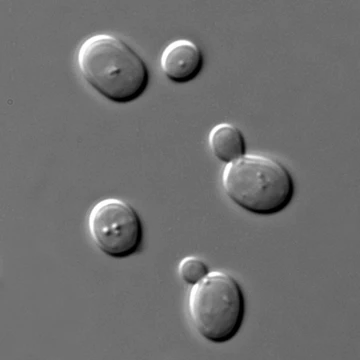
Hanseniaspora meyeri is a yeast species belonging to the Saccharomycetaceae family. Its cells, examined in YM liquid medium after two days at 25 °C, are apiculate, ovoid to elongated, and range from 2.5 to 12.5 μm by 1.5 to 6.0 μm, appearing singly or in pairs. Budding occurs at both ends of the cell. In broth, sediment forms, and after a month, a very thin ring develops. On malt agar after a month at 25 °C, colonies are cream-colored, butyrous, glossy, and smooth, with a flat to slightly raised center and an entire to slightly undulating margin. Poorly developed pseudohyphae appear on cornmeal or potato agar. When grown for at least two weeks on 5% Difco malt extract agar, the yeast produces two to four hat-shaped ascospores.
The species ferments glucose and cellobiose but not galactose, sucrose, maltose, lactose, raffinose, or trehalose. It grows at 30 °C but not at 35 °C. It can grow on agar containing 0.1% cycloheximide and 10% sodium, though growth on 50% glucose-yeast extract agar is weak. It also grows on media with 2-Keto-d-gluconate as the sole carbon source.
The first sample was isolated from a soapberry fruit in Hawaii, and the species name "meyeri" honors Piet Meyer, a young South African scientist. Genetic sequencing shows it is very closely related to *Hanseniaspora clermontiae*. Beyond its Hawaiian origin, the yeast has been found worldwide: in spoiled grape punch in Georgia, USA; in flowers of the *Schotia* tree in South Africa; in stem rot of *Clermontia* species; and in fruit flies on soapberry berries in Hawaii. Its human pathogenic potential is unknown, but it cannot grow at normal body temperature.
Quick Facts
- Taxon
- Hanseniaspora meyeri
Facts from the source article.
Lore & Background
The first isolated sample of Hanseniaspora meyeri was obtained from the fruit of a soapberry plant in Hawaii. Its specific epithet 'meyeri' honors Piet Meyer, a young South African scientist. Genetic sequencing shows the species is very closely related to Hanseniaspora clermontiae.
Microscopic examination in YM liquid medium after 48 hours at 25 °C reveals cells that are 2.5 to 12.5 μm by 1.5 to 6.0 μm, apiculate, ovoid to elongate, appearing singly or in pairs. Reproduction is by budding at both poles. In broth culture, sediment is present, and after one month a very thin ring forms. Colonies on malt agar after one month at 25 °C appear cream-colored, butyrous, glossy, and smooth, with flat to slightly raised centers and entire to slightly undulating margins. The yeast forms poorly-developed pseudohyphae on cornmeal or potato agar and produces two to four hat-shaped ascospores after at least two weeks on 5% Difco malt extract agar.
It can ferment glucose and cellobiose, but not galactose, sucrose, maltose, lactose, raffinose or trehalose. It has positive growth at 30 °C but no growth at 35 °C. It can grow on agar containing 0.1% cycloheximide and 10% sodium, but growth on 50% glucose-yeast extract agar is weak. It can grow on media with 2-Keto-d-gluconate as a sole carbon source.
Reader's Guide
Hanseniaspora meyeri is significant as a species with a broad ecological range, having been isolated from diverse substrates including flowers, fruit flies, stem rot, and spoiled grape punch across multiple continents. Its discovery in Hawaii from a soapberry fruit, and subsequent isolations from Georgia (USA), South Africa, and Hawaii, illustrate its global presence. The species is closely related to Hanseniaspora clermontiae, as determined by genetic sequencing, placing it within a well-defined taxonomic group. Its inability to grow at 35 °C, including normal human body temperature, suggests it is not a human pathogen, though its pathogenic potential is not fully known. The yeast's distinctive apiculate cell shape, bipolar budding, and hat-shaped ascospores are characteristic features. Its fermentation profile—fermenting glucose and cellobiose but not several other common sugars—helps distinguish it from related species. The species was named after Piet Meyer, a young South African scientist, honoring his contributions. Overall, H. meyeri contributes to understanding yeast biodiversity and ecology in natural and human-associated environments.
Did You Know?
- It has been isolated from spoiled grape punch in Georgia, USA.
- It forms two to four hat-shaped ascospores on 5% Difco malt extract agar.
More in Yeasts 1-24
Spotted an error? Know more?
Reader corrections go straight into our review queue. Suggest an edit · How this site is sourced