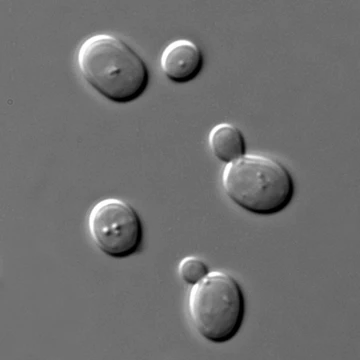
Hanseniaspora lachancei
A yeast from fermenting agave juice and a tequila facility.

Hanseniaspora lachancei belongs to the yeast family Saccharomycetaceae. This species is primarily known from fermenting agave juice and a tequila production site in Mexico, and it stands out among its genus because it can grow at 37 °C.
The first samples were collected at the Tequila Herradura estate in Jalisco, Mexico, over a week in February 1992. Initially, researchers mistook them for unusual strains of *Hanseniaspora guilliermondii*, but later analysis showed they were a distinct species. The yeast was formally described in 2003 by Neža Čadež, Gé A. Poot, Peter Raspor, and Maudy Th. Smith, who named it after Marc-André Lachance, the taxonomist and ecologist who gathered the original samples. Genetic work reveals that *H. lachancei* is closely related to *Hanseniaspora opuntiae*, *Hanseniaspora pseudoguilliermondii*, and *Hanseniaspora guilliermondii*.
Under a microscope, cells grown in YM liquid medium for 48 hours at 25 °C measure 2.5 to 18.5 μm by 1.0 to 5.5 μm. They are apiculate, ovoid to elongate, and appear singly or in pairs. Budding occurs at both poles. In broth, sediment forms, and after a month a very thin ring appears. On malt agar after one month at 25 °C, colonies are cream-colored, butyrous, glossy, and smooth. Growth is flat to slightly raised in the center, with an entire to slightly wavy edge. On cornmeal or potato agar, the yeast produces poorly-developed pseudohyphae. When kept on 5% Difco malt extract agar for at least seven days, it forms four hat-shaped ascospores.
The yeast ferments glucose and cellobiose but not galactose, sucrose, maltose, lactose, raffinose, or trehalose. It grows at 37 °C—a trait that sets it apart from other *Hanseniaspora* species—but not at 40 °C. It can grow on media containing 0.1% cycloheximide and 10% sodium, though growth on 50% glucose-yeast extract agar is weak.
Three strains have been isolated from fermenting agave juice in Mexico and from *Drosophila* flies caught inside a tequila facility. Whether it can cause disease in humans is unknown, but its ability to grow at normal body temperature is noted.
Quick Facts
- Taxon
- Hanseniaspora lachancei
Facts from the source article.
Lore & Background
Samples of H. lachancei were first isolated from the Tequila Herradura estate in Jalisco, Mexico over a seven-day period in February 1992. Initially misidentified as atypical Hanseniaspora guilliermondii strains, further testing showed they were distinct. The species was first described in 2003 by Neža Čadež, Gé A. Poot, Peter Raspor, and Maudy Th. Smith, who gave it the specific epithet 'lachancei' after Marc‑André Lachance, the yeast taxonomist and ecologist who collected the original samples. Genetic sequencing reveals it is closely related to Hanseniaspora opuntiae, Hanseniaspora pseudoguilliermondii, and Hanseniaspora guilliermondii.
Microscopic examination in YM liquid medium after 48 hours at 25 °C shows cells that are 2.5–18.5 μm by 1.0–5.5 μm, apiculate, ovoid to elongate, appearing singly or in pairs. Reproduction is by bipolar budding. In broth culture, sediment is present, and after one month a very thin ring forms. Colonies on malt agar after one month at 25 °C are cream‑colored, butyrous, glossy, and smooth, with flat to slightly raised centers and entire to slightly undulating margins. Poorly developed pseudohyphae form on cornmeal or potato agar. Four hat‑shaped ascospores are observed after at least seven days on 5% Difco malt extract agar.
The yeast ferments glucose and cellobiose, but not galactose, sucrose, maltose, lactose, raffinose, or trehalose. It grows at 37 °C (a distinguishing trait from other Hanseniaspora species) but not at 40 °C. It grows on media containing 0.1% cycloheximide and 10% sodium, but growth on 50% glucose‑yeast extract agar is weak.
Reader's Guide
Hanseniaspora lachancei holds significance primarily as a species discovered in a specific industrial and ecological context: fermenting agave juice and a tequila production facility in Mexico. Its initial misidentification as atypical Hanseniaspora guilliermondii highlights the challenges of yeast taxonomy and the importance of molecular methods, as genetic sequencing later confirmed its distinctness and its close relationship to H. opuntiae, H. pseudoguilliermondii, and H. guilliermondii. The species was formally described in 2003, with its epithet honoring Marc‑André Lachance, the collector of the original samples. Its ability to grow at 37 °C is noted as a distinguishing characteristic from other Hanseniaspora species, though its human pathogenic potential is unknown. The species has been isolated from fermenting agave juice and from Drosophila species captured inside a tequila facility, suggesting an ecological link to the agave fermentation environment and associated insect vectors. Its physiological profile—including fermentation of only glucose and cellobiose, and weak growth on high‑sugar media—provides a baseline for future comparative studies within the genus. The description of its microscopic and colonial morphology, along with its ascospore formation, contributes to the taxonomic framework of the Saccharomycetaceae family.
Did You Know?
- The species was first isolated from the Tequila Herradura estate in Jalisco, Mexico in February 1992.
- It was initially misidentified as atypical Hanseniaspora guilliermondii before being recognized as distinct.
- The specific epithet 'lachancei' honors yeast taxonomist and ecologist Marc‑André Lachance, who collected the original samples.
- It can grow at 37 °C, a trait that distinguishes it from other Hanseniaspora species.
More in Yeasts 1-24
Spotted an error? Know more?
Reader corrections go straight into our review queue. Suggest an edit · How this site is sourced