Hanseniaspora guilliermondii
A yeast from nail, fruits, and insects.

Hanseniaspora guilliermondii is a species of yeast in the family Saccharomycetaceae, originally isolated from an infected human nail. It is notable for its association with fruits, plants, fermenting musts, and insects, and for producing acetoin, a compound used in food and fragrances.
Quick Facts
- Taxon
- Hanseniaspora guilliermondii
Facts from the source article.
Lore & Background
The initial sample of Hanseniaspora guilliermondii was isolated by South African pathologist Adrianus Pijper from an infected nail of a patient. In 1952, the species was placed in synonymy with Hanseniaspora valbyensis, but in 1968, N. J. W. Kerger-Van Rij and Donald G. Ahearn observed physiological and morphological differences and proposed a resumed separation. Their study identified that a strain originally described as H. melligeri by J. Lodder in 1932, isolated from dates and later synonymized with H. valbyensis, was actually synonymous with H. guilliermondii. Further DNA testing by Meyer, Brown, and Smith in 1977 confirmed these findings, and additional DNA examination in 1978 showed that samples from grape juice identified as H. apuliensis by Castelli in 1948 were also synonymous with H. guilliermondii. Yeast samples from a bee obtained by P. Lavie in 1954, designated as Kloeckera apis, were found to be the anamorph form of H. guilliermondii.
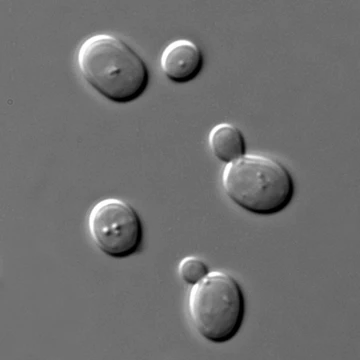
Microscopically, cells in YM liquid medium after 48 hours at 25°C are 2.2 to 5.8 μm by 4.5 to 10.2 μm, apiculate, ovoid to elongate, appearing singly or in pairs. Reproduction is by bipolar budding. In broth culture, sediment forms, and after one month a very thin ring appears. Colonies on malt agar after one month at 25°C are white to cream, glossy, smooth, and slightly raised at the center. The yeast forms poorly-developed pseudohyphae on potato agar or none. It produces one to four, mostly four, hat-shaped ascospores on 5% Difco malt extract agar or potato dextrose agar, which tend to clump when released.
The yeast ferments glucose but not galactose, sucrose, maltose, lactose, raffinose, or trehalose. It grows at 37°C but not at 40°C, and can grow on media containing 0.1% cycloheximide and utilize 2-keto-d-gluconate as a sole carbon source. Although originally from a clinical setting, it is primarily associated with fruits, plants, fermenting musts, and insects. Strains produce acetoin.
Reader's Guide
Hanseniaspora guilliermondii holds significance as a yeast species with a complex taxonomic history, having been synonymized with and later separated from Hanseniaspora valbyensis through physiological, morphological, and DNA studies. Its isolation from a clinical source—an infected nail—contrasts with its primary ecological role in fruits, plants, fermenting musts, and insects, highlighting its adaptability. The species produces acetoin, a chemical valued in food and fragrance industries, which may contribute to its relevance in fermentation and biotechnology. The identification of its anamorph form, Kloeckera apis, from a bee underscores its association with insects and pollination environments. Its ability to grow at 37°C and tolerate cycloheximide suggests potential for medical or industrial applications, though the article does not elaborate on such uses. The species' legacy is rooted in the taxonomic debates resolved through DNA testing in the 1970s, which clarified its distinctness from related yeasts and incorporated strains from dates and grape juice into its classification. This history illustrates the evolving understanding of yeast diversity and the importance of molecular methods in resolving synonymies.
Did You Know?
- The species was first isolated from an infected human nail by South African pathologist Adrianus Pijper.
- Its anamorph form is called Kloeckera apis, originally obtained from a bee by P. Lavie in 1954.
- It produces acetoin, a chemical used in food products and fragrances.
- The yeast forms one to four, mostly four, hat-shaped ascospores that clump together when released.
More in Yeasts 1-24
Spotted an error? Know more?
Reader corrections go straight into our review queue. Suggest an edit · How this site is sourced