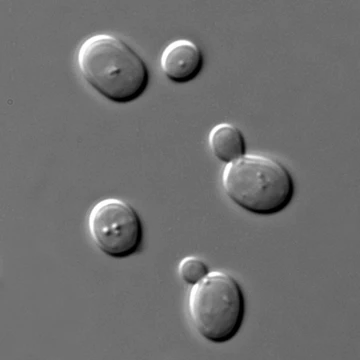
Hanseniaspora gamundiae
A Patagonian yeast from Cyttaria mushrooms, key to chicha fermentation.

Hanseniaspora gamundiae belongs to the yeast family Saccharomycodaceae. This species was first collected from the stromata of edible *Cyttaria hariotii* mushrooms growing on southern beech trees in Patagonia during spring 2007. Genetic analysis confirmed it as a new species, and it was named after Dr. Irma Gamundi, an Argentine mycologist recognized for her work on fungi, particularly the genus *Cyttaria*. Its closest relatives, based on DNA sequencing, are *Hanseniaspora taiwanica* and *Hanseniaspora occidentalis*.
Under a microscope, after 48 hours in YM liquid medium at 25°C, the cells measure 4.3 to 15.7 μm by 2.4 to 4.7 μm. They are apiculate, ovoid to elongated, and appear singly or in pairs. Budding occurs at both poles of the cell. In broth, sediment forms, and after one month a very thin ring develops. On malt agar at 25°C for one month, colonies are cream-colored, butyrous, glossy, and smooth, with a flat to slightly raised center and an entire to slightly undulating margin. On cornmeal agar, the yeast produces poorly developed pseudohyphae. After at least two weeks on 5% Difco malt extract agar, it forms one or two spherical, warty ascospores.
The yeast ferments glucose and weakly ferments sucrose, but not galactose, cellobiose, maltose, or lactose. It assimilates glucose, sucrose, cellobiose, arbutin, and salicin. Growth occurs at 30°C but not at 35°C. It grows on agar with 10% sodium chloride but not with 16%. No growth is seen on agar with 50% glucose-yeast extract, 1% acetic acid, or 0.01% cycloheximide.
This species was discovered during a survey of yeasts on *Cyttaria* mushrooms. Mature *Cyttaria* fruiting bodies contain up to 10.2% fructose, glucose, and sucrose, a sugar composition similar to grape juice—a habitat where *Hanseniaspora* species are commonly found. The Mapuche people of Patagonia used these mushrooms in several ways, including making an alcoholic beverage called chicha. They collected mature stromata, either squeezing out the juice or soaking them in cooled boiled water for a few days, allowing spontaneous fermentation. Given the yeast community on *Cyttaria*, *Hanseniaspora gamundiae* is thought to drive the early fermentation stages, after which naturally occurring *Saccharomyces cerevisiae*, *Saccharomyces uvarum*, or *Saccharomyces eubayanus* take over.
Quick Facts
- Taxon
- Hanseniaspora gamundiae
Facts from the source article.
Lore & Background
Samples of H. gamundiae were first isolated from the stromata of edible Cyttaria hariotii mushrooms growing on southern beech trees in Patagonia in Spring 2007. Genetic testing revealed it was a previously undescribed species, and it was given the specific epithet 'gamundiae' in honor of Dr. Irma Gamundi for her taxonomic work with fungi, particularly the Cyttaria genus. Genetic sequencing shows the species is closely related to Hanseniaspora taiwanica and Hanseniaspora occidentalis.
Microscopic examination in YM liquid medium after 48 hours at 25°C shows apiculate, ovoid to elongate cells, 4.3–15.7 μm by 2.4–4.7 μm, appearing singly or in pairs. Reproduction is by bipolar budding. On malt agar after one month at 25°C, colonies are cream-colored, butyrous, glossy, and smooth. The yeast forms poorly developed pseudohyphae on cornmeal agar and produces one to two spherical and warty ascospores on 5% Difco malt extract agar after at least two weeks.
The yeast ferments glucose and weakly ferments sucrose, but not galactose, cellobiose, maltose, or lactose. It assimilates glucose, sucrose, cellobiose, arbutin, and salicin. It grows at 30°C but not at 35°C, and can grow on media with 10% sodium chloride but not 16%. Growth is absent on media with 50% glucose-yeast extract agar, 1% acetic acid, or 0.01% cycloheximide.
Reader's Guide
Hanseniaspora gamundiae was collected during a study of yeasts on Cyttaria mushrooms. Mature Cyttaria mushrooms contain up to 10.2% fructose, glucose, and sucrose, a composition resembling grape juice, a habitat known for Hanseniaspora species. The Mapuche people of Patagonia consumed Cyttaria in several ways, including producing the alcoholic beverage chicha by collecting mature stromata and either squeezing them for juice or leaving them in cooled boiled water for a few days to ferment spontaneously. Due to the yeast composition found in Cyttaria, H. gamundiae is believed to play a significant role in the early stages of chicha fermentation, followed by naturally occurring Saccharomyces cerevisiae, Saccharomyces uvarum, or Saccharomyces eubayanus. Its discovery highlights the ecological link between native yeasts and traditional fermentation practices in Patagonia.
Did You Know?
- Hanseniaspora gamundiae was first isolated in Spring 2007 from Cyttaria hariotii mushrooms on southern beech trees in Patagonia.
- The species is named after Dr. Irma Gamundi for her taxonomic work with fungi, especially the Cyttaria genus.
- It can ferment glucose and weakly ferment sucrose, but not galactose, cellobiose, maltose, or lactose.
- The Mapuche people used Cyttaria mushrooms to produce the alcoholic beverage chicha, in which H. gamundiae likely initiates fermentation.
More in Yeasts 1-24
Spotted an error? Know more?
Reader corrections go straight into our review queue. Suggest an edit · How this site is sourced