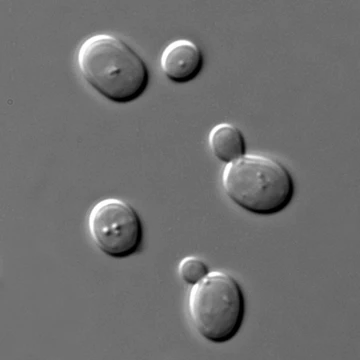
Hanseniaspora clermontiae
Yeast isolated from stem rot of a Hawaiian lobelioid plant.

Hanseniaspora clermontiae belongs to the yeast family Saccharomycetaceae. The first sample of this species came from stem rot on a lobelioid plant in Hawaii, and it may be found nowhere else but the Hawaiian Islands.
Its scientific name was established in 2003 by Neža Čadež, Gé A. Poot, Peter Raspor, and Maudy Th. Smith, who isolated it from a rotting stem of a *Clermontia* plant. The species name honors that host plant.
Under a microscope, cells grown in YM liquid medium for two days at 25°C measure 3.5 to 18 μm by 2.5 to 5.0 μm. They are apiculate, ovoid to elongated, and appear alone or in pairs. Budding occurs at both ends of the cell. In broth, sediment forms, and after a month a very thin ring appears. On malt agar at 25°C, one-month-old colonies are cream-colored, butyrous, and smooth, with a flat to slightly raised center and an entire to slightly wavy edge. Poorly developed pseudohyphae form on cornmeal or potato agar. When grown for two weeks on 5% Difco malt extract agar, the yeast produces two to four hat-shaped ascospores.
This yeast ferments glucose and cellobiose but not galactose, sucrose, maltose, lactose, raffinose, or trehalose. It grows well at 25°C but not at 30°C or higher. It can grow on agar with 0.1% cycloheximide and 10% sodium, though growth on 50% glucose-yeast extract agar is weak.
The type specimen was collected in Hawaii. In 2005, Marc-André Lachance suggested the species might be endemic to the Hawaiian Islands. Because it cannot grow at human body temperature, it is not considered a likely human pathogen.
Quick Facts
- Taxon
- Hanseniaspora clermontiae
Facts from the source article.
Lore & Background
The species was first described by Neža Čadež, Gé A. Poot, Peter Raspor, and Maudy Th. Smith in 2003 after isolating a sample in stem rot of a Clermontia plant in Hawaii. The specific epithet is derived from the genus name of the host plant where it was first isolated. Microscopic examination of the yeast cells in YM liquid medium after 48 hours at 25°C reveals cells that are 3.5 to 18 μm by 2.5 to 5.0 μm in size, apiculate, ovoid to elongate, appearing singly or in pairs. Reproduction is by budding, which occurs at both poles of the cell. In broth culture, sediment is present, and after one month a very thin ring is formed. Colonies that are grown on malt agar for one month at 25°C appear cream-colored, butyrous, and smooth. Growth is flat to slightly raised at the center, with an entire to slightly undulating margin. The yeast forms poorly-developed pseudohyphae on cornmeal or potato agar. The yeast has been observed to form two to four hat-shaped ascospores when grown for two weeks on 5% Difco malt extract agar. The yeast can ferment glucose and cellobiose, but not galactose, sucrose, maltose, lactose, raffinose or trehalose. It has a positive growth rate at 25°C, but no growth at 30°C or above. It can grow on agar media containing 0.1% cycloheximide and 10% sodium but growth on 50% glucose-yeast extract agar is weak. The type sample was obtained in Hawaii, and in 2005, Marc-André Lachance described the species as possibly endemic to the Hawaiian Islands. It is considered unlikely to be a human pathogen due to its inability to grow at human body temperatures.
Reader's Guide
Hanseniaspora clermontiae is notable primarily for its discovery in a unique ecological niche: stem rot of a Clermontia plant, a lobelioid endemic to Hawaii. Its description in 2003 by Čadež and colleagues added a new species to the genus Hanseniaspora, and its potential endemism to the Hawaiian Islands, as suggested by Lachance in 2005, highlights the specialized yeast diversity of isolated island ecosystems. The species' inability to grow at 30°C or above, and consequently at human body temperature, indicates it is unlikely to be a human pathogen, which is a significant safety consideration. Its fermentation profile—fermenting glucose and cellobiose but not several common sugars—distinguishes it metabolically from related yeasts. The formation of hat-shaped ascospores and bipolar budding are characteristic microscopic features. The species' weak growth on high-glucose media and tolerance of cycloheximide and 10% sodium provide additional physiological markers. Overall, H. clermontiae represents a yeast adapted to a specific plant-associated habitat in Hawaii, with no known pathogenic potential, making it of interest for studies of island biogeography and yeast ecology.
Did You Know?
- The yeast forms two to four hat-shaped ascospores on 5% Difco malt extract agar.
- It cannot grow at 30°C or above, making it unlikely to be a human pathogen.
- The type sample was isolated from stem rot of a lobelioid plant in Hawaii.
More in Yeasts 1-24
Spotted an error? Know more?
Reader corrections go straight into our review queue. Suggest an edit · How this site is sourced