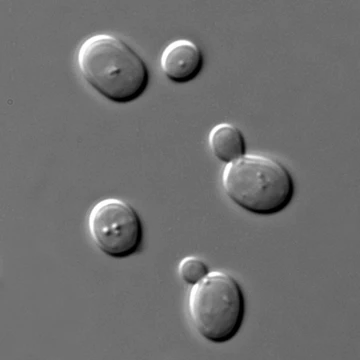
Diutina catenulata
A globally distributed yeast with bioremediation potential and rare pathogenicity.

Diutina catenulata is a yeast-form fungus in the phylum Ascomycota, distributed globally and commonly found on the skin of humans and animals, in soil, and in dairy products. It is notable for its reclassification from the genus Candida to the new genus Diutina based on phylogenetic analysis, and for its potential in bioremediation of oil-contaminated environments.
Quick Facts
- Genus
- Diutina
- Species
- catenulata
Facts from the source article.
Lore & Background
Diutina catenulata was originally assigned to the genus Candida, implying close relatedness to Candida tropicalis. However, tRNA, rRNA, and other phylogenetic analyses revealed it is not closely related to C. tropicalis, leading to its reclassification into the new genus Diutina. This change also moved its family classification from Saccharomycetaceae to Debaryomycetaceae/Metschnikowiaceae, while its membership in phylum Ascomycota, class Saccharomycetes, and order Saccharomycetales remained unchanged. Morphologically, D. catenulata can live as a yeast or as a pseudomycelium composed of pseudohyphae and capsule-shaped cells measuring 1-2 micrometers by 5-7 micrometers. Ecologically, it is a component of the skin and gut microbiome of humans and animals, a soil microbiome fungus, a dairy product contaminant, and an occasional opportunistic pathogen. In soil, it is most strongly associated with the necrobiome community, with populations growing to compose a significant portion of soil communities surrounding cadavers over time. As an opportunistic pathogen, infections most commonly manifest as superficial skin infections. A rare case of invasive infection was recorded in a 42-year-old woman in Strasbourg, France, who was found to be invasively infected after blood cultures were prepared upon re-admittance to a hospital post cancer treatment; this is the only recorded case of invasive infection by D. catenulata.
Reader's Guide
Diutina catenulata holds significance primarily through its ecological roles and its demonstrated potential in bioremediation. As a globally distributed yeast found on human and animal skin, in soil, and in dairy products, it is a common component of various microbiomes. Its association with the soil necrobiome, where it can become a dominant community member in soils surrounding cadavers, highlights its role in decomposition processes. In a laboratory setting, D. catenulata colonies supplied with food waste and composting degraded approximately 80% of petroleum hydrocarbons in diesel fuel-inoculated environments, compared to 48% degradation in un-inoculated colonies. This indicates the species is promising for bioremediation of oil-contaminated environments. Medically, while it is an occasional opportunistic pathogen causing superficial skin infections, only one case of invasive infection has been recorded, involving a 42-year-old woman in Strasbourg, France, following cancer treatment. The reclassification of this species from Candida to Diutina, based on phylogenetic evidence, underscores the ongoing refinement of fungal taxonomy and the importance of molecular methods in clarifying evolutionary relationships.
Did You Know?
- Diutina catenulata was reclassified from the genus Candida based on tRNA, rRNA, and other phylogenetic analysis.
- In lab settings, D. catenulata degraded approximately 80% of petroleum hydrocarbons in diesel fuel-inoculated colonies.
- D. catenulata is most strongly associated with the necrobiome soil community in soils surrounding cadavers.
More in Yeasts 1-24
Spotted an error? Know more?
Reader corrections go straight into our review queue. Suggest an edit · How this site is sourced