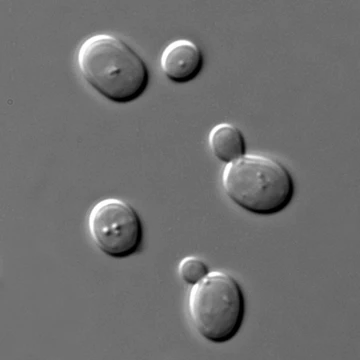
Debaryomyces hansenii
An osmotolerant yeast found in cheese, beer, and hypersaline waters.

Debaryomyces hansenii (also called *Candida famata*) is a yeast belonging to the Saccharomycetaceae family. It is responsible for up to 2% of invasive candidiasis cases in humans. The yeast has been detected in ulcerations associated with Crohn’s disease, and researchers are exploring whether it acts as an environmental trigger for the condition. Some strains are being studied as potential probiotics, with possible health benefits.
This yeast is osmotolerant, halotolerant, and xerotolerant, and it produces toxins such as mycocins that kill competing yeast species. It is common in all types of cheese, including soft cheeses and the brines used for semi-hard and hard varieties. Among 383 isolates from unsulfited and sulfited sausages, skinless sausages, and minced beef, it was the most frequently found yeast. It also contributes to the fermentation of barrel-aged beers, such as Le Coq Imperial Stout from Harveys Brewery in southern England; the brewery’s head brewer suspects it is either airborne in the facility or a slow-growing part of their house yeast blend. Additionally, *D. hansenii* lives in hypersaline waters, including salterns on Namibia’s Atlantic coast and the Great Salt Lake in Utah.
The species can be grown in media containing up to 25% NaCl or 18% glycerol. Its growth rate increases in solutions with 1M or more NaCl or KCl, with sodium and potassium ions playing a key role in maintaining osmotic balance. It survives a pH range of 3 to 10. It also has the highest perchlorate tolerance reported for any species, which may have implications for microbial life on Mars, where perchlorate salts are widespread.
Most strains are haploid and rarely mate; they transiently diploidize through somatogamous autogamy (fusion of two cells without nuclear fusion). Sexual reproduction occurs via heterogamous conjugation (fusion of two differently sized cells), leading to a short diploid phase followed by meiosis and ascospore formation. Haploid yeasts reproduce vegetatively through multilateral budding.
The species has seven chromosomes, labeled A through G. It uses an alternative genetic code for the codon CUG, translating it as serine instead of the usual leucine.
To distinguish *D. hansenii* from other ascomycetous yeasts, its ability to grow at 10% NaCl or 5% glucose is used. It comprises two varieties: *D. hansenii* var. *hansenii* and var. *fabryii*.
Quick Facts
- Taxon
- Debaryomyces hansenii
Facts from the source article.
Lore & Background
Debaryomyces hansenii is an osmo-, halo- and xerotolerant yeast that produces toxins, including mycocins, to destroy competitive yeast species. It is a common species in all types of cheese, including soft cheeses and the brines of semi-hard and hard cheeses, and the most common yeast among 383 isolates from samples of unsulfited or sulfited sausages, skinless sausages and minced beef. It contributes to the fermentation of barrel-aged beers such as Le Coq Imperial Stout from Harveys Brewery in southern England, where the head brewer speculates it is either airborne in the brewery or a slow-growing component of their house yeast blend. D. hansenii is also found in hyper-saline waters such as the salterns on the Atlantic coast of Namibia or in the Great Salt Lake of Utah.
The species can be cultivated in media with up to 25% NaCl or 18% glycerol. Growth rate increases in solutions with ≥ 1M NaCl or KCl, with sodium and potassium ions playing a very important role in the mechanisms involved in maintaining osmobalance. The species can survive a pH range between 3 and 10. Furthermore, D. hansenii has been described as the species with the highest perchlorate tolerance reported to date, which might have consequences for the microbial habitability of Mars, where perchlorate salts are widely distributed.
Most strains are haploid, mating very rarely and diploidize transiently by somatogamous autogamy. Sexual reproduction proceeds via heterogamous conjugation leading to short diplophase followed by meiosis and ascospore formation. Haploid yeasts reproduce vegetatively by multilateral budding. This species has seven chromosomes, labeled A-G, and uses an alternative genetic code for the codon CUG, coding for serine instead of leucine.
Reader's Guide
Debaryomyces hansenii accounts for up to 2% of invasive candidiasis cases, indicating its clinical relevance as an opportunistic pathogen. It has been found in Crohn's disease ulcerations in humans and is being investigated as the environmental trigger of Crohn's disease. Conversely, certain strains have been researched for potential use as probiotics and may have health benefits. In biotechnology, the species has been demonstrated to synthesize useful quantities of D-arabinitol, riboflavin, xylitol, and pyruvic acid under thiamine limitation. It has also been used to decarboxylate ferulic acid to 2-Methoxy-4-vinylphenol via biotransformation, achieving a 95.07% yield (1470.8 mg/L) within 10 hours. The ability to grow at 10% NaCl or 5% glucose is used to discriminate D. hansenii from other ascomycetous yeasts. The species comprises two varieties—D. hansenii var. hansenii and var. fabryii—which can be differentiated via rRNA, electrophoretic mobility of glucose-6-phosphate dehydrogenase, or maximum growth temperatures (35 °C for var. hansenii and 39 °C for var. fabryii). Its perchlorate tolerance raises astrobiological interest for Mars habitability.
Did You Know?
- It has been found in Crohn's disease ulcerations and is investigated as a possible environmental trigger.
- The species can tolerate up to 25% NaCl or 18% glycerol in culture media.
- It uses an alternative genetic code where the codon CUG codes for serine instead of leucine.
More in Yeasts 1-24
Spotted an error? Know more?
Reader corrections go straight into our review queue. Suggest an edit · How this site is sourced