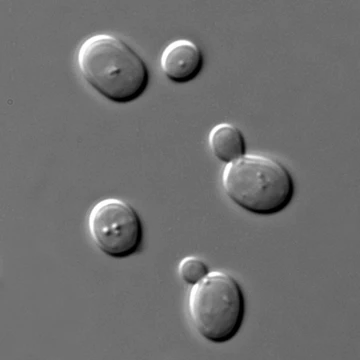
Candida tropicalis
A common yeast pathogen in neutropenic hosts, treatable with several antifungals.

Candida tropicalis is a yeast species belonging to the genus *Candida*. It frequently causes disease in people with neutropenia, where it can travel through the bloodstream and reach distant organs. Invasive infections are treated with drugs such as amphotericin B, echinocandins, or extended-spectrum triazole antifungals.
The genus name *Candida* comes from the Latin word for "glowing white," referring to the smooth, shiny appearance of its colonies. This genus is part of the family Debaryomycetaceae. Historically, any asexual yeast that did not produce acetic acid, red/pink/orange pigments, arthroconidia, unipolar or bipolar budding, enteroblastic-basipetal budding, blastoconidia on sympodulae, buds on stalks, triangular cells, needle-shaped terminal conidia, or grow on inositol as its sole carbon source was placed in *Candida*. Though around 200 species are recognized, the taxonomy remains unsettled due to name changes, new discoveries, and reclassification of older species. Species that test positive for diazonium blue B are no longer included in this genus. Older names for the genus include *Oidium* and *Monilia*.
Several other *Candida* species resemble *C. tropicalis*. *Candida albicans* is closely related and shares many disease-causing traits. *Candida maltosa* and *Candida sake* are physiologically similar but can be told apart by growth at 35°C (only *C. sake* fails to grow) and assimilation of soluble starch (only *C. tropicalis* does this).
Identification of *C. tropicalis* is straightforward using both physical traits and genetic methods. For the genus, identification relies on cell shape, budding patterns, and the structure of pseudohyphae and blastoconidia. Carbon and nitrogen use, along with other biochemical features, also help. DNA sequencing is now a primary tool for accurate species identification. *C. tropicalis* tests positive in the germ tube test, which distinguishes it from *C. albicans* and *C. dubliniensis*. In *C. albicans* or *C. dubliniensis*, a short hyphal extension grows sideways from a yeast cell without a constriction at its base. In *C. tropicalis*, blastoconidial germination shows a constriction. Some *C. tropicalis* isolates may form pseudo-germ tubes after three hours, but these still have a constriction at the origin.
The cells of *C. tropicalis* are round to oval, about 2 to 10 micrometers in size.
Quick Facts
- Genus
- Candida
- Species
- tropicalis
Facts from the source article.
Lore & Background
The genus name Candida derives from the Latin term 'candidus' meaning 'glowing white', referring to smooth and glistening colonies. The genus originally referred to any asexual yeast lacking certain characteristics such as production of acetic acid, red/pink/orange pigments, arthroconidia, or ability to grow on inositol as sole carbon source. Although there are 200 species identified in this genus, the taxonomy remains undefined and incomplete due to changing representations, new species discoveries, and reclassification of old species. The defunct genera Oidium and Monilia were used to represent the genus Candida. Candida albicans is taxonomically close to C. tropicalis, sharing many pathogenic traits, while C. maltosa and C. sake are physiologically similar but can be differentiated by growth at 35 °C and assimilation of soluble starch.
C. tropicalis is easily identified using phenotypic and molecular methods. It is positive for the germ tube test, which distinguishes it from C. albicans and C. dubliniensis: C. tropicalis shows blastoconidial germination with constriction, whereas the others show a short hyphal extension with no constriction. Some isolates may produce pseudo-germ tubes after 3 hours but with constriction at the point of origin. The yeast is round to oval, 2–10 micrometers, and exhibits dimorphism, forming single-celled yeast (blastoconidia) that reproduce by simple budding. Colonies are white, smooth, and butyrous with a fringed border. Optimal growth temperature is 25–35 °C, and growth is enhanced with added sugar or fat.
C. tropicalis reproduces asexually by budding, forming blastoconidia that may elongate into pseudohyphae. Under reduced oxygen, submerged conditions, or 5-10% CO2, true septate hyphae may form. It is urease negative and diazonium blue B negative. It can mate in a parasexual cycle: diploid cells of opposite mating type form tetraploids, which may undergo chromosome loss to regenerate diploids. Opaque cells can form a complex sexual biofilm.
Reader's Guide
Candida tropicalis is notable as a common pathogen in neutropenic hosts, capable of spreading through the bloodstream to peripheral organs. In tropical countries, it is one of the most common colonizers and pathogens causing human disease, found on skin, in the gastrointestinal tract, and in the female genitourinary tract. It can be transmitted between health-care workers and patients, surviving up to 24 hours on hands, with a 69% probability of cross-transmission to a second hand and 38% to a third. It is responsible for approximately half of beyond-surface candida infections. The article notes that C. tropicalis is the second most common cause of such infections, though the sentence is cut off. Its significance lies in its role as an invasive pathogen in immunocompromised individuals, with treatments including amphotericin B, echinocandins, or extended-spectrum triazole antifungals. The yeast is also osmotolerant, able to survive in high salt concentrations, and a strain found in oil-contaminated soil can oxidize dodecane into dodecanedioic acid. Its identification relies on phenotypic features such as germ tube test with constriction, and molecular methods like DNA sequencing are increasingly used for accurate species determination.
Did You Know?
- C. tropicalis is positive for the germ tube test, showing blastoconidial germination with constriction, unlike C. albicans.
- It can survive up to 24 hours on hands and has a 69% probability of cross-transmission to a second hand.
More in Yeasts 1-24
Spotted an error? Know more?
Reader corrections go straight into our review queue. Suggest an edit · How this site is sourced