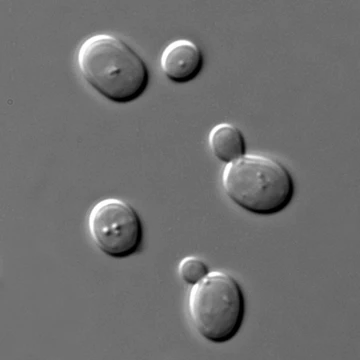
Candida oleophila
A yeast used as a biocontrol agent against post-harvest fruit decay.

Candida oleophila is a yeast species belonging to the genus Candida and the family Saccharomycetaceae. It is used as a biological alternative to fungicides for protecting harvested fruits and vegetables from decay.
The yeast was first described in 1967 by Montrocher, who placed it in the family Dipodascaceae, and independently by Kaisha and Iizuka, who classified it under Saccharomycetales.
Candida oleophila is a component of the commercial product Aspire, which is applied to control postharvest spoilage. The yeast cells have a dumbbell-shaped hairpin structure called an SMRTbell. Its primary method of action involves competing with pathogens for nutrients and space, and it also degrades enzymes that break down fungal cell walls.
This yeast is commonly found on plants and plant debris, its natural habitat. The specific strain Candida oleophila Strain O is a single-celled yeast that occurs naturally on plant tissues such as fruits, flowers, and wood, as well as in water. Plant secretions, or exudates, provide sugars and other nutrients that support these epiphytic yeasts.
Research indicates that Candida oleophila produces complex bioactive compounds that benefit fruit after harvest. The production of these compounds is stimulated by fragments of Penicillium cell walls and by glucose. The yeast can secrete several cell wall-degrading enzymes, including exo-β-1,3-glucanase, protease, and chitinase. Exo-β-1,3-glucanase and chitinase appear early in growth, while protease production peaks after about six to eight days. In one study, the yeast secreted exo-β-1,3-glucanase (CoEXG1) at the wound site of a fruit. These findings were based on in vitro experiments that tested how the biocontrol activity worked against pathogen infection in a controlled setting.
Candida oleophila is found wherever biocontrol agents are needed to manage postharvest diseases of fruits and vegetables. Studies on extending the shelf life of produce have concluded that this yeast can be used in place of fungicides. Fungicides commonly used in agriculture can irritate the skin and eyes and cause harm if ingested.
In the laboratory, Candida oleophila has been developed as the active agent I-182 for commercial products like Aspire.
Quick Facts
- Genus
- Candida
- Species
- oleophila
Facts from the source article.
Lore & Background
Candida oleophila was described by Montrocher in 1967 as belonging to the family Dipodascaceae; in the same year, Kaisha & Iizuka placed it in the family Saccharomycetales. It is a yeast that forms part of the commercial product Aspire, recommended for controlling postharvest decay of fruit and vegetables. Its main modes of action include competition for nutrients and space, as well as degradation of enzymes that break down the fungal cell wall.
The yeast is commonly found on plant tissues such as fruits, flowers, and wood, as well as in water. It produces and secretes several cell-wall-degrading enzymes, including exo-β-1,3-glucanase (CoEXG1), protease, and chitinase. Exo-β-1,3-glucanase and chitinase are produced in early growth stages, while protease appears later, around 6 to 8 days. These enzymes are stimulated by Penicillium cell wall fragments and glucose.
Candida oleophila Strain O is a single-celled yeast that colonizes wounds on fruit and multiplies rapidly, reaching maximum density around day 3. Its growth then declines, dropping to 1/18 of the initial amount by day 28. It is used commercially to control gray mold (Botrytis cinerea) and blue mold (Penicillium expansum) on apples and pears.
Reader's Guide
Candida oleophila is significant as a biological alternative to chemical fungicides in post-harvest agriculture. The source article notes that fungicides used for food control can irritate eyes and skin and cause harm if ingested, whereas C. oleophila offers a biocontrol method to reduce such risks. Its ability to compete for nutrients and space, combined with the secretion of cell-wall-degrading enzymes like exo-β-1,3-glucanase, protease, and chitinase, allows it to suppress pathogenic fungi such as Botrytis cinerea and Penicillium expansum. Studies described in the article show that C. oleophila can proliferate at wound sites, accelerating the accumulation of suberin polyphenolic and lignin, which helps heal tissue and prevent infections. The yeast's rapid colonization and growth within three days make it effective in reducing postharvest losses and associated economic damage. Its use in the commercial product Aspire demonstrates its practical application in central postharvest handling of fruits like apples and pears. The article emphasizes that biocontrol with C. oleophila can be used over fungicides, highlighting its role in sustainable agriculture.
Did You Know?
- Candida oleophila is part of the commercial product Aspire, used to control postharvest decay.
- It produces and secretes exo-β-1,3-glucanase, protease, and chitinase to degrade fungal cell walls.
- Its cell density can reach 2.2 × 10^11 CFU mL⁻¹ at peak growth on day 3.
- The yeast is found naturally on plant tissues and in water.
More in Yeasts 1-24
Spotted an error? Know more?
Reader corrections go straight into our review queue. Suggest an edit · How this site is sourced