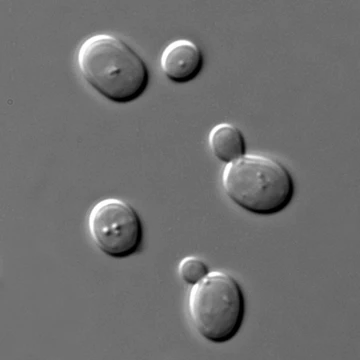
Candida albicans
Opportunistic yeast, common gut flora, causes candidiasis in immunocompromised hosts.

Candida albicans is an opportunistic pathogenic yeast that is a common member of the human gut flora. It is detected in the gastrointestinal tract and mouth in 40–60% of healthy adults, usually as a commensal organism, but it can become pathogenic in immunocompromised individuals, causing the infection candidiasis. It is one of the few Candida species that cause candidiasis, often observed in HIV-infected patients, and is the most common fungal species isolated from biofilms on implanted medical devices or human tissue.
Quick Facts
- Genus
- Candida
- Species
- albicans
Facts from the source article.
Lore & Background
The name 'Candida albicans' is tautological, derived from Latin words meaning 'shining white' and 'becoming white', leading to the interpretation 'pure white becoming white'. It is often referred to as thrush, candidiasis, or candida, with over a hundred synonyms. The oldest reference to thrush, likely caused by C. albicans, dates back to 400 BC in Hippocrates' work 'Of the Epidemics' describing oral candidiasis.
C. albicans is generally considered a dimorphic fungus, growing as both yeast and filamentous cells, but it has several morphological phenotypes including opaque, GUT, and pseudohyphal forms. It was long thought to be an obligate diploid without a haploid stage, but it can exist in haploid and tetraploid stages. The diploid genome is highly heterozygous, with numeric and structural chromosomal rearrangements contributing to genetic diversity. An unusual feature is that the CUG codon, normally specifying leucine, specifies serine in C. albicans and some other Candida species, a departure from the standard genetic code.
C. albicans is easily cultured in the lab and can be studied both in vivo and in vitro. A special medium, CHROMagar Candida, can identify different Candida species. The most commonly used strains are WO-1, known for frequent white-opaque switching, and SC5314, the reference strain for gene sequence. The genome has been fully sequenced, making it one of the first fungi completely sequenced, alongside Saccharomyces cerevisiae and Schizosaccharomyces pombe.
Reader's Guide
Candida albicans is notable as the most common fungal species isolated from biofilms on implanted medical devices and human tissue, and it is a leading cause of candidiasis in humans. Together with C. tropicalis, C. parapsilosis, and C. glabrata, it accounts for 50–90% of all candidiasis cases. Systemic candidiasis due to C. albicans carries a mortality rate of 40%, and invasive candidiasis contracted in hospitals causes an estimated 2,800 to 11,200 deaths yearly in the US. It is commonly used as a model organism for fungal pathogens, with its genome fully sequenced and resources like the ORFeome and GRACE library available for study. The yeast-to-hypha transition is considered a key factor in virulence, though not deemed necessary, with hyphal cells thought to be invasive and important for tissue penetration and escaping macrophages. The high heterozygosity and dynamic genome, including the unusual CUG codon reassignment, contribute to its adaptability and have been used for molecular epidemiological studies. The presence of a parasexual cycle, with no detected meiotic division, has been identified, and evolutionary studies suggest that CUG identity redefinition may have locked Candida species into a diploid or polyploid state, possibly blocking sexual reproduction.
Did You Know?
- Candida albicans is detected in the gastrointestinal tract and mouth of 40–60% of healthy adults.
- The CUG codon, which normally specifies leucine, specifies serine in C. albicans.
- C. albicans can exist in haploid, diploid, and tetraploid stages.
More in Yeasts 1-24
Spotted an error? Know more?
Reader corrections go straight into our review queue. Suggest an edit · How this site is sourced