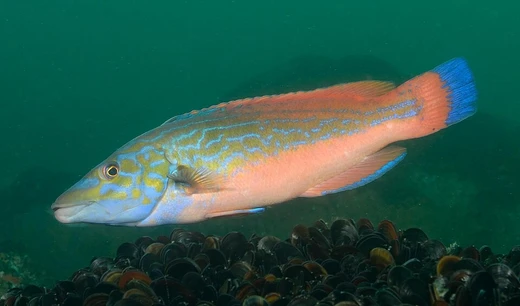
Wrasse
A diverse family of marine ray-finned fish, often brightly colored.

The wrasses, belonging to the family Labridae, are a large and varied group of marine ray-finned fish, often noted for their vivid colors. This family includes over 600 species spread across 81 genera, organized into eight subfamilies. While most wrasses are small, typically under 20 cm (7.9 in) long, the largest species—the humphead wrasse—can reach up to 2.5 m (8.2 ft). They are skilled carnivores that prey on a broad array of small invertebrates. Many smaller wrasses trail behind larger fish to snatch up invertebrates stirred up in their wake. Juveniles of certain species in the genera *Bodianus*, *Epibulus*, *Cirrhilabrus*, *Oxycheilinus*, and *Paracheilinus* hide among the tentacles of free-living mushroom corals and *Heliofungia actiniformis*.
The name "wrasse" originates from the Cornish word *wragh*, a lenited form of *gwragh* meaning "old woman" or "hag," which passed through Cornish dialect as *wrath*. It is related to the Welsh *gwrach* and Breton *gwrac'h*.
Taxonomically, parrotfish were once placed in their own family (Scaridae) but are now frequently considered a subfamily (Scarinae) or tribe (Scarini) within the wrasses, as they are deeply nested in the wrasse evolutionary tree. Similarly, the odacine wrasses, formerly classified as a separate family, are now found deep within the wrasse tribe Hypsigenyini and are most closely related to the tuskfishes.
The classification of genera follows Eschmeyer's Catalog of Fishes. Several fossil genera are known but lack a clear subfamily or tribal placement, including †*Bellwoodilabrus*, †*Eocoris*, †*Labrobolcus*, ?†*Paralabrus*, †*Wainwrightilabrus*, and †*Zorzinilabrus*. Fossil wrasses date back to the Early Eocene of Monte Bolca, Italy. Among these, *Phyllopharyngodon* can be uniquely assigned to the extant subfamily Hypsigenyinae. Wrasses had a broader prehistoric range, with fossils found in the Middle Eocene La Meseta Formation of Antarctica, likely disappearing from the continent as it cooled during the Oligocene.
Wrasses have protractile mouths with separate, outward-jutting jaw teeth. Many species are easily recognized by their thick lips, which are sometimes curiously folded inside—a feature that inspired the German name *Lippfische* ("lip-fishes") and the Dutch *lipvissen*. The dorsal fin runs most of the length of the back, with 8 to 21 spines and 6 to 21 soft rays.
Quick Facts
- Taxon
- Labridae
Facts from the source article.
Lore & Background
The word 'wrasse' comes from the Cornish word wragh, a lenited form of gwragh, meaning an old woman or hag, via Cornish dialect wrath. It is related to the Welsh gwrach and Breton gwrac'h. Parrotfish were traditionally regarded as comprising their own family (Scaridae), but are now often treated as a subfamily (Scarinae) or tribe (Scarini) of the wrasses, being nested deep within the wrasse phylogenetic tree. The odacine wrasses, traditionally classified as forming their own family, were found nested deep within the wrasse tribe Hypsigenyini, and most closely related to the tuskfishes.
Wrasses have protractile mouths, usually with separate jaw teeth that jut outwards. Many species can be readily recognized by their thick lips. The dorsal fin has 8 to 21 spines and 6 to 21 soft rays. Wrasses are sexually dimorphic, and many species are capable of changing sex. Juveniles are a mix of males and females (initial-phase individuals), but the largest adults become territory-holding (terminal-phase) males. The wrasses have become a primary study species in fish-feeding biomechanics due to their jaw structures, which form a 'four-bar linkage' allowing numerous arrangements to achieve a given mechanical result.
Reader's Guide
Wrasses are notable for their complex reproductive and behavioral diversity. Most labrids are protogynous hermaphrodites within a haremic mating system, exhibiting three different mating systems: polygynous, lek-like, and promiscuous. Labroids typically exhibit broadcast spawning, releasing high numbers of planktonic eggs, though wrasses of the subgroup Labrini do not. The subfamily Labrinae arose from a basal split within family Labridae during the Eocene period, and 15 of 23 species in this subgroup exhibit broodcare behavior, ranging from simple to complex parental care of spawn. Wrasses also exhibit three types of sexual development: functional gonochorism, monandric protogyny, and diandric protogyny. Evolutionarily, wrasse lineages trend towards developing monandry.
Many species of wrasses have been recorded using large rocks or hard coral as 'anvils' to smash open hard-shelled prey items, with twenty-one species of eight genera documented exhibiting this behavior. Cleaner wrasses are the best-known of the cleaner fish, living in a cleaning symbiosis with larger fish. The bluestreak cleaner wrasse, Labroides dimidiatus, is one of the most common cleaners found on tropical reefs. In a 2019 study, cleaner wrasses passed the mirror test, the first fish to do so.
Did You Know?
- The humphead wrasse can measure up to 2.5 m (8.2 ft) long.
- Many smaller wrasses follow the feeding trails of larger fish to pick up disturbed invertebrates.
- Cleaner wrasses passed the mirror test in a 2019 study, the first fish to do so.
Taxonomic Breadth and Deep Fossil Roots
The wrasse family, Labridae, represents one of the most species-rich assemblages among marine ray-finned fishes, encompassing more than six hundred species distributed across eighty-one genera and eight distinct subfamilies. This extraordinary diversity has prompted ongoing revisions in how related groups are classified. Parrotfish, long treated as their own family Scaridae, are now generally nested as a subfamily or tribe within Labridae, reflecting their deep phylogenetic position inside the wrasse tree. Similarly, the odacine wrasses, once considered a separate family, were found to sit within the wrasse tribe Hypsigenyini, sharing their closest ties with tuskfishes. The fossil record stretches the family's history back to the Early Eocene of Monte Bolca in Italy, where several genera—Bellwoodilabrus, Eocoris, Labrobolcus, and others—have been identified. One remarkable find, Phyllopharyngodon, can be confidently assigned to the living subfamily Hypsigenyinae. Even broader ancient ranges are hinted at by Middle Eocene fossils from Antarctica's La Meseta Formation, suggesting wrasses once thrived in waters that later froze over during the Oligocene cooling, eliminating them from that continent entirely.
Feeding Ecology and the Four-Bar Jaw
Wrasses are highly efficient carnivores preying on a broad spectrum of small invertebrates. Their foraging strategies are remarkably varied. Many smaller species adopt an opportunistic approach, trailing behind larger fish and snatching up invertebrates stirred loose by the bigger animal's passage. Juveniles of several genera—including Bodianus, Epibulus, Cirrhilabrus, Oxycheilinus, and Paracheilinus—take shelter among the tentacles of free-living mushroom corals and the sea anemone Heliofungia actiniformis, using these structures as protective refuges. The mechanical ingenuity of wrasse feeding has made them a primary model in fish biomechanics research. Their jaw system operates as a four-bar linkage: the nasal and mandibular bones anchor to the rigid neurocranium at their rear ends, while the maxilla's upper and lower articulations connect to the front tips of those two bones, forming a closed loop of four rigid elements joined by movable joints. This arrangement can achieve the same mechanical outcome—whether rapid jaw protrusion or a powerful bite—through many different morphological configurations, effectively decoupling structure from function. Multiple wrasse lineages have evolved distinct jaw shapes that nonetheless produce identical feeding performance in similar ecological niches.
Sex Change, Mating Systems, and Parental Care
Most wrasses are protogynous hermaphrodites operating within a haremic mating framework, a pattern well illustrated by the California sheephead. Juveniles begin life as a mixed group of initial-phase males and females, and the largest individuals eventually transition into territory-holding terminal-phase males. Under experimental conditions, however, the process can reverse: when two male Labroides dimidiatus are confined together, the smaller one reverts to female. Interestingly, the largest female does not always change sex; evidence shows she may deliberately remain female when doing so maximizes her evolutionary fitness. Labrids display three mating systems—polygynous, lek-like, and promiscuous—with spawning occurring as either group or pair events depending on male body size. Most species practice broadcast spawning, releasing vast numbers of planktonic eggs carried by tidal currents, with no subsequent parental involvement. A notable exception exists in the subfamily Labrinae, where fifteen of twenty-three species across genera such as Symphodus, Centrolabrus, and Labrus exhibit broodcare: males construct algae nests or crude cavities, ventilate the eggs, and defend the site against rival males and predators. In these species, the eggs cannot survive without that care.
Physical Form and Geographic Range
Wrasses are typically small fish, the majority measuring under twenty centimetres, yet the family's size range extends dramatically: the humphead wrasse can grow to two and a half metres, making it one of the largest reef-dwelling species. Their most distinctive physical feature is the protractile mouth, equipped with separate jaw teeth that jut outward, and notably thick lips whose inner surfaces are sometimes curiously folded. This lip morphology earned them the German common name Lippfische and the Dutch lipvissen, both translating to "lip-fishes." The dorsal fin spans most of the back, bearing between eight and twenty-one spines alongside six to twenty-one soft rays. Wrasses are sexually dimorphic, with visible differences between males and females. Geographically, the family is overwhelmingly tropical and subtropical, populating the Atlantic, Indian, and Pacific Oceans. However, a few species push into temperate waters; the Ballan wrasse, for instance, ranges as far north as Norwegian coasts. In terms of habitat, wrasses favour shallow environments such as coral reefs and rocky shores, where they remain close to the substrate rather than drifting in open water.
Frequently Asked Questions
What is a wrasse?
A wrasse is a member of the family Labridae, a large and colorful group of marine ray-finned fish. The family encompasses more than 600 species and is one of the most visually striking lineages in the ocean.
How big do wrasses typically get?
Most wrasses stay under 20 cm (about 8 inches) in length, making them relatively small reef dwellers. The notable exception is the humphead wrasse, which can grow to roughly 2.5 m (over 8 feet), making it by far the largest member of the family.
What do wrasses eat and how do they hunt?
Wrasses are active carnivores that feed on a wide variety of small invertebrates. Many smaller species follow in the wake of larger fish, picking up the tiny prey stirred up by their movement.
How is the wrasse family organized taxonomically?
The Labridae family is divided into eight subfamilies and 81 genera, giving it a remarkably broad evolutionary spread. This structure reflects the enormous morphological and ecological diversity found across the 600-plus species.
Why are wrasses considered ecologically important?
Their voracious invertebrate predation helps regulate populations of small reef organisms, keeping coral and sponge communities in balance. Their vivid coloration and active foraging also make them a key component of reef biodiversity and a major draw for marine observers.
More in Wrasses 1-24
Spotted an error? Know more?
Reader corrections go straight into our review queue. Suggest an edit · How this site is sourced