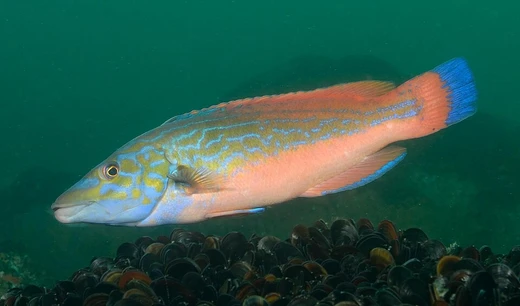
Bodianus
A genus of wrasses known as hogfishes, found globally.

Bodianus is a genus of fish in the wrasse family, Labridae, often called hogfishes. They inhabit the Atlantic, Indian, and Pacific Oceans, and are host to numerous parasites.
Within the wrasse tribe Hypsigenyini, the genus was divided into ten subgenera by Gomon in 2006. However, these subdivisions only roughly match the results of later phylogenetic studies. The three species commonly known as sheephead wrasses—*B. darwini*, *B. pulcher*, and *B. reticulatus*—were once placed in their own genus, *Semicossyphus*. Although at least the latter two form a monophyletic group, *Semicossyphus* has since been merged into *Bodianus* because molecular work shows it is nested deep within the genus. Similarly, *Clepticus parrae* and likely all *Clepticus* species also fall within *Bodianus*.
Currently, 45 species are recognized in the genus.
Quick Facts
- Taxon
- Bodianus
- Type Species
- Bodianus bodianus
- Type Species Authority
- Bloch, 1790
Facts from the source article.
Lore & Background
Bodianus belongs to the wrasse tribe Hypsigenyini. Gomon (2006) split the species into 10 subgenera, though these subclassifications only roughly align with more recent phylogenetic analyses. The three species B. darwini, B. pulcher, and B. reticulatus, commonly called the sheephead wrasses, were traditionally placed in their own genus Semicossyphus. Although at least the latter two form a monophyletic lineage with each other, Semicossyphus has been synonymized with Bodianus because molecular phylogenetics found it nested deep within Bodianus. Similarly, Clepticus parrae and likely all Clepticus species also nest within Bodianus.
Reader's Guide
The genus Bodianus is notable for its taxonomic complexity and the ongoing refinement of its classification. Gomon (2006) recognized 10 subgenera, but these groupings only roughly correspond to later molecular findings. The traditional genus Semicossyphus (sheephead wrasses) has been synonymized with Bodianus based on molecular evidence, and the genus Clepticus also nests within Bodianus. The genus currently contains 45 recognized species, many described in the 2000s by researchers such as Gomon, Heiser, Moura, and Robertson. The species are distributed across the Atlantic, Indian, and Pacific Oceans. The article notes that Bodianus species host many parasites, though no further details are given. The taxonomic disputes and synonymizations highlight the dynamic nature of wrasse systematics.
Did You Know?
- Bodianus species are commonly known as hogfishes.
- The genus contains 45 recognized species.
- The three sheephead wrasse species were formerly placed in the genus Semicossyphus.
- Clepticus parrae and likely all Clepticus species nest within Bodianus.
Taxonomic Framework & Subgeneric Structure
Bodianus sits within the wrasse family Labridae, specifically in the tribe Hypsigenyini, and is popularly known by the common name hogfishes. The genus has undergone significant taxonomic reorganization over the years. In 2006, researcher Gomon proposed a subdivision of Bodianus into ten distinct subgenera, an attempt to capture the internal diversity of the group. However, this subgeneric framework has only a rough correspondence with what more modern phylogenetic analyses have revealed, suggesting that the true evolutionary relationships within the genus are more complex than a simple ten-way split. The genus also absorbed members from what were once considered separate genera, as molecular evidence showed that lineages previously set apart actually nest within Bodianus itself. This ongoing refinement means that the boundaries of Bodianus have expanded considerably from its earlier, narrower conception, and the subgeneric categories remain provisional markers rather than definitive evolutionary units.
Species Richness & Oceanic Range
Forty-five species are currently recognized under the Bodianus name, making it one of the more species-rich genera among the wrasses. These fish inhabit all three major ocean basins—the Atlantic, Indian, and Pacific—giving the genus a truly circumglobal tropical and subtropical presence. The common names assigned to individual species reflect this geographic spread and morphological variety: some are called creole wrasses (such as B. africanus and B. brasiliensis), others sheepshead wrasses (B. darwini, B. pulcher, B. reticulatus), and the majority carry the hogfish label, often modified with a descriptor like lyre-tail, tarry, harlequin, or masked. The species list spans a wide range of discovery dates, from Linnaeus's 1758 description of B. rufus (the Spanish hogfish) to Gomon and Walsh's 2016 naming of B. bennetti (the lemon-striped pygmy hogfish), illustrating that new members of the genus are still being identified and described in the twenty-first century.
Molecular Phylogenetics & Genus Boundaries
The modern understanding of Bodianus owes much to molecular phylogenetic work that has repeatedly redrawn the genus's boundaries. Three species long classified under the separate genus Semicossyphus—B. darwini, B. pulcher, and B. reticulatus, collectively known as the sheephead wrasses—were found through molecular analysis to be nested deep within Bodianus, prompting their formal synonymization into the larger genus. While at least B. pulcher and B. reticulatus do form a monophyletic clade with one another, their placement within Bodianus rather than in a standalone genus reflects the broader pattern revealed by DNA-based trees. A parallel finding applies to the genus Clepticus: the species C. parrae, and likely all Clepticus species, also nest within Bodianus according to phylogenetic evidence. These results demonstrate that what were once treated as distinct genera represent, in molecular terms, internal branches of a single, more inclusive Bodianus lineage.
Ecological Profile & Parasite Load
Members of Bodianus are commonly referred to as hogfishes, a name that applies across the genus regardless of the specific common name attached to individual species. As members of the wrasse family Labridae, they share the broader ecological context of that large and diverse group of marine fishes. Their distribution across the Atlantic, Indian, and Pacific Oceans places them in a wide array of reef and coastal habitats, though the available information does not detail specific microhabitats. One notable ecological characteristic highlighted in the literature is that Bodianus species harbor a significant parasite load; they are described as carrying many parasites, a trait that likely reflects their position in complex marine food webs and their broad geographic range. The genus also includes species with notable size variation, as suggested by common names such as the giant hogfish (B. macrognathos) and the pygmy hogfish (B. bennetti), hinting at considerable morphological diversity within a single taxonomic group.
Frequently Asked Questions
What is Bodianus and what family does it belong to?
Bodianus is a genus of wrasse fish in the family Labridae, and its members go by the common name hogfishes. The genus sits within the tribe Hypsigenyini and spans 45 recognized species found across warm waters worldwide.
How many species are in Bodianus, and how are they organized?
The genus currently holds 45 species. In 2006, Gomon proposed dividing them into ten subgenera, but subsequent phylogenetic analyses have only loosely confirmed those groupings, so the taxonomy remains a work in progress.
Where can I find Bodianus in the wild?
Hogfishes of this genus are genuinely global, occurring in the Atlantic, Indian, and Pacific Oceans. They are typically encountered around reef and coastal habitats in tropical and subtropical regions.
What happened to the old genus Semicossyphus?
Three species once placed in Semicossyphus—B. darwini, B. pulcher, and B. reticulatus, the well-known sheephead wrasses—were absorbed back into Bodianus. Although at least B. pulcher and B. reticulatus do form a monophyletic clade, the separate Semicossyphus name is no longer upheld.
Is there anything particularly notable about Bodianus biology?
Beyond their vivid coloration, these wrasses are well documented as hosts to a wide array of parasites, which makes them a recurring subject in ichthyoparasitology literature. Their broad global range and tangled taxonomy also keep them a popular topic in wrasse-systematics discussions.
More in Wrasses 1-24
Spotted an error? Know more?
Reader corrections go straight into our review queue. Suggest an edit · How this site is sourced