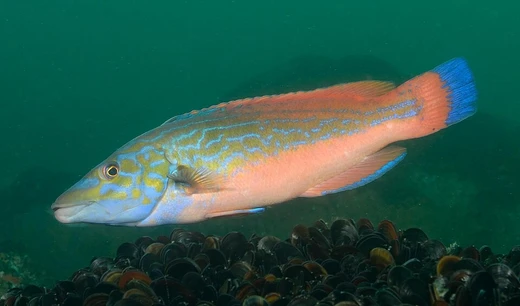
Asian sheephead wrasse
A large, protogynous wrasse with a bulbous forehead in males.

The Asian sheephead wrasse, called kobudai in Japan, is a large fish that ranks among the biggest wrasses. It lives in the western Pacific Ocean, sticking to rocky reefs in temperate waters near the Korean Peninsula, China, and Japan, including the Ogasawara Islands. Adults can grow up to 100 centimeters long and weigh as much as 14.7 kilograms.
This fish belongs to the wrasse family, Labridae. Scientists first described it as *Cossyphus reticulatus* and later grouped it with the California and goldspot sheephead wrasses under the genus *Semicossyphus*. However, a 2016 study of its molecular phylogeny showed that *Semicossyphus* sits deep inside the genus *Bodianus*, so the Asian sheephead wrasse and its two relatives were moved there. Later research backed this change.
The Asian sheephead wrasse has a round, bulky body and a blunt tail fin. Males grow larger than females. Its mouth sits at the front of the head, which fits its habit of swimming in the middle of the water and grabbing prey that is right in front or below. Hard, tooth-like structures in its mouth help it crush crustaceans. The fish is best known for the bulbous forehead that develops only in adult males—juveniles lack it entirely. Young fish have black patches on some fins, but these fade as they grow, leaving adults a plain pink-gray color. Unlike many other wrasses, this species is not very colorful.
Like many wrasses, the Asian sheephead wrasse is a sequential hermaphrodite. It is protogynous, meaning every individual starts life as a female. When it reaches a certain body size—though there is no set age—it may change into a male. This change is one-way; it cannot reverse. After the switch, the fish grows its bulbous forehead and becomes aggressive. Even then, it keeps some female traits, such as parts of the ovary-like reproductive tissue.
For reproduction, males and females spawn, usually in warmer waters. They court each other beforehand. One large male often mates with several smaller females at the same time, pointing to a polygynous mating system. The fish can live 40 to 50 years. Newly hatched fry are about 1 centimeter long. By age 15, they reach roughly 40 centimeters. Mature males are typically 40 to 60 centimeters and may stay that size for the rest of their lives.
Quick Facts
- Taxon
- Bodianus reticulatus
Facts from the source article.
Lore & Background
The Asian sheephead wrasse was originally described as Cossyphus reticulatus and was long placed in the genus Semicossyphus alongside the California and goldspot sheephead wrasses. However, a 2016 molecular phylogenetics study suggested moving it to the genus Bodianus, as Semicossyphus was found to be nested deep within Bodianus; subsequent studies supported this placement. The fish is known for its globiform, bulky body, truncate caudal fin, and terminal mouth, which suits its mid-water feeding habits. Its hard tooth-like structures are excellent for crushing crustaceans. Juveniles have black areas on certain fins, which are lost in adults, giving way to a pink-gray color, making the species less colorful than many other wrasses.
Reader's Guide
The Asian sheephead wrasse is significant for its role in marine ecosystems, particularly in controlling populations of sea urchins, which helps maintain healthy habitats. It is also notable for its protogynous hermaphroditism: individuals are born female and may change to male upon reaching a critical body size, after which they develop a bulbous forehead and exhibit aggressive behavior. This sex change was captured on camera by the BBC Earth crew near Sado Island, Japan, and featured in the Blue Planet II episode 'One Ocean'. In Japan, the species is considered edible and valued for its sweet, shellfish-like taste. Despite its ecological importance, the IUCN lists it as Data Deficient due to insufficient data, though it faces threats from overfishing, unsustainable practices like bottom trawling, pollution, and habitat loss.
Did You Know?
- The Asian sheephead wrasse can reach up to 100 cm (39 in) in total length and weigh up to 14.7 kg (32 lb).
- Japanese diver Hiroyuki Arakawa had a 30-year relationship with an Asian sheephead wrasse named 'Yuriko' at an underwater Shinto shrine in Tateyama Bay.
- The species was moved from the genus Semicossyphus to Bodianus based on a 2016 molecular phylogenetics study.
Sexual Transformation and the Bulbous Forehead
Every Asian sheephead wrasse enters the world as a female, a biological arrangement known as protogynous sequential hermaphroditism. As the individual matures and reaches a critical body size—though no precise age threshold has been identified—it may undergo a one-way transition to male. This shift is irreversible; once the change occurs, the fish cannot revert to its former sex. The most visible sign of the transformation is the dramatic development of a bulbous forehead, a feature entirely absent in juveniles and females. Alongside this physical change, newly transitioned males begin displaying aggressive behavior. Interestingly, even after the sex change, some residual female characteristics persist, including traces of ovariform gonads. The transition does not happen to every individual, and the exact trigger remains tied to body size rather than a fixed calendar. This remarkable life strategy means that the population's reproductive dynamics are shaped by growth rather than by the sex assigned at birth.
Physical Form and Growth
The Asian sheephead wrasse is among the largest wrasses in the western Pacific, reaching a total length of up to 100 centimeters and a recorded maximum weight of 14.7 kilograms. Its body is globiform and bulky, with a truncate caudal fin, and males typically outgrow females. The mouth sits at the front of the head, a terminal position that aligns with the fish's habit of cruising through the middle of the water column and striking prey directly ahead or below. Inside the mouth, hard tooth-like structures are well adapted for crushing the shells of crustaceans. Unlike many of its wrasse relatives, this species is not particularly colorful. Juveniles carry black markings on certain fins, but as they mature those dark patches fade, giving way to a dominant pink-gray hue. The fish grows from roughly one centimeter at the fry stage to about 40 centimeters by age fifteen, after which mature males settle into a 40-to-60-centimeter range and can maintain that size for the rest of a lifespan stretching to 40 or 50 years.
Ecological Role and Feeding
The Asian sheephead wrasse is a generalist predator, but its most ecologically significant role lies in controlling sea urchin populations. Its diet centers on marine invertebrates—mollusks, crabs, and sea urchins—though it will also take small fish and other vertebrates when the opportunity arises. The hard, crushing structures in its mouth are particularly effective against the spiny, armored bodies of urchins, making this wrasse a natural check on urchin overgrowth. By keeping urchin numbers in balance, the fish helps preserve the structural integrity of rocky reef habitats across the western Pacific, from the temperate waters around the Korean Peninsula to the Ogasawara Islands off Japan. Spawning, which takes place in warmer waters, follows a courtship ritual between males and females. Observations indicate a polygynous mating system, in which a single large male will court and spawn with several smaller females simultaneously. This reproductive strategy, combined with the species' protogynous sex change, means that the largest, most experienced individuals in a reef community are almost always males, reinforcing their role as both ecological regulators and reproductive leaders.
Human Encounters and Conservation
The Asian sheephead wrasse has a long history of interaction with humans, particularly in Japan, where it is known as kobudai and prized as a food fish for its sweet, shellfish-like flavor. In 2017, the species gained international visibility when BBC Earth captured its sex-change process on camera near Sado Island, a clip featured in the Blue Planet II episode "One Ocean." A more personal story comes from Japanese diver Hiroyuki Arakawa, who spent three decades in Tateyama Bay tending an underwater Shinto shrine and formed a lasting bond with a single wrasse he named Yuriko, summoning her by striking a bell on the shrine. Yet the species faces mounting pressure. Overfishing, bottom trawling, pollution, and habitat degradation have driven population declines across its range. Despite these documented threats, the IUCN currently classifies the Asian sheephead wrasse as Data Deficient, reflecting a lack of comprehensive population data rather than any indication that the species is secure.
Frequently Asked Questions
What is the Asian sheephead wrasse?
It is one of the largest members of the wrasse family (Labridae), widely known in Japan by the name kobudai. Every individual begins life as a female, and some later undergo a sex change to become males, making it a protogynous species.
How big does the Asian sheephead wrasse get?
Full-grown adults can reach 100 centimeters (about 39 inches) in length and tip the scales at up to 14.7 kilograms (roughly 32 pounds). Mature males that have completed their sex change typically measure between 40 and 60 centimeters.
Where does the Asian sheephead wrasse live?
It is restricted to temperate rocky reefs in the western Pacific, spanning waters around the Korean Peninsula, coastal China, and Japan, including the Ogasawara island chain.
How can you tell a male kobudai from a female?
Males develop a noticeably bulbous, swollen forehead that females lack, giving them a distinctly different head profile. This sexual dimorphism is one of the most visible signs that a protogynous sex change has occurred.
How long can a kobudai live?
This wrasse has a lifespan of roughly 40 to 50 years, growing from a mere 1 centimeter at birth to potentially 100 centimeters as a full adult. By the time it reaches about 15 years old, a typical specimen is around 40 centimeters long.
More in Wrasses 1-24
Spotted an error? Know more?
Reader corrections go straight into our review queue. Suggest an edit · How this site is sourced